VIZIO vs Logitech: Overview
Comparing VIZIO and Logitech helps you determine which brand is best suited for your needs in Home Theaters. Both brands offer strong choices depending on your budget and key feature requirements.
Key Features & Comparison
Evaluate factors such as build quality, warranty, customer satisfaction, and total value before making your final purchase choice between VIZIO and Logitech.
Features
The feature sets of VIZIO and Logitech diverge significantly due to the generations of technology they leverage and their intended playback sources. VIZIO home theater solutions are engineered around contemporary digital AV standards, boasting high-bandwidth HDMI eARC/ARC, optical audio, Bluetooth, and extensive native decoding for object-based audio formats like Dolby Atmos and DTS:X. Higher-tier VIZIO systems, such as the M-Series and Elevate, include specialized voice assistant integration, dynamic sound enhancement modes, and rotating height-channel speakers that mechanically reorient based on the incoming audio signal. Furthermore, VIZIO soundbars feature dedicated remote displays, sub-level equalizer controls, and automatic TV handshake protocols that streamline daily operation via standard television remotes.
Conversely, Logitech's feature suite is rooted in pragmatic, multi-channel flexibility and legacy compatibility. Flagship offerings like the Z906 provide robust connectivity via dual digital optical inputs, a digital coaxial input, 6-channel direct inputs (3.5mm), and standard stereo RCA inputs, allowing multiple computers, consoles, and legacy media players to be tethered simultaneously without requiring an HDMI switch. However, Logitech notably lacks support for contemporary lossless formats, Wi-Fi streaming, HDMI pass-through, and spatial audio decoding like Dolby TrueHD or Atmos. Instead, Logitech relies on THX certification and onboard hardware decoding for legacy Dolby Digital and DTS 5.1 tracks, paired with proprietary 3D stereo matrixing to upscale two-channel feeds, emphasizing utilitarian input management over modern video-audio orchestration.
Performance
Acoustic performance between the two brands highlights a stark contrast in soundstage tuning and frequency handling. VIZIO tunes its home theater systems explicitly for cinematic dynamics, emphasizing vocal intelligibility through dedicated center channels and broad horizontal dispersion. In multi-channel configurations, VIZIO systems excel at atmospheric immersion, steering directional cues smoothly across the front and rear soundstages while delegating mid-to-high frequencies cleanly through modern driver arrays. Wireless subwoofers across the VIZIO range are engineered to blend with satellite units to deliver impactful low-end punch for movie explosions and cinematic scores, although lower-tier models can occasionally suffer from thin lower-midrange response where the small drivers struggle to cross over seamlessly with the subwoofer.
Logitech, on the other hand, is renowned for authoritative, visceral power and formidable low-frequency extension. Systems like the Z906 employ robust side-firing or front-firing subwoofers with substantial magnetic assemblies that deliver earth-shattering bass capable of filling medium-to-large spaces with ease. The satellite speakers utilize full-range drivers rather than dedicated multi-way tweeters and woofers, which produces a punchy, aggressive signature ideal for PC gaming, action movies, and heavy electronic music. However, this architectural choice comes at the expense of high-frequency shimmer and micro-detail, where dialogue can sound somewhat boxy or recessed compared to the refined, DSP-enhanced clarity found in VIZIO’s dedicated center channels.
Design
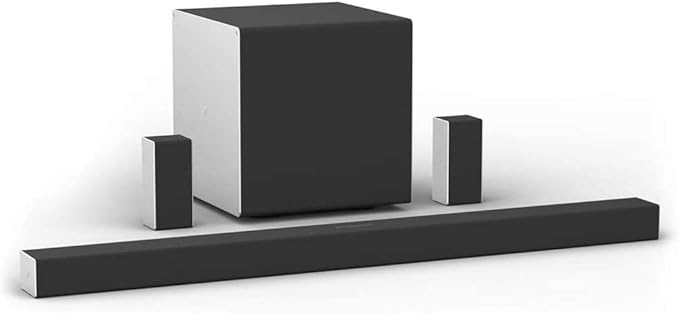
From an aesthetic and mechanical design perspective, VIZIO adheres strictly to contemporary living-room design trends. Their soundbars, satellite speakers, and subwoofers favor slim, unobtrusive profiles wrapped in dark acoustically transparent fabrics, brushed metallic accents, and rounded enclosures designed to nestle beneath ultra-thin televisions. Innovation is prominent in VIZIO’s premium hardware, such as the motorized auto-rotating end-caps on the Elevate soundbar that physically articulate upwards when spatial audio is detected. VIZIO also emphasizes convenience in physical deployment, engineering their rear satellite speakers to plug directly into the wireless subwoofer placed near the back of the room, thereby eliminating long wire runs across the living room floor.
Logitech champions an unapologetically industrial, rugged aesthetic that reflects its computer peripheral heritage. The enclosures are primarily constructed from dense, matte-finished plastics with exposed metal grilles that protect drivers from accidental strikes in high-traffic desktop or floor environments. Satellite units feature classic pedestal mounts or keyhole wall mounts, accompanied by a dedicated desktop control console with tactile rotary dials and LED indicators. Unlike VIZIO's streamlined wireless links, Logitech systems rely heavily on traditional spring-clip speaker wire connections for all satellites, offering the advantage of easily replaceable and customizable cable lengths, but demanding far more effort to route discreetly in a polished living room environment.
Compare current retail pricing, active promotions, and verified stock availability directly from authorized stores: