Yamaha vs Bose: Overview
Comparing Yamaha and Bose helps you determine which brand is best suited for your needs in Home Theaters. Both brands offer strong choices depending on your budget and key feature requirements.
Key Features & Comparison
Evaluate factors such as build quality, warranty, customer satisfaction, and total value before making your final purchase choice between Yamaha and Bose.
Features
In terms of feature sets and connectivity, Yamaha outpaces Bose by offering comprehensive support for industry standards and physical inputs. Yamaha’s AV receivers and advanced soundbars boast state-of-the-art HDMI 2.1 switching, 4K/120Hz and 8K passthrough, variable refresh rates (VRR), and exhaustive audio decoding from Dolby Atmos to DTS:X. The brand's proprietary MusicCast ecosystem delivers robust high-resolution audio streaming across multi-room devices, while its sophisticated on-screen interface allows power users to tweak crossover frequencies, speaker distances, and parametric EQ settings with professional-grade precision.
Bose approaches features from a minimalist, convenience-first perspective, deliberately streamlining connectivity to reduce user friction. Modern Bose systems typically rely on a single HDMI eARC port complemented by optical audio and wireless protocols like Apple AirPlay 2, Spotify Connect, and Bluetooth. Instead of granular equalizer menus, Bose incorporates intelligent automated features such as Voice4Video technology for universal voice control via Amazon Alexa or Google Assistant, alongside its proprietary ADAPTiQ room calibration. While Bose sacrifices deep format flexibility—often omitting native DTS:X support—it excels at smart home integration and intuitive companion app navigation.
Performance
Yamaha's acoustic performance is anchored in dynamic range, clean power output, and exceptional spatial realism. Backed by decades of professional musical instrument manufacturing, Yamaha engineers its equipment with heavy-duty power transformers and high-slew-rate amplifiers that handle transient audio peaks with minimal distortion. Yamaha’s proprietary CINEMA DSP HD3 technology processes acoustic reflections to replicate the ambient sound fields of famous concert halls and cinema venues. The low-end response from Yamaha subwoofers is tight, articulated, and musical, providing an authentic theater presentation that preserves the dynamic nuances of cinematic scores and action sequences alike.
Bose achieves acoustic greatness through advanced digital signal processing and proprietary driver configurations, such as PhaseGuide arrays and upward-firing dipole transducers. The resulting soundstage is remarkably broad, creating a convincing illusion of surround sound that belies the system's diminutive physical size. Bose is particularly celebrated for its vocal clarity; proprietary center-channel tuning ensures that movie dialogue remains crisp and intelligible even at low listening volumes. However, during complex, highly dynamic scenes, Bose’s reliance on DSP compression can make the upper mids sound somewhat bright, while its compact bass modules lack the ultra-low sub-bass extension found in Yamaha’s larger ported enclosures.
Design
Yamaha's design language leans unapologetically industrial and functional, catering to those who appreciate visible audio engineering. While its modern soundbars feature understated fabric and clean lines, Yamaha's flagship Aventage AV receivers showcase substantial, ventilated chassis, tactile volume knobs, and the iconic Anti-Resonance Technology (A.R.T.) Wedge fifth foot designed to dampen internal vibrations. These are physically commanding units intended to be showcased in dedicated media consoles, prioritizing thermal management, component shielding, and long-term durability over compact living-room disguise.
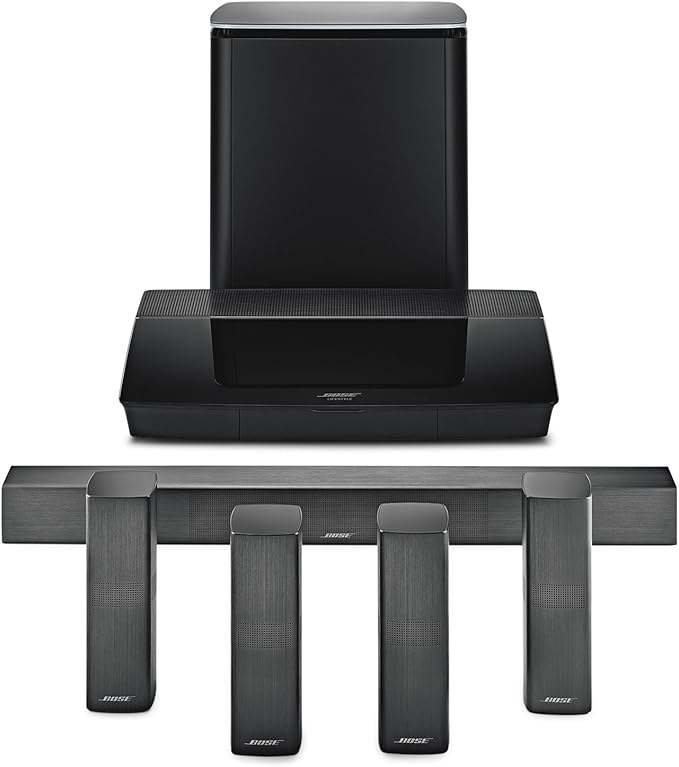
Conversely, Bose sets the benchmark for industrial luxury, crafting systems that seamlessly disappear into modern home decor. Utilizing premium materials such as tempered impact-resistant glass, micro-perforated aluminum grilles, and soft-touch matte plastics, Bose soundbars and satellite speakers exude architectural sophistication. The footprint of Bose components—such as the nearly invisible OmniJewel surround speakers—solves the perennial problem of living room clutter without requiring complex cable conduit installations. For homeowners who refuse to compromise interior design for cinematic audio, Bose's sleek, sculpture-like form factors remain virtually unmatched.
Compare current retail pricing, active promotions, and verified stock availability directly from authorized stores: