SVS vs Bose: Overview
Comparing SVS and Bose helps you determine which brand is best suited for your needs in Home Theaters. Both brands offer strong choices depending on your budget and key feature requirements.
Key Features & Comparison
Evaluate factors such as build quality, warranty, customer satisfaction, and total value before making your final purchase choice between SVS and Bose.
Features
In terms of feature sets, Bose relies heavily on digital signal processing (DSP), smart ecosystem integration, and automated calibration. Bose systems, particularly their Smart Ultra Soundbar and modular surround setups, excel with modern connectivity including eARC, Apple AirPlay 2, Chromecast built-in, and native voice assistants like Amazon Alexa and Google Assistant. Additionally, Bose's proprietary ADAPTiQ audio calibration automatically analyzes room acoustics and optimizes the sound field without requiring deep technical knowledge from the user. Their platform is deeply integrated with mobile apps, multi-room audio capabilities, and Bluetooth streaming, making it remarkably versatile for casual music and daily TV consumption.
SVS approaches features from a specialized engineering and customizability standpoint rather than smart-home automation. Rather than all-in-one soundbar ecosystems, SVS focuses on advanced acoustic controls, best exemplified by their acclaimed SVS Subwoofer DSP Smartphone App. This tool provides enthusiasts with deep parametric EQ tuning, room gain compensation, low-pass filter adjustments, and phase controls directly from the listening position. While SVS has expanded into active systems with their Prime Wireless line—offering Play-Fi, AirPlay, and optical inputs—their traditional lineup leaves decoding and smart features to the AV receiver, focusing their proprietary technology on driver mechanics, crossover optimization, and high-current amplifier efficiency.
Performance
Performance is where the divergence between SVS and Bose is most pronounced, particularly regarding low-frequency extension, headroom, and dynamic impact. SVS is an industry benchmark for low-end reproduction; their subwoofers, such as the PB-1000 Pro or SB-4000, reach down to subsonic frequencies below 20 Hz with flat frequency response and minimal harmonic distortion. Their Prime and Ultra series speakers deliver pristine clarity, expansive mid-range resolution, and the capability to handle explosive cinema transients at reference volume levels without compression. The result is a tactile, deeply immersive soundstage that articulates subtle micro-details alongside thunderous cinematic effects.
Bose utilizes sophisticated psychoacoustics, proprietary PhaseGuide technology, and digital beamforming to make compact drivers sound exponentially larger than their physical footprint suggests. For dialogue clarity and ambient surround diffusion, Bose soundbars perform admirably, elevating speech intelligibility through dedicated center channel processing and artificial intelligence dialogue modes. However, physics remains an unavoidable constraint: the compact Bose Bass Modules, while impressively punchy for their size, cannot compete with SVS in extension, SPL capability, or raw low-end authority. At high listening volumes, Bose systems tend to engage aggressive dynamic limiting to protect drivers, whereas SVS maintains effortless linear scaling.
Design
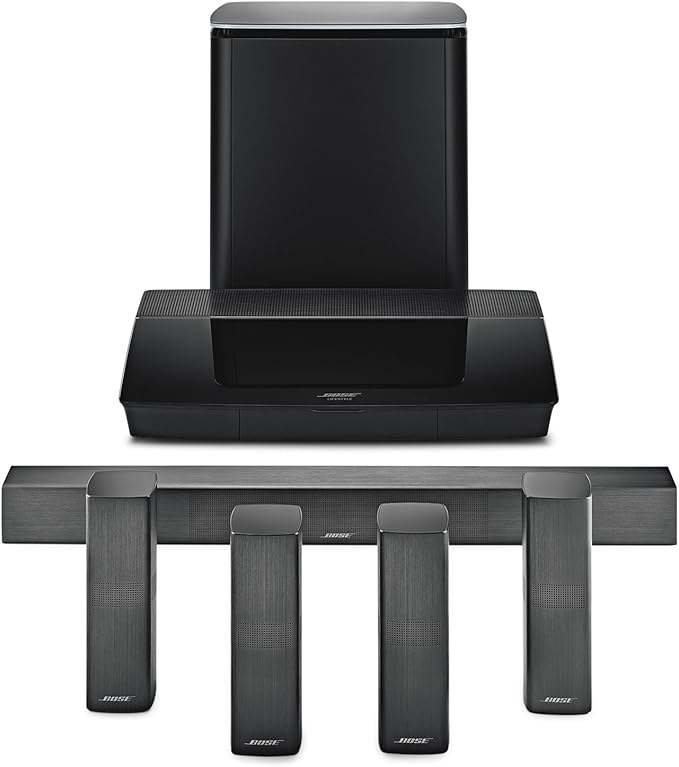
From an aesthetic and industrial design standpoint, Bose is a perennial market leader in minimalism and modern elegance. Bose products feature slim profiles, premium glass tops, seamless metal grilles, and understated finishes that disappear into living spaces rather than commanding visual attention. Their modular surround speakers and wireless bass modules are exceptionally compact, catering directly to consumers who refuse to let audio hardware dictate their interior design. The physical installation is remarkably clean, relying heavily on low-visibility enclosures and wireless inter-device communication to eliminate visible cable runs.
SVS embraces an unapologetic, form-follows-function industrial design characterized by substantial, heavy MDF cabinetry and optimized internal bracing. While the company offers high-end piano gloss black and white finishes alongside traditional black ash, the sheer physical volume of SVS speakers and subwoofers demands dedicated floor space and deliberate acoustic placement. Features like acoustically transparent curved metal grilles and custom cast-aluminum baskets reflect their pro-audio DNA. For the audiophile, the bold presence of an SVS tower or ported subwoofer is a badge of performance, but for the minimalist consumer, the visual weight can be an undeniable barrier to entry.
Compare current retail pricing, active promotions, and verified stock availability directly from authorized stores: