Onkyo vs VIZIO: Overview
Comparing Onkyo and VIZIO helps you determine which brand is best suited for your needs in Home Theaters. Both brands offer strong choices depending on your budget and key feature requirements.
Key Features & Comparison
Evaluate factors such as build quality, warranty, customer satisfaction, and total value before making your final purchase choice between Onkyo and VIZIO.
Features
Onkyo stands as a technical powerhouse when it comes to connectivity, signal processing, and multi-room management. Its modern AVRs boast uncompressed HDMI 2.1 bandwidth, handling 4K at 120Hz and 8K at 60Hz alongside advanced gaming technologies like VRR and ALLM. Crucially, Onkyo frequently incorporates high-end room correction suites such as Dirac Live, which provides sophisticated impulse-response and phase optimization across varied listening environments. Furthermore, Onkyo features extensive streaming protocol integration, natively supporting Apple AirPlay 2, Chromecast built-in, Roon Ready certification, and bidirectional Bluetooth, making it a master hub for intricate smart home media systems.
VIZIO focuses its feature set on high-value convenience, emphasizing low latency, seamless television handshakes, and intuitive spatial audio execution. VIZIO’s soundbars and satellite bundles lean heavily on HDMI eARC for pristine transmission of Dolby Atmos and DTS:X, paired with voice assistant integration and Bluetooth streaming. While VIZIO foregoes complex parametric EQ calibration and multi-zone speaker matrixing, it delivers smart auto-calibration routines and streamlined remote-interface synchronization, especially when paired with VIZIO SmartCast displays. For users seeking specialized audio-video routing, Onkyo is unmatched, but VIZIO delivers the precise feature set needed for zero-friction streaming and movie watching.
Performance
Acoustic performance reveals the distinct engineering goals of discrete separate components versus tightly DSP-managed soundbars. Onkyo shines through its discrete high-current amplification stages, wide frequency response, and low total harmonic distortion (THD). The brand's hardware delivers exceptional dynamic headroom, ensuring that sudden explosive transients in film tracks do not compress or introduce amplifier clipping. Because Onkyo systems power passive speakers with custom crossover frequencies, soundstages are expansive, instrument separation is crystalline, and center-channel dialog maintains natural vocal timbre even at high sound pressure levels.
VIZIO leverages advanced digital signal processing (DSP) and active driver arrays to punch remarkably above its physical weight class. Its flagship Elevate soundbar system, for instance, uses auto-rotating height speakers to project overhead Atmos channels with surprising dispersion and immersion. Bass is provided by dedicated wireless subwoofers tuned for punchy, low-end cinema rumble. However, when pushed to reference-level volumes, VIZIO's integrated micro-drivers can exhibit dynamic compression and high-frequency harshness compared to Onkyo's effortless power delivery. For standard living room listening, VIZIO impresses with clarity and spatial trickery, whereas Onkyo dominates in raw acoustic scale, fidelity, and dynamic range.
Design
The aesthetic and physical footprint of each brand directly reflects their target deployment environments. Onkyo adopts an unapologetically utilitarian, industrial design language characteristic of classic audio engineering. Its AV receivers are substantial, vented chassis built with brushed metal faceplates, heavy rotary knobs, and comprehensive front-panel displays. This component-centric design demands dedicated media console real estate, deliberate cable management, and proper airflow consideration, signaling serious performance capability rather than interior-decor minimalism.
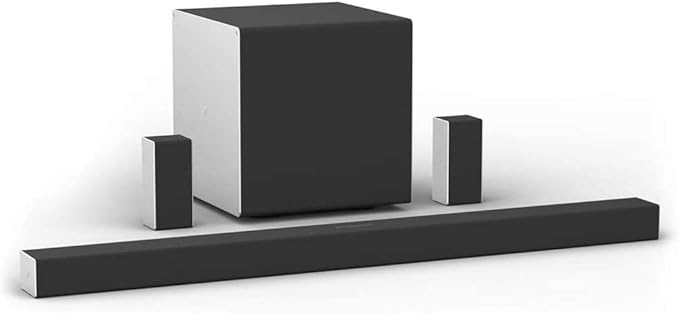
In stark contrast, VIZIO designs with modern interior minimalism and spatial efficiency as primary considerations. VIZIO soundbars and rear surround modules sport slim silhouettes, premium acoustic fabric wraps, and clean, low-profile lines engineered to sit cleanly below thin-bezel televisions without obstructing the screen or IR receivers. Wireless subwoofers and low-profile satellites minimize cable clutter, making VIZIO vastly superior for apartments, multipurpose spaces, or bedrooms where large rack gear and thick speaker wire runs are unacceptable. While Onkyo prioritizes heat dissipation, internal shielding, and physical interfaces, VIZIO prioritizes lifestyle integration and visual subtlety.
Compare current retail pricing, active promotions, and verified stock availability directly from authorized stores: