Definitive Technology vs Bose: Overview
Comparing Definitive Technology and Bose helps you determine which brand is best suited for your needs in Home Theaters. Both brands offer strong choices depending on your budget and key feature requirements.
Key Features & Comparison
Evaluate factors such as build quality, warranty, customer satisfaction, and total value before making your final purchase choice between Definitive Technology and Bose.
Features
In terms of feature sets, Bose typically leads in ecosystem integration, smart home connectivity, and user-facing convenience. Modern Bose home theater solutions, such as their Smart Soundbar lineup and modular surround expansions, offer built-in voice assistants (Amazon Alexa and Google Assistant), AirPlay 2, Spotify Connect, and simple app-based room calibration via their proprietary ADAPTiQ technology. The setup is guided through intuitive software, allowing users to effortlessly group multi-room speakers and calibrate system EQ without navigating dense receiver menus. Bose simplifies modern connectivity with seamless eARC implementation, making the consumer interface virtually invisible during day-to-day television viewing.
Conversely, Definitive Technology approaches features from an acoustic engineering perspective, providing hardware-level tools rather than software-driven smart perks. Their flagship floor-standing and bookshelf speakers often feature built-in powered subwoofers with Intelligent Bass Control, integrated upward-firing Dolby Atmos modules, and forward-focused bipolar driver arrays. While they offer active soundbar systems equipped with DTS Play-Fi, HEOS, or standard streaming protocols, their primary engineering investment is dedicated to physical transducer mechanics and thermal power management. The trade-off is clear: Bose provides richer smart-lifestyle conveniences out of the box, whereas Definitive Technology supplies advanced audio architecture requiring dedicated receiver processing to unlock its full potential.
Performance
Performance reveals the most profound acoustic contrast between the two brands. Definitive Technology excels in dynamic headroom, frequency extension, and transient accuracy. Their inclusion of BDSS (Balanced Double Surround System) drivers and aluminum dome tweeters produces crystalline highs, nuanced midrange fidelity, and exceptional vocal intelligibility even under reference-level theater volumes. Because many of their speaker towers feature integrated Class-D powered subwoofers with passive radiators, they achieve true sub-bass extension without localizing the low-frequency source, resulting in an exceptionally broad, authoritative soundstage with lifelike spatial presence that effortlessly replicates cinema dynamics.
Bose utilizes sophisticated digital signal processing and proprietary PhaseGuide technology to punch well above its physical weight class. A Bose system can simulate expansive spatial audio from an extraordinarily slim chassis, making movie dialogue crisp and clear while preventing sudden volume spikes via aggressive dynamic range compression. However, the laws of physics impose hard boundaries on Bose systems; when pushed to extreme volumes in medium-to-large listening spaces, they can exhibit dynamic compression and a lack of true sub-bass impact compared to the physical displacement of Definitive Technology's drivers. Definitive Technology remains the decisive winner for sheer output, micro-detail, and fidelity, whereas Bose delivers remarkably polished sound relative to its small physical footprint.
Design
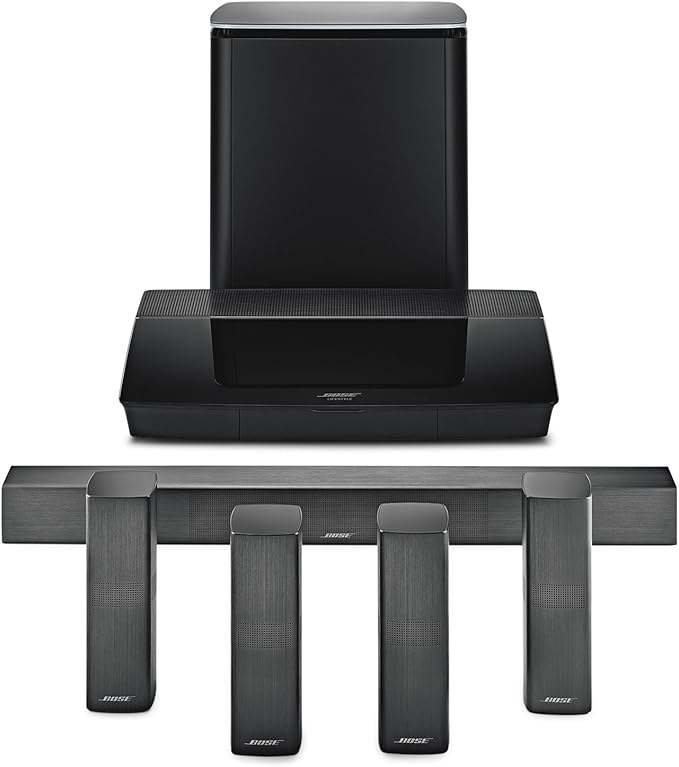
Design priorities reflect each brand's operational philosophy, balancing visual unobtrusiveness against acoustic chamber optimization. Bose champions minimalist, contemporary industrial design characterized by clean lines, premium tempered glass tops, seamless anodized metal grilles, and remarkably low-profile enclosures. Bose speakers are engineered to blend harmoniously into any interior decor, occupying minimal visual real estate beneath a television or around a living space. Their wireless surrounds and subwoofers prioritize easy concealment, minimizing cord clutter and making them an easy sell for design-conscious consumers who reject bulky black boxes.
Definitive Technology embraces a more architectural, monolithic aesthetic that celebrates speaker engineering. While their modern lines—such as the Demand and Dymension series—feature sleek, acoustically transparent wraparound fabric grilles, extruded aluminum base plates, and premium finishes, they are unapologetically substantial pieces of audio furniture. The cabinet depths and driver configurations require thoughtful floor or wall placement to optimize boundary reinforcement and dispersion patterns. For users who view high-end audio hardware as a proud visual centerpiece of a media space, Definitive Technology delivers striking, industrial elegance, whereas Bose remains the benchmark for sleek, low-profile understatement.
Compare current retail pricing, active promotions, and verified stock availability directly from authorized stores: