Lenovo vs MSI: Overview
Comparing Lenovo and MSI helps you determine which brand is best suited for your needs in Prebuilt PC. Both brands offer strong choices depending on your budget and key feature requirements.
Key Features & Comparison
Evaluate factors such as build quality, warranty, customer satisfaction, and total value before making your final purchase choice between Lenovo and MSI.
Features
In terms of system features and software integration, Lenovo relies on its Lenovo Vantage suite, which provides an exceptionally clean, non-intrusive dashboard for hardware monitoring, automatic driver updates, and thermal profile management. Lenovo often incorporates discrete hardware features such as integrated headphone hangers, reinforced chassis carry handles, and tool-less drive sleds that simplify maintenance. Connectivity is consistently well-balanced, providing adequate USB-C, Wi-Fi 6E/7, and Ethernet configurations; however, Lenovo’s motherboards and power distributions frequently utilize proprietary pinouts and non-standard ATX layouts, which significantly restricts long-term modularity and custom aftermarket expansion.
MSI contrasts this by packing its prebuilts with enthusiast-level BIOS features and standard, retail-grade hardware connections. Controlled via MSI Center, their rigs provide granular control over fan curves, advanced memory overclocking via Intel XMP or AMD EXPO profiles, and comprehensive RGB synchronization through Mystic Light. Furthermore, MSI systems typically feature standard front I/O headers, standard 24-pin ATX power delivery, and retail PCIe layouts, ensuring nearly 100% interoperability with future aftermarket components. While MSI’s bundled software suite can occasionally feel bloated compared to Lenovo’s minimalist approach, the hardware feature set is undeniably superior for power users seeking long-term upgrade freedom.
Performance
Performance execution between the two brands reflects their respective cooling and power delivery architectures. Lenovo’s Legion line utilizes their Coldfront thermal system, which balances acoustic optimization with sustained silicon clock speeds through sculpted air ducting and efficient, high-surface-area vapor chambers or custom AIO coolers. While Lenovo’s power limits (PL1 and PL2 for Intel, or PPT for AMD) are tuned slightly more conservatively to guarantee longevity and low noise output, they exhibit minimal thermal throttling during sustained workloads. For gaming and professional rendering tasks, Lenovo delivers steady, predictable frame pacing with acoustical profiles that rarely become abrasive even under full load.
MSI, in contrast, tends to tune its factory power envelopes much more aggressively, pairing unlocked K-series Intel or X-series AMD processors with high-wattage thermal dissipators and oversized MAG CoreLiquid assemblies. Thanks to their motherboard lineage, MSI desktops frequently run chips at elevated power limits for longer durations, resulting in marginally higher peak benchmark figures and high-refresh-rate gaming scores. However, this peak performance can result in elevated power draw, steeper internal temperatures, and louder acoustic spikes from the fans during rapid transient load changes, demanding that users become comfortable adjusting fan curves to balance thermals with noise.
Design
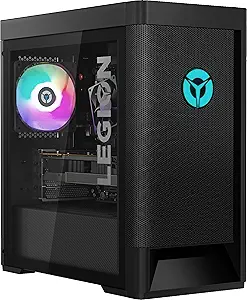
Aesthetically and structurally, Lenovo champions an industrial, understated design language that blends seamlessly into both corporate workspaces and gaming dens. Legion towers are built around rigid, rolled-steel chassis with refined, shadow-black matte panels, concealed intake vents, and tasteful internal lighting accents. Their internal engineering emphasizes clean cable routing channels and structural stability, often incorporating proprietary internal GPU support brackets to eliminate transport sag. The layout is pragmatic, clean, and utilitarian, though it leans heavily toward standardized mid-towers that lack visual variation across product tiers.
MSI takes a considerably more daring and aggressive approach to industrial design, offering diverse chassis form factors ranging from the ultra-slim, console-like Trident series to the boldly angular Aegis cases with tempered glass side panels. MSI frequently incorporates specialized physical cooling zones—such as their Silent Storm Cooling architecture—which physically isolates the GPU, CPU, and PSU into independent chambers to optimize cross-flow convection. While this results in visually striking machines with expansive tempered-glass showcases, the aggressive gamer aesthetic may alienate minimalist users, and certain compact models can make internal access more complex compared to Lenovo’s standardized box layouts.
Compare current retail pricing, active promotions, and verified stock availability directly from authorized stores: