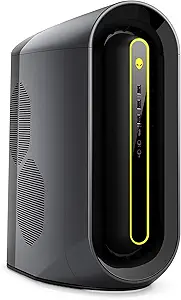
Alienware vs Corsair: Overview
Comparing Alienware and Corsair helps you determine which brand is best suited for your needs in Prebuilt PC. Both brands offer strong choices depending on your budget and key feature requirements.
Key Features & Comparison
Evaluate factors such as build quality, warranty, customer satisfaction, and total value before making your final purchase choice between Alienware and Corsair.
Features
The feature landscape highlights two drastically different approaches to software ecosystems and hardware expandability. Alienware equips its machines with the Alienware Command Center (AWCC), an all-in-one suite designed to monitor system vitals, apply basic overclocking profiles, and synchronize AlienFX RGB lighting across branded peripherals. While conceptually solid, AWCC has historically struggled with software bloat and driver instability. More critically, Alienware's hardware features are often bottlenecked by proprietary motherboard layouts, non-standard front I/O panels, and limited PCIe lane distribution, severely restricting secondary storage expansion or future motherboard swaps.
Corsair counters with one of the most mature and refined feature ecosystems in the PC industry, anchored by its iCUE software suite. iCUE provides hyper-granular control over every aspect of system health, allowing users to build custom fan curves tied to individual hardware sensors and execute sophisticated, multi-layer lighting choreography. From a hardware standpoint, Corsair systems excel by providing feature-complete, standardized motherboards equipped with robust VRM power stages, ample M.2 NVMe heatsinks, and comprehensive rear I/O connectivity. Because Corsair builds with standardized ATX or mini-ITX components, every port, internal header, and expansion slot is readily accessible for future enhancements.
Performance
In terms of peak synthetic performance, both brands have access to the highest-tier silicon from Intel, AMD, and NVIDIA, but their thermal engineering dictates how sustained that performance remains under heavy workloads. Alienware systems, such as the Aurora series, have historically struggled with thermal dissipation due to compact, restricted interior volumes and idiosyncratic airflow paths. Even with recent thermal redesigns, Alienware machines often see higher core temperatures and louder fan acoustics under sustained gaming or multi-threaded rendering tasks, occasionally triggering thermal throttling that clips the sustained boost clocks of top-end CPUs.
Corsair systems generally extract better sustained performance and stability from identical silicon thanks to their superior cooling architectures. In the mid-tower Vengeance lineup, Corsair leverages high-airflow mesh chassis, high-static-pressure fans, and robust all-in-one (AIO) liquid coolers to keep junction temperatures well below critical thresholds. In their compact Corsair One series, innovative convection-assisted dual-loop liquid cooling achieves incredible thermal efficiency in an ultra-small form factor. This advanced thermal headroom translates directly to stable frame rates, sustained clock speeds without throttling, and a substantially quieter acoustic profile during marathon gaming or workstation sessions.
Design
Aesthetically, Alienware and Corsair target completely different design sensibilities within the enthusiast market. Alienware leans heavily into a bold, sci-fi-inspired visual identity characterized by curvilinear outer shells, pill-shaped silhouettes, and prominent loop lighting. While visually arresting from across a room, the exterior aesthetic relies heavily on sculpted plastic panels wrapping a stamped steel chassis. Internally, the packaging can feel dense and cluttered, with proprietary internal brackets and constrained routing paths that make routine cleaning and maintenance more arduous than necessary.
Corsair focuses on industrial elegance, structural rigidity, and minimalist craftsmanship. The Vengeance series adopts clean, geometric lines crafted from powder-coated steel and tinted tempered glass, showcasing meticulous internal cable management that rivals professional custom boutique builds. The Corsair One takes this minimalist luxury a step further, utilizing a compact, bead-blasted aluminum chassis with subtle, ambient light pipes that blend seamlessly into professional studio environments or modern living rooms. Corsair’s design ethos prioritizes thermal efficiency, component visibility, and tool-less accessibility, delivering a premium tactile experience that clearly reflects its higher engineering pedigree.
Compare current retail pricing, active promotions, and verified stock availability directly from authorized stores: