





Artillery and Creality both cater to makers and enthusiasts seeking reliable, high-performance FDM 3D printing at reasonable prices. While they overlap in many ways—particularly in offering large build volumes and strong community support—their philosophies differ. Creality thrives on scale, offering one of the broadest 3D printing ecosystems on the market, including CoreXY printers, resin models, and even laser engravers.

Artillery, by contrast, has carved out a space as a semi-premium alternative, known for quieter operation, clean design, and out-of-the-box simplicity. Let’s compare them across the most important aspects for serious hobbyists, educators, and small-scale professionals.
Print Quality & Speed
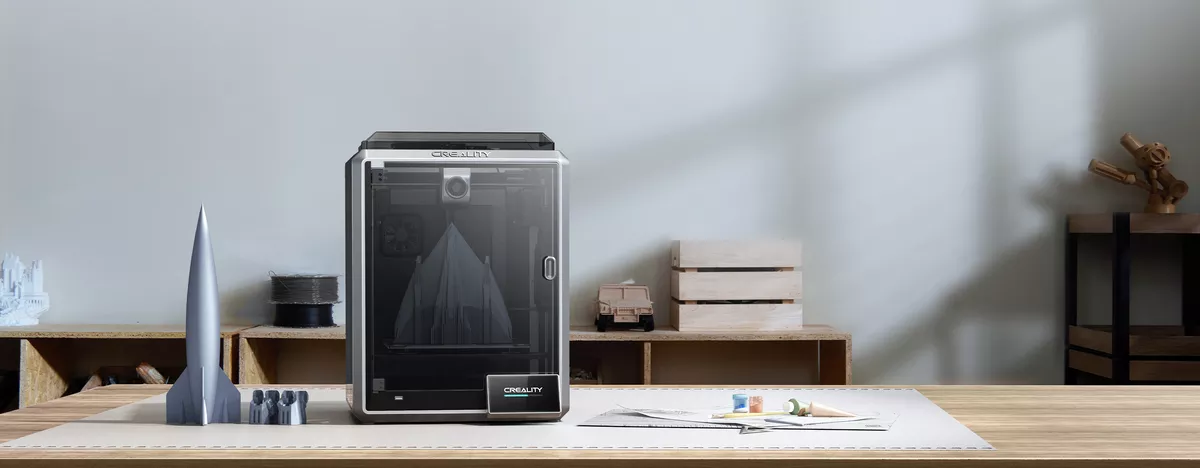
🟦 Creality outpaces in raw speed. Its K1 and K1 Max models feature CoreXY architecture (a motion system that decouples the X and Y axes, allowing faster and more stable prints), Input Shaping, and speeds up to 600 mm/s. Even at these speeds, with AI-assisted flow control and pre-calibrated profiles, Creality’s flagship printers maintain a high level of detail—especially with rigid frames and vibration-dampening systems.
🟪 Artillery printers like the Sidewinder X4 Pro and X3 Pro are built for smooth, consistent output. They produce clean outer surfaces, accurate dimensions, and strong overhang handling at standard speeds. With the introduction of Klipper firmware (an advanced controller that enables faster acceleration, Input Shaping, and smoother curves), Artillery’s X4 series has entered high-speed territory. However, their motion systems still use traditional Cartesian mechanics, which aren’t as optimized for very high-speed stability as CoreXY designs.

✅ Creality is slightly better in high-speed performance. Artillery matches quality at moderate speeds but can’t push quite as fast without compromise.
Material Compatibility
🟦 Creality has a wider selection of machines designed with advanced filament support in mind. Models like the CR-10 Smart Pro or Sermoon D3 are fully enclosed, maintaining a consistent internal temperature for tricky materials such as ABS or Nylon. Their all-metal hotends, high-wattage heaters, and multi-material slicer profiles make them more turnkey for advanced material applications.
🟪 Artillery machines support the usual consumer-grade filaments—PLA, PETG, and TPU—out of the box, with reliable hotend temperatures up to 260 °C and heated beds. Higher-temp materials like ABS, ASA, or PC blends are possible, but typically require a DIY enclosure or upgrades for better thermal stability.
✅ Creality leads for professional filament handling, with broader options and better thermal engineering. Artillery is competent but sometimes needs modification for demanding jobs.
Maintenance
🟦 Creality printers are famously mod-friendly, using standard connectors, widely supported control boards, and community-backed firmware. Replacement parts and upgrade kits are ubiquitous, making self-repair simple.
🟪 Artillery machines are easy to maintain with modular hotends, direct extruders, and uncluttered internal layouts; however, their ribbon cables, while tidy, can be fragile and harder to replace.
✅ Creality wins with broader documentation, better part availability, and a larger modding ecosystem.
Technology & Features
🟦 Creality flagship machines sport AI-assisted print recovery, LiDAR first-layer inspection (K1 Max), AMS-style multi-filament handling, cloud monitoring, closed-loop motion, automatic flow tuning, and silent fans for smart, quiet operation.
🟪 Artillery integrates Klipper, auto-bed levelling, and responsive UIs in the X4 series, plus filament runout sensors, flexible magnetic beds, and power-loss recovery on most models.
✅ Creality is slightly more innovative, pushing high-end features into consumer machines. Artillery covers the basics well but ventures less into smart automation.
🟦 Go with Creality if you are:
- Looking for the largest selection of 3D printers across size and function
- Interested in cutting-edge features such as CoreXY, LiDAR, or AI monitoring
- A modder who wants the widest community and aftermarket support
🟪 Go with Artillery if you are:
- Focused on value: big build volume, quiet operation, and direct drive under 500 USD
- A casual to intermediate user wanting minimal assembly and clean aesthetics
- A hobbyist who appreciates simplicity with a premium feel
Conclusion
Creality remains the powerhouse of the consumer 3D printing world, offering unparalleled variety, innovation, and ecosystem support. Its printers span every budget and skill level, with an impressive flow of new technologies reaching the desktop. Artillery, on the other hand, is a focused value champion: quieter, simpler, and tuned for makers who want flagship features at a wallet-friendly price. If you want cutting-edge, go with Creality. If you want plug-and-play power without the fluff, Artillery delivers.