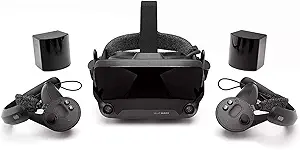
Sony vs Valve: Overview
Comparing Sony and Valve helps you determine which brand is best suited for your needs in VR Headsets. Both brands offer strong choices depending on your budget and key feature requirements.
Key Features & Comparison
Evaluate factors such as build quality, warranty, customer satisfaction, and total value before making your final purchase choice between Sony and Valve.
Features
In terms of feature sets, Sony's PSVR2 outpaces Valve's older architecture with next-generation sensor technology and tactile immersion. Sony heavily integrates eye-tracking cameras developed with Tobii, enabling dynamic foveated rendering which drastically reduces computational overhead while facilitating intuitive gaze-based UI navigation. Additionally, Sony brought its celebrated DualSense tactile technology to the headset itself, featuring a built-in rumble motor that complements the adaptive triggers and sophisticated haptic actuators in the Sense controllers. These sensory features create a visceral layer of immersion that few PC VR headsets can natively replicate.
Valve, however, champions ergonomic interaction and acoustic immersion through the Index's unique feature array. The standout feature remains the 'Knuckles' controllers, which utilize 87 individual sensors per unit to track finger positions, grip force, and hand release, allowing for natural grasping and dropping mechanics without pressing physical buttons. Furthermore, Valve's near-field off-ear BMR (Balanced Mode Radiator) speakers provide an industry-leading spatial audio experience that avoids ear fatigue and preserves ambient situational awareness. While lacking Sony's built-in eye tracking, Valve offsets this with superior peripheral tracking expansion and peripheral ecosystem support via modular SteamVR Base Stations.
Performance
Performance benchmarks reveal clear divergence in display technology and tracking execution. Sony utilizes high-contrast custom OLED panels boasting a resolution of 2000 x 2040 pixels per eye, supporting true HDR with deep inky blacks and vibrant color gamuts that transform dark, atmospheric gameplay. Driven by the PlayStation 5, Sony relies heavily on motion reprojection to achieve 90Hz or 120Hz refresh rates in demanding titles, which can occasionally introduce visible ghosting artifacts. Its inside-out optical tracking is remarkably convenient, requiring no external sensors, though it can occasionally suffer from tracking blind spots when controllers are held too close to the visor or behind the user's back.
Valve prioritizes low-persistence clarity and absolute positional accuracy over pure pixel density. The Index employs dual LCD panels at 1440 x 1600 pixels per eye, featuring a refresh rate that can be pushed to an ultra-fluid 144Hz experimental mode, significantly mitigating motion sickness and visual smearing. Paired with an enthusiast-grade PC, the Index renders native high-framerate images without the need for artificial reprojection. More importantly, Valve’s sub-millimeter Lighthouse tracking system relies on external laser basestations, ensuring flawless, zero-latency 360-degree tracking coverage even under challenging lighting conditions, outclassing Sony's optical inside-out system in competitive and precision-oriented applications.
Design
Sony's physical design language reflects refined ergonomic balancing aimed at mass-market comfort. Utilizing a halo-strap architecture inspired by its initial PSVR iteration, the PSVR2 suspends the optical visor in front of the user's face rather than pressing it firmly against the cheekbones, which drastically minimizes facial fatigue during extended play sessions. The accordion-style rubberized light shield provides superb light blocking while accommodating various facial structures, and a convenient rotary dial enables precise mechanical IPD adjustments. The overall aesthetic is sleek and cohesive with the PlayStation 5, maintaining a lightweight profile despite housing advanced haptics and cooling fans.
Valve takes a more industrial, materials-first approach to hardware construction, resulting in a heavier but exceptionally durable and premium-feeling chassis. The Index features plush, breathable antimicrobial fabric face gaskets that attach magnetically for effortless cleaning and replacement. Its mechanical adjustments are among the most robust in the industry, offering independent IPD adjustment and physical eye-relief sliders that bring the lenses closer to the eyes to maximize the horizontal field of view to roughly 130 degrees. While bulkier than Sony's streamlined headset, the Valve Index's weight distribution, premium off-ear audio mounts, and customizable front expansion slot ('Frunk') make it an exceptionally well-engineered piece of enthusiast hardware.