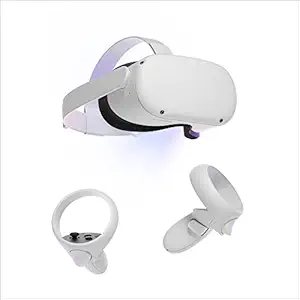
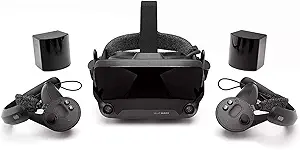
Meta Quest vs Valve: Overview
Comparing Meta Quest and Valve helps you determine which brand is best suited for your needs in VR Headsets. Both brands offer strong choices depending on your budget and key feature requirements.
Key Features & Comparison
Evaluate factors such as build quality, warranty, customer satisfaction, and total value before making your final purchase choice between Meta Quest and Valve.
Features
Meta Quest sets the standard for modern feature diversity by blending virtual and mixed-reality experiences into an untethered chassis. Key innovations include full-color high-resolution stereoscopic passthrough, advanced optical hand tracking that operates reliably without controllers, experimental upper-body tracking, and seamless wireless PC streaming via Air Link. Meta's rapid iteration cycle also yields regular system updates that introduce experimental spatial computing interfaces, seamless local multiplayer shared spaces, and deep integration with their vast standalone digital storefront, making the hardware feel constantly refreshed.
Valve approaches its feature set through mechanical and acoustic engineering perfection rather than standalone multifunctionality. The defining feature of the Valve Index ecosystem remains its "Knuckles" controllers, which utilize 87 optical and capacitive sensors to track individual finger movements naturally, enabling true physical gripping and releasing mechanics that Meta's standard controllers cannot natively replicate. Additionally, Valve's integrated off-ear balanced-mode radiator speakers offer industry-leading spatial audio that floats outside the ear canal, minimizing fatigue and maximizing immersion without requiring aftermarket audio modifications, a common necessity on Meta Quest hardware.
Performance
In terms of raw compute performance and graphical fidelity, the comparison hinges on local mobile architecture versus dedicated tethered graphics processing units. Meta Quest relies on cutting-edge Qualcomm Snapdragon XR silicon, which delivers remarkably sharp mobile renders, responsive UI navigation, and capable on-device 3D processing. However, even with advanced dynamic foveated rendering and super-resolution upscaling, Meta's standalone performance is naturally constrained by thermal dissipation limits and battery life, meaning mobile titles cannot match the environmental density, real-time lighting, or asset detail of high-end desktop rigs.
Valve bypasses these mobile compute limitations entirely by leveraging external desktop GPUs through an uncompressed, dedicated DisplayPort interface, completely eliminating the video compression artifacts and latency that occasionally plague Meta's wireless or USB-tethered PC Link solutions. The Index offers an impressive 144Hz refresh rate capability, providing unparalleled motion smoothness that drastically reduces motion sickness during intense gaming sessions. Furthermore, Valve's Lighthouse 2.0 tracking system delivers sub-millimeter tracking accuracy without the occlusion dead zones inherently present in Meta's headset-mounted camera systems.
Design
Meta Quest's physical design emphasizes consumer-friendly ergonomics, portability, and structural compactness. The transition toward advanced pancake optics has allowed Meta to dramatically slim down the physical profile of their headsets, pulling the center of gravity closer to the user's face to decrease downward neck strain during active experiences. The industrial design favors clean lines, smooth matte plastics, and minimal setup complexity, requiring no external sensors, dangling cables, or permanent room calibration to operate within diverse physical environments.
Valve takes a fundamentally industrial approach focused on sustained enthusiast comfort and modular customization. The Index features a heavier overall chassis, but it distributes mass counterbalanced across a robust, rigid head strap lined with antimicrobial, moisture-wicking fabrics that significantly reduce pressure points during marathon play sessions. Valve also engineered physical hardware interpupillary distance (IPD) sliders with millimeter precision, an integrated expansion bay (the "Frunk") for third-party hardware mods, and replaceable face gaskets, underscoring an enduring, repair-friendly design ethos compared to Meta's disposable consumer electronics model.
Compare current retail pricing, active promotions, and verified stock availability directly from authorized stores: