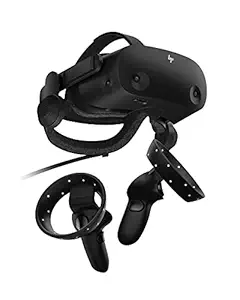
Sony vs HP: Overview
Comparing Sony and HP helps you determine which brand is best suited for your needs in VR Headsets. Both brands offer strong choices depending on your budget and key feature requirements.
Key Features & Comparison
Evaluate factors such as build quality, warranty, customer satisfaction, and total value before making your final purchase choice between Sony and HP.
Features
When evaluating core feature architecture, Sony and HP approach virtual reality through distinct engineering philosophies: Sony prioritizes holistic sensory immersion, whereas HP centers its platform on raw visual clarity and acoustic fidelity. Sony’s flagship hardware, exemplified by the PlayStation VR2, leads the consumer segment in sensory integration with standard eye-tracking hardware that drives dynamic foveated rendering, intuitive gaze-based menu navigation, and optimized processing efficiency. Furthermore, Sony incorporates sophisticated tactile engineering directly into the headset chassis via built-in headband haptic motors, complementing the Sense controllers' DualSense-derived adaptive triggers and micro-actuators. In contrast, HP, through the Reverb G2 series, concentrates its feature set on high-end PC simulation. HP eschews eye-tracking on standard consumer models—reserving biometric features like pupillometry and heart-rate tracking exclusively for the enterprise Omnicept edition—and utilizes conventional rumble motors in its controllers, lacking the nuanced force-feedback layer that defines Sony's interactive suite.
In audiovisual engineering and tracking mechanics, the two brands showcase stark technical trade-offs. Sony deploys custom 2000x2040 per-eye OLED micro-panels featuring high-dynamic-range (HDR) support and pure black levels, though this introduces a subtle diffusion filter to mitigate sub-pixel screen-door effects. HP counters with dual 2160x2160 full-RGB stripe LCD panels developed in partnership with Valve, yielding superior edge-to-edge optical clarity, minimal mura, and virtually zero chromatic aberration, which has made it a benchmark for flight and racing simulators. However, HP dominates in spatial acoustic engineering with its floating, off-ear BMR (Balanced Mode Radiator) speakers that deliver superior soundstaging without physical ear fatigue, an area where Sony requires users to supply their own 3.5mm headphones or rely on basic pack-in earbuds. On the tracking front, Sony’s streamlined four-camera inside-out system offers superior volume coverage and infrared synchronization compared to HP’s Windows Mixed Reality-based four-camera array, which notoriously suffers from vertical tracking blind spots and sensitive ambient lighting dependencies.
From an ecosystem and functional perspective, the feature comparison reveals diverging target utilities. Sony provides a frictionless, plug-and-play console experience with features like rapid capacitive boundary setup, a high-fidelity see-through pass-through mode, and a seamless single-cable USB-C interface, though it inherently confines users to closed or restricted ecosystems. HP offers the open-ended utility of PCVR, granting access to expansive SteamVR modifications, third-party overlay utilities, and broad enterprise software suites, but it carries the baggage of the fragmented Windows Mixed Reality software stack and a cumbersome breakout cable configuration. Ultimately, Sony provides the more advanced, future-proof consumer feature set through standard eye tracking and multi-point haptic feedback, while HP’s feature package remains a specialized, precision-engineered instrument primarily tailored for PC visual clarity and acoustic excellence.
Performance
When evaluating performance in the virtual reality space, Sony and HP represent two divergent engineering philosophies: Sony leverages a bespoke, closed-loop console architecture, while HP focuses on raw PC-tethered visual fidelity. Sony’s flagship PlayStation VR2 delivers an exceptional visual and sensory experience powered by custom 2000 x 2040 per-eye OLED displays featuring High Dynamic Range (HDR) and refresh rates reaching up to 120Hz. The standout technical achievement in Sony's performance pipeline is its integrated eye-tracking array, which facilitates dynamic foveated rendering. This allows the host PlayStation 5 to concentrate computing power directly where the user’s pupils are focused, achieving remarkable graphical complexity, low-persistence clarity, and high frame rates without systemic thermal throttling. In contrast, the HP Reverb G2 relies on dual 2160 x 2160 sub-millimeter LCD panels designed in collaboration with Valve. HP achieves benchmark-grade center-lens clarity and virtually eliminates the screen-door effect, making it a longstanding favorite for detailed simulation environments. However, lacking eye-tracking-assisted foveated rendering, HP requires immense brute-force graphical horsepower from a high-end PC GPU to sustain its native 90Hz output without frame drops.
Tracking architecture and input latency further delineate the performance profiles of both brands. Sony utilizes a modern four-camera inside-out tracking system paired with infrared optical tracking on its Sense controllers, delivering low-latency positional accuracy and a wide operational volume. This is complemented by tactile feedback mechanisms—specifically, headset-mounted motor haptics and dual-actuator controller feedback—that reduce cognitive latency and amplify sensory immersion. HP also relies on an inside-out four-camera sensor array built atop the Windows Mixed Reality platform. While HP’s head tracking is reliably stable, its controller tracking volume suffers from narrower vertical and lateral optical coverage, occasionally leading to tracking dead zones and rotational snap-back when hands are positioned outside the cameras' field of view. Furthermore, HP’s controllers lack capacitive touch sensors and adaptive resistance, placing its tactile feedback loop a generation behind Sony’s responsive inputs.
Ultimately, the practical trade-offs come down to scalability versus optimization. HP’s performance ceiling is fundamentally higher for stationary enthusiasts, particularly in flight and racing simulators, because it can tap into top-tier PC desktop hardware to drive native uncompressed textures across its 114-degree field of view with pristine Valve-engineered off-ear acoustics. However, Sony delivers a vastly more balanced, reliable, and holistic performance package. By tightly coupling dedicated hardware features—such as deep OLED black levels, advanced eye-tracking, integrated headset haptics, and seamless plug-and-play optimization—Sony ensures sustained, high-fidelity VR performance without the driver conflicts, calibration overhead, and tracking compromises inherent to HP’s PC-based ecosystem.
Design
Sony and HP approach virtual reality design with distinctly different ergonomic philosophies and target audiences, resulting in stark contrasts in chassis architecture and weight distribution. Sony, particularly with the PlayStation VR2, doubles down on its proven "halo" headband design, which suspends the bulk of the visor's weight across the upper forehead and the base of the skull rather than pressing directly against the user’s cheekbones. This floating visor is paired with a flexible, accordion-style silicone light shield that provides superior ambient light occlusion while preventing internal lens fogging via subtle, integrated ventilation channels. Conversely, the HP Reverb G2 adopts a more traditional, Valve-inspired three-strap harness consisting of semi-rigid side arms and an elasticized overhead velcro strap. While HP’s chassis is remarkably lightweight (approximately 500 grams) and utilizes plush, magnetic-detachable memory foam padding, it fundamentally exerts direct pressure on the user's face. Users prioritizing long-session facial relief often favor Sony’s counterbalanced halo, whereas racing and flight simulator enthusiasts often prefer HP’s snug, flush-to-face fit, which remains more stable during rapid head movements.
When evaluating integrated audio and sensory hardware engineering, both brands demonstrate brilliant yet polarized technical priorities. HP’s greatest design triumph lies in its collaboration with Valve to integrate hovering, off-ear Balanced Mode Radiator (BMR) speakers. These floating drivers eliminate physical ear contact entirely, reducing ear fatigue and heat buildup while delivering industry-leading spatial acoustic immersion. Sony, in contrast, curiously omits integrated open-back speakers, opting instead for a bundled 3.5mm stereo earbud attachment that docks seamlessly into the rear headband, which—while functional and private—introduces added friction during setup. However, Sony compensates for this with groundbreaking tactile engineering: the PSVR2 is the only mainstream headset featuring an internal rumble motor embedded directly within the headband to simulate environmental impacts and head-level haptics, alongside an exceptionally smooth, integrated rotary IPD (interpupillary distance) adjustment dial that seamlessly syncs with motorized eye-tracking sensors.
The input design and periphery ergonomics further solidify the divide between Sony's modern, consumer-first philosophy and HP’s utilitarian, enterprise-adjacent approach. Sony’s "Sense" controllers feature an avant-garde spherical orb architecture that naturally wraps around the hands, providing an optimal center of gravity, integrated capacitive touchpads, and advanced adaptive trigger mechanisms borrowed from the DualSense ecosystem. In contrast, HP's controllers represent the weakest link of the Reverb's design footprint; they rely on a bulky, top-heavy Windows Mixed Reality aesthetic with prominent tracking rings that are prone to collision during close-hand interactions, combined with a smooth plastic shell that lacks touch capacitance. Overall, while HP delivers a masterclass in acoustic integration, lightweight minimalism, and sim-rig practicality, Sony delivers a far more refined, cohesive, and feature-rich industrial design tailored for complete physical and tactile immersion.