HP vs Valve: Overview
Comparing HP and Valve helps you determine which brand is best suited for your needs in VR Headsets. Both brands offer strong choices depending on your budget and key feature requirements.
Key Features & Comparison
Evaluate factors such as build quality, warranty, customer satisfaction, and total value before making your final purchase choice between HP and Valve.
Features
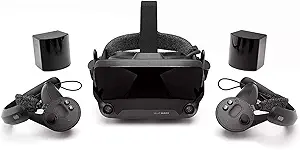
In terms of feature sets, Valve pushed hardware innovation significantly further than HP, particularly through its groundbreaking 'Knuckles' controllers. The Valve Index controllers incorporate 87 sensors across each unit to track individual finger movements, grip pressure, and velocity, enabling natural gestures like grabbing, dropping, and throwing objects without physical button presses. Additionally, the Index features Valve’s pioneering off-ear balanced-mode radiator (BMR) speakers, which provide spatial audio with exceptional realism without touching the outer ear. It also includes an expansion 'frunk' with a USB port for modding, integrated dual front-facing cameras for pass-through, and hardware IPD adjustments ranging from 58mm to 70mm.
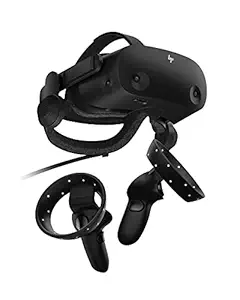
HP, in contrast, focused its feature set on high-utility components while borrowing key elements from Valve's engineering playbook. The HP Reverb G2 famously adopted the exact same Valve-designed off-ear BMR speakers and facial interface gasket, granting it audio and comfort parity with the Index. However, HP chose inside-out tracking via four integrated cameras to eliminate the need for external beacons, prioritizing plug-and-play simplicity. Unfortunately, HP’s controllers are relatively basic compared to the Index; they rely on standard button layouts, lack capacitive finger tracking, and consume AA batteries quickly, making HP's interactive feature suite considerably more utilitarian and less immersive than Valve's tactile interface.
Performance
Performance benchmarks between these two headsets highlight a direct trade-off between pure pixel density and fluid visual dynamics. HP holds an undisputed advantage in raw resolution, packing 2160 x 2160 pixels per eye into its dual LCD panels. This produces an astonishingly crisp image with virtually no screen-door effect, rendering cockpit instruments, distant apexes, and fine text with pristine clarity that Valve cannot match. However, the Reverb G2 is capped at a 90Hz refresh rate, and its visual sweet spot is notoriously narrow, meaning image sharpness degrades noticeably as your gaze moves away from the direct center of the lenses.
Valve prioritized temporal fidelity and broad field of view over sheer resolution. The Index operates at 1440 x 1600 pixels per eye, which exhibits a more noticeable pixel structure than the HP, but it compensates with an expansive field of view (up to ~130 degrees depending on face relief) and industry-leading refresh rates of 120Hz and an experimental 144Hz. This higher refresh rate drastically reduces motion sickness, latency, and visual smearing during fast-paced movement. Furthermore, Valve’s SteamVR lighthouse tracking offers sub-millimeter, 360-degree precision with zero blind spots, heavily outperforming HP’s camera-based tracking which frequently loses controller position when hands drop below the waist or move near the headset.
Design
From an industrial design standpoint, Valve built the Index with an unapologetic emphasis on durability, balanced weight distribution, and adjustability. Weighing around 809 grams, it is heavier than many competitors, but its counterbalanced rear strap, dialed eye-relief mechanism, and antimicrobial, moisture-wicking fabric padding distribute that mass evenly across the cranium. Valve's dual-element, canted optics are physically adjustable to optimize both pupil distance and eye relief, maximizing both comfort and field of view for varied facial anatomies. The construction feels robust, premium, and built to withstand hundreds of hours of intense room-scale movement.
HP's design philosophy with the Reverb G2 leaned toward lightweight minimalism, weighing in at a remarkably light 498 grams. This featherweight chassis dramatically reduces neck fatigue during marathon seated sessions, such as long flights or racing stints. The headset sports clean, understated aesthetics with soft fabric coverings on the front and sides, and features a flip-up visor design that facilitates quick transitions back to the real world. While the materials feel somewhat more plasticky and less tank-like than Valve's hardware, HP achieved a sleek, comfortable, and highly practical form factor that excels in prolonged, stationary environments.