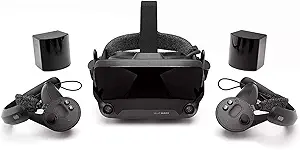
Samsung vs Valve: Overview
Comparing Samsung and Valve helps you determine which brand is best suited for your needs in VR Headsets. Both brands offer strong choices depending on your budget and key feature requirements.
Key Features & Comparison
Evaluate factors such as build quality, warranty, customer satisfaction, and total value before making your final purchase choice between Samsung and Valve.
Features
In terms of feature sets, Valve decisively outclasses Samsung by engineering specialized hardware innovations that elevate the foundational VR experience. The centerpiece of Valve's feature ecosystem is the 'Knuckles' Index controllers, which incorporate 87 sensors across each unit to track individual finger movements, grip pressure, and natural hand poses. Combined with off-ear near-field speakers that deliver peerless spatial audio without physical ear fatigue, Valve built a headset that fundamentally rethinks sensory engagement. While setup requires mounting external SteamVR base stations, this feature delivers sub-millimeter 360-degree tracking volume with unmatched consistency, making it the preferred choice for competitive and physical VR applications.
Samsung focused its feature profile primarily around visual comfort, display innovation, and simplicity of setup. The standout feature of the Odyssey series was the proprietary Anti-SDE (Screen Door Effect) technology combined with vibrant dual AMOLED displays, which effectively smoothed pixel grids to create a film-like image. Furthermore, Samsung leveraged the Windows Mixed Reality platform to incorporate inside-out camera tracking, eliminating the need for external beacons entirely. While this setup drastically lowers the barrier to entry and minimizes cable management, the bundled controllers and limited tracking volume around the user's back and sides lack the nuanced capacitive sensors and mechanical refinement engineered by Valve.
Performance
Performance comparisons highlight a stark contrast between display-focused fidelity and raw interactive throughput. Samsung holds a notable advantage in color rendering, contrast, and black levels thanks to its utilization of custom AMOLED panels. In dark, atmospheric titles like elite space simulators or horror experiences, Samsung's deep blacks and vibrant color saturation provide a visual richness that typical LCD panels cannot replicate. However, its performance is constrained by standard 90Hz refresh rates and the inherent limitations of camera-based inside-out tracking, which can stutter or lose hand positioning when controllers are held close to the face or placed outside the cameras' immediate field of view.
Valve prioritized temporal fidelity, latency reduction, and tracking reliability over the deep contrast of OLED technology. The Valve Index utilizes low-persistence dual LCD panels capable of overclocking to 120Hz and an experimental 144Hz mode, providing exceptionally fluid motion that drastically reduces visual latency, micro-stutter, and simulation sickness. When paired with SteamVR 2.0 lighthouse tracking, the Index delivers flawless, ultra-responsive tracking performance with virtually zero dead zones. While the Index's black levels suffer from standard LCD backlight glow, its superior refresh rates, wider edge-to-edge optical clarity, and unwavering positional stability make it the superior performer for demanding gameplay.
Design
The mechanical design and ergonomics of both brands reflect their targeted market segments and price tiers. Samsung adopted a halo-style headband design for the Odyssey line, redistributing weight across the forehead rather than pulling against the face. While this design allows for a quick flip-up motion and generally comfortable short-session usage, it suffers from a somewhat rigid chassis and nose-bridge light leakage for certain facial structures. The materials are predominantly high-grade consumer plastics with synthetic leather padding, striking a fine balance between durability and production cost, though the overall form factor can feel slightly bulky during high-movement activities.
Valve engineered the Index with an obsession for long-term comfort, weight distribution, and premium tactile materials. Featuring an adjustable rigid-strap mechanism, finely tuned dual-axis IPD (interpupillary distance) adjustments, and canted lenses designed to maximize the field of view up to approximately 130 degrees, the Index accommodates diverse facial topographies effortlessly. The use of breathable, antimicrobial woven fabrics for the magnetic face gasket prevents heat and sweat buildup during extended sessions. Furthermore, Valve's physical design includes an expansion bay dubbed 'the Frunk' with a front USB port for hobbyist mods, showcasing an open-ended, industrial-grade design language that caters specifically to power users.