LG vs Valve: Overview
Comparing LG and Valve helps you determine which brand is best suited for your needs in VR Headsets. Both brands offer strong choices depending on your budget and key feature requirements.
Key Features & Comparison
Evaluate factors such as build quality, warranty, customer satisfaction, and total value before making your final purchase choice between LG and Valve.
Features
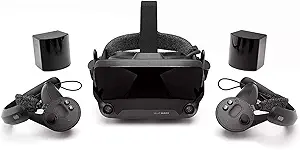
In terms of feature sets, Valve designed the Index from the ground up to maximize spatial immersion through deep hardware and software integration. The standout feature remains the 'Knuckles' controllers, which utilize 87 capacitive, optical, and force sensors per hand to track individual finger movements without requiring physical buttons to be pressed. Combined with the Valve Index's integrated off-ear BMR (Balanced Mode Radiator) speakers, the hardware delivers exceptional spatial audio without physical pressure on the ears. Furthermore, Valve integrates hardware IPD adjustment, an expansion frunk with a USB port for modding, and dual pass-through cameras, making it a dream platform for power users and developers.
LG's VR initiatives, including their earlier SteamVR prototypes, introduced notable features that presaged modern headset ergonomics, such as a flip-up display crown that allows users to return to reality without removing the headset entirely. LG also championed high-density sub-pixel arrays and integrated eye-tracking prototypes in developmental iterations. However, because LG has not brought an updated, fully-fledged consumer ecosystem to market alongside Valve, its feature portfolio remains largely fragmented across concept demonstrations and supply-chain components, leaving Valve far ahead in actionable, user-ready VR software and hardware features.
Performance
Performance benchmarks heavily favor Valve due to the Index's relentless focus on visual fluidity, spatial tracking accuracy, and low latency. Utilizing external SteamVR Base Stations (Lighthouse tracking), the Valve Index offers sub-millimeter precision that is completely impervious to dead zones or poor ambient lighting, satisfying competitive sim-racers and flight enthusiasts. On the visual front, Valve engineered custom canted dual-element LCDs that can push refresh rates up to 120Hz and an experimental 144Hz mode, minimizing motion sickness and delivering exceptionally smooth visual persistence at the expense of needing a powerful dedicated GPU.
LG's historical prototypes and technical demonstrations targeted visual fidelity through their elite panel technology, showing early prototypes with 1440x1280 resolution per eye at 90Hz, which offered competitive black levels and crisp visual clarity relative to its generation. Furthermore, LG's display division continues to pioneer micro-OLED and ultra-high-density panels capable of 4K-per-eye resolutions. Nevertheless, raw panel potential cannot overcome the real-world performance deficits of an unrealized ecosystem, meaning Valve easily wins on sustained rendering throughput, sensor responsiveness, and real-time execution in modern VR workloads.
Design
From an industrial design standpoint, the Valve Index represents a masterclass in weight distribution, structural stability, and thermal management. Despite weighing roughly 809 grams, the Index feels significantly lighter in practical use due to its balanced rear-counterweight strap, plush antimicrobial fabric facial interface, and dial-driven adjustments for both mechanical IPD and eye relief (lens-to-eye distance). The off-ear speaker design also eliminates heat retention around the ears, allowing users to engage in extended VR sessions without discomfort, while internal fans dissipate heat from the forward-mounted display panels.
LG's design language, demonstrated through its hardware prototypes, prioritized modularity and convenience over industrial bulk. Their flagship design philosophy featured a halo-strap architecture with a hinged visor, which solved the common friction point of quickly stepping out of an immersive application to view a monitor or check physical surroundings. While LG's designs leaned toward sleek, lightweight aesthetics and innovative quick-release mechanisms, Valve's design remains the functional benchmark for durable, ergonomic, and repairable enthusiast VR hardware built specifically to endure years of intensive use.