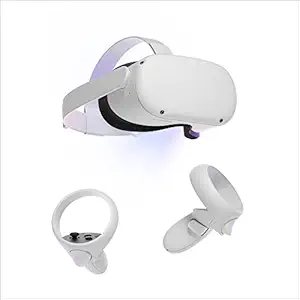
LG vs Meta Quest: Overview
Comparing LG and Meta Quest helps you determine which brand is best suited for your needs in VR Headsets. Both brands offer strong choices depending on your budget and key feature requirements.
Key Features & Comparison
Evaluate factors such as build quality, warranty, customer satisfaction, and total value before making your final purchase choice between LG and Meta Quest.
Features
Meta Quest’s feature set is undeniably expansive, engineered to provide a fully realized standalone VR and mixed-reality experience out of the box. Meta’s Horizon OS delivers robust spatial computing capabilities, including full-color passthrough, advanced inside-out tracking, spatial audio, hand tracking, and integrated voice commands. The ecosystem is supported by an extensive content marketplace encompassing AAA gaming, productivity suites like Microsoft 365, social hangouts, and fitness platforms. Furthermore, Meta continues to pioneer social presence features, offering eye-tracking and face-tracking in its enterprise-focused Pro hardware, alongside PC-VR tethering via Air Link and high-speed USB-C connectivity for ultimate versatility.
LG counters by focusing on premium component integration and media-centric features rather than building an isolated gaming ecosystem from scratch. Emphasizing synergy with its webOS smart TV platform, LG designs its XR initiatives around ultra-high-definition media playback, spatial computing for multitasking, and seamless connectivity with broader home electronics. Rather than locking users into a proprietary software silo, LG leverages open XR standards and strategic alliances with engine developers to prioritize high-fidelity productivity, spatial entertainment, and mixed-reality telepresence. While lacking Meta’s vast native games catalog, LG provides superior audiovisual decoding, high-bandwidth interconnects, and an elevated media-viewing interface tailored for cinematic immersion.
Performance
When measuring technical performance, Meta Quest balances compute power, thermal efficiency, and graphical output through customized silicon. Equipped with chips such as the Qualcomm Snapdragon XR2 Gen 2, the Quest lineup achieves impressive standalone rendering speeds, low-latency tracking, and responsive high-resolution passthrough. Meta’s software pipeline uses sophisticated dynamic foveated rendering, space warp frame generation, and optimized inside-out sensor algorithms, ensuring stable framerates between 72Hz and 120Hz. While graphical fidelity is naturally constrained compared to dedicated desktop rigs, Meta pushes mobile processing architecture to its absolute engineering threshold.
LG’s performance strengths reside predominantly in raw display pipeline execution, dynamic range, and pixel latency. Renowned for its industry-leading OLED and Micro-OLED manufacturing, LG delivers visual performance that minimizes motion blur, eliminates screen-door effects, and produces near-infinite contrast ratios with deep, true blacks. Driven by top-tier Qualcomm Snapdragon XR platforms and dedicated auxiliary display processors, LG hardware excels at ultra-high-resolution rendering and low-persistence visual output. While Meta extracts every ounce of compute capability for complex interactive simulations, LG achieves a superior visual benchmark, prioritizing color precision, instantaneous pixel response, and crystal-clear text readability vital for enterprise and spatial media.
Design
Meta Quest’s design language prioritizes user-friendly pragmatism, balance, and cost-effective durability. Headsets like the Quest 3 utilize sleek pancake lenses to dramatically reduce the front-box profile compared to older Fresnel iterations, distributing weight more evenly across the facial interface. The chassis emphasizes lightweight polycarbonate construction, intuitive physical controls, and smooth continuous interpupillary distance (IPD) adjustment sliders. While the out-of-the-box fabric straps often draw criticism for extended comfort, Meta’s modular approach allows users to easily swap headstraps, facial interfaces, and battery counterweights to customize balance and ergonomic support.
LG approaches industrial design with a modern, consumer-electronics aesthetic that highlights luxury, breathability, and prolonged ergonomic comfort. Taking cues from modern spatial headsets and high-end audio gear, LG frequently implements rigid halo-style suspension systems that transfer the bulk of the device’s weight from the sensitive cheekbones to the forehead and crown. The material palette showcases soft-touch breathable fabrics, metallic accents, and refined ventilation channels to eliminate lens fogging during extended sessions. By integrating compact Micro-OLED components, LG crafts a streamlined, visually sophisticated chassis that feels less like a plastic gaming peripheral and more like an executive-grade spatial computer.
Compare current retail pricing, active promotions, and verified stock availability directly from authorized stores: