












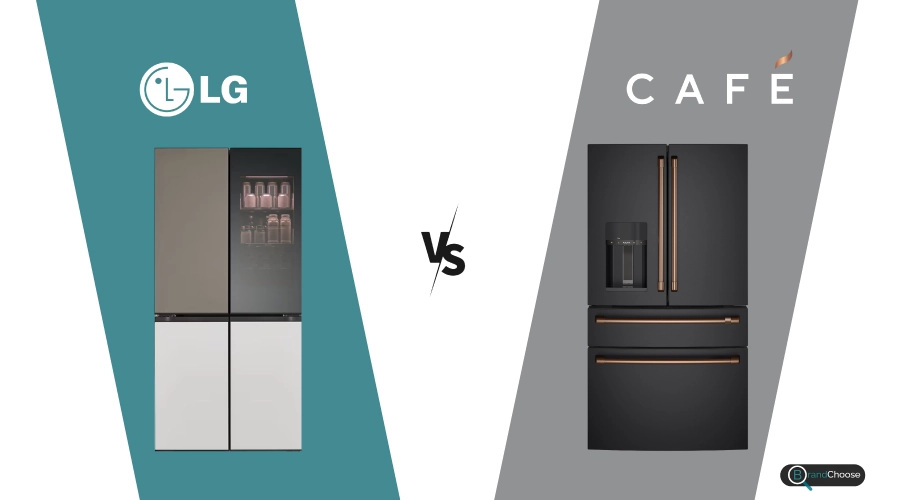
When it comes to refrigerators that do more than just keep things cold, LG and Café both bring serious appeal—but in completely different ways.
LG leans into innovation with AI-driven cooling, app connectivity, and standout features. Café, on the other hand, plays in the premium design space, delivering custom finishes, pro-style hardware, and an upscale vibe that makes your kitchen feel curated. So, do you want tech that works for you—or a fridge that works with your aesthetic?
Let’s dive into this side-by-side to find out which one better fits your lifestyle.
Features
When evaluating the functional landscape of modern refrigeration, LG approaches feature engineering through a lens of tech-forward convenience, whereas Café (GE Appliances' luxury arm) prioritizes culinary utility and sensory refinement. LG’s technical strengths are anchored in high-visibility smart home integrations and advanced preservation systems. Key proprietary features include the InstaView door-in-door technology, which reduces thermal loss through a knock-to-illuminate glass panel, and specialized ice-making suites capable of producing standard cubed, crushed, and slow-melting spherical Craft Ice. LG also heavily integrates its ThinQ smart platform, enabling remote diagnostics, proactive maintenance alerts, and automated temperature profiling driven by usage-pattern algorithms. In contrast, Café refrigerators focus heavily on bespoke host-centric utilities, most notably their built-in Keurig K-Cup brewing systems and precision-engineered hot water dispensers that allow users to select exact temperatures and ounces, a massive practical advantage for avid tea drinkers and home cooks.
The technical divergence between the two brands becomes particularly evident in food preservation and dispensing mechanics. LG utilizes a dual-evaporator framework known as Linear Cooling combined with Door Cooling+, which channels dedicated cold air streams to the door bins to minimize internal temperature fluctuations within a strict half-degree Celsius tolerance. Café counters this with its TwinChill evaporators, engineered to isolate the dry climate of the freezer from the humid environment of the fresh-food compartment, significantly reducing odor transfer and freezer burn. Furthermore, Café stands out in daily dispensing ergonomics with its hands-free AutoFill technology, which uses sophisticated ultrasonic sensors to fill any vessel with filtered water to 90% capacity without manual monitoring—a feature that consistently proves more practically convenient than LG’s standard measured-fill dispensers.
Ultimately, the trade-off in features between LG and Café hinges on whether a consumer values digital connectivity and entertainment-focused cooling or tactile, culinary-grade convenience. LG delivers a more digitally seamless experience with superior novelty features—such as integrated LED mood lighting on its MoodUP line and ultra-hygienic UVnano dispensers—making it an exceptional choice for tech-savvy households focused on modern gadgetry and broad storage flexibility. Café, on the other hand, trades whimsical connectivity for higher-gauge physical hardware, backlit LED interior walls that drastically improve shelf visibility, and customizable aesthetic hardware that integrates smoothly into designer kitchens. While LG wins on smart automation and specialized ice formats, Café edges ahead in daily kitchen functionality and the sheer mechanical luxury of its water, beverage, and lighting systems.
Performance
When evaluating performance in the refrigeration space, LG and Café approach food preservation through distinctly different engineering philosophies. LG anchors its cooling performance on its proprietary Smart Inverter and Linear Compressor technology, designed to minimize temperature fluctuations within a remarkably tight band of plus-or-minus one degree Fahrenheit. Supported by systems like Door Cooling+ and Linear Cooling, LG pushes cold air systematically across all shelving zones, including the door bins, which are traditionally susceptible to temperature loss. In contrast, Café—GE Appliances' design-forward luxury subsidiary—utilizes robust dual-evaporator systems (often branded as TwinChill technology). This separation of airflow ensures that the humid, fresh air required for produce in the refrigerator compartment never co-mingles with the dry, frigid air needed to prevent freezer burn. Consequently, Café excels in odor isolation and long-term humidity retention, whereas LG often leads in sheer thermodynamic efficiency and recovery speed after doors are opened.
Technical feature sets further delineate the practical capabilities of each brand. Café models often cater to culinary enthusiasts and host-centric households, integrating specialized high-demand features such as built-in Keurig K-Cup brewing stations, precise auto-fill water dispensers, and customizable temperature-controlled full-width drawers that can shift between soft freeze, deli, and wine-chilling environments. LG counters with cutting-edge convenience performance, prominently featuring its Craft Ice dual ice-maker technology, which produces slow-melting spherical ice alongside standard cubed and crushed varieties. Additionally, LG’s InstaView panels and multi-duct airflow arrays optimize performance by mitigating internal climate disruption, as users can survey contents without releasing cold air. Both brands incorporate smart Wi-Fi platforms (LG ThinQ and Café’s SmartHQ) that monitor diagnostic health, but Café’s internal sensor suite tends to provide more granular, active adaptations to ambient room temperatures than LG's broader platform.
The primary performance trade-offs center on component durability versus daily operational consistency. LG offers whisper-quiet operation and industry-leading energy ratings; however, the brand has historically faced consumer scrutiny regarding the long-term reliability and complex repair logistics of its specialized compressors, despite offering a 10-year component warranty. Café refrigerators employ more conventional, time-tested compressor architectures that, while slightly louder and marginally less energy-efficient, offer high mechanical resilience and an expansive domestic service network for maintenance. For consumers prioritizing pristine humidity zoning, superior odor barrier execution, and robust commercial-grade cooling longevity, Café holds a slight performance edge. Conversely, buyers seeking rapid pull-down times, whisper-quiet baseline operation, and superior ice-making innovations will find LG to be the more technologically advanced performer.
Design
When evaluating the design paradigms of LG and Café in the refrigeration space, consumers are presented with a fundamental divergence in philosophy: high-tech modernism versus bespoke, interior design-driven luxury. LG’s engineering emphasizes sleek, minimalist contemporary styling anchored in functional technology. Hallmarks of LG’s aesthetic include pocket handles, flat-panel doors, and proprietary innovations like the InstaView door-in-door panel, which blends seamlessly into the facade until illuminated. In contrast, Café—GE Appliances’ premium design-centric brand—prioritizes an artisanal, transitional aesthetic aimed at elevating the kitchen to a professional culinary showcase. Built around customizable, heavy-duty hardware in finishes like brushed bronze, copper, black, and stainless steel, paired with matte white, matte black, or classic stainless surfaces, Café caters directly to luxury home aesthetics where the refrigerator is meant to be a deliberate focal point rather than a discreet utility.
The interior architecture reveals equally distinct approaches to material quality and technical engineering. Café stands out for its dramatic, hospitality-inspired interiors, prominently featuring backlit LED light walls that cast a shadowless, diffuse glow across the entire cabin. It utilizes high-end materials such as copper trim accents, metallic-trimmed glass shelving, and platinum-colored interiors, which convey substantial physical refinement and tactile quality. LG approaches interior design with an emphasis on ergonomic optimization and advanced preservation mechanics, utilizing their CoolGuard metal interior walls not only to provide a commercial-grade visual finish but also to enhance thermal mass and temperature recovery. LG’s space planning often incorporates ultra-flexible folding shelves, integrated slim in-door ice makers to liberate top-shelf cubic footage, and specialized drawers designed for Craft Ice spheres, demonstrating superior space-saving engineering.
Ultimately, the practical trade-offs between the two brands hinge on whether a homeowner prioritizes customizable, appliance-as-furniture aesthetics or tech-forward utility. Café’s robust, commercial-style handles require physical clearance, which can occasionally complicate flush installations against adjacent cabinetry or tight wall enclosures, but they deliver an uncompromised high-end tactile experience that resists rapid obsolescence. LG’s reliance on integrated touchpoints, gloss black glass panels, and motorized or proximity-based lighting delivers a high-impact, futuristic appearance, yet these smooth surfaces demand frequent maintenance to manage fingerprints and smudges. While Café offers a richer, decorator-friendly build quality with superior interior illumination, LG delivers superior mechanical integration and modern ergonomics designed for households that value cutting-edge utility wrapped in contemporary minimalism.
Conclusion
They may live in different design universes, but both brands bring real value to the table.
If smart features and adaptive technology are your priority, LG delivers on function and future-ready convenience. If you care more about visual impact, personalized finishes, and refined details, Café is where form meets luxury.
Bottom line? Choose the one that fits your lifestyle—and your kitchen will thank you.




