











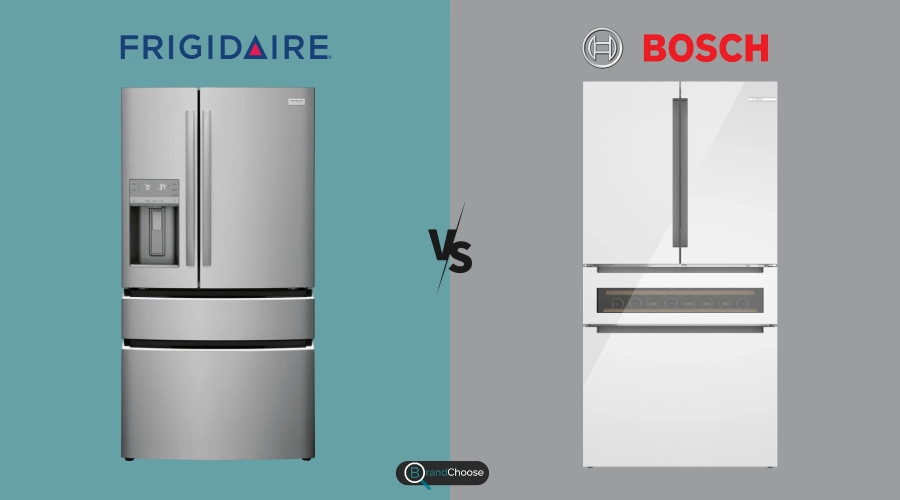
If you’re choosing between Bosch and Frigidaire, you’re essentially choosing between two very different philosophies in refrigeration. Frigidaire focuses on everyday practicality, with accessible pricing and straightforward performance. Bosch, by contrast, leans into engineering excellence and European design, crafting appliances that are quiet, efficient, and impressively refined.
So, what matters more to you—affordability and simplicity, or precision and polish? This comparison covers all the angles to help you make the smarter choice.
Features
When evaluating the feature ecosystems of Bosch and Frigidaire, the distinction lies between high-precision food preservation technology and high-utility convenience designed for active households. Bosch distinguishes itself through its European-engineered dual-compressor, dual-evaporator systems, prominently featured in its 800 Series via the FarmFresh System. This platform utilizes specialized components, including the VitaFreshPro automated humidity and temperature drawer, the ethylene-gas-absorbing FreshProtect filter, and the MultiAirFlow channel system to extend produce longevity dramatically. Furthermore, Bosch integrates Home Connect Wi-Fi capabilities across most modern models, allowing for remote temperature monitoring, open-door alerts, and diagnostics. In contrast, Frigidaire—particularly within its core and Frigidaire Gallery lineups—prioritizes functional storage versatility over multi-compressor thermodynamics. Its flagship features include the SpaceWise organization system with flip-up and sliding shelves, dynamic door-bin arrangements, and the CrispSeal Plus crisper, which uses basic ethylene-blocking filters to manage humidity. While Bosch focuses on internal climate engineering, Frigidaire maximizes usable interior volume and everyday physical access.
Dispenser technology and secondary amenities also reflect the contrasting philosophies of the two brands. Frigidaire excels in consumer-facing convenience, equipping many of its French-door and side-by-side models with external through-the-door ice and water stations powered by PurePour filtration. In higher-tier Gallery and Professional series, Frigidaire frequently integrates dual ice makers, including popular craft ice options or high-output secondary dispensers built directly into the freezer drawer to handle large-family demand. Bosch, by comparison, adopts a minimalist, built-in aesthetic that typically conceals the water dispenser inside the cabinet wall to maintain a seamless, handle-less exterior appearance. Bosch’s internal ice production is anchored by its QuickIcePro system, which claims industry-leading production speeds for standard pyramid ice rather than novel spheres. The practical trade-off is evident: Bosch caters to consumers willing to invest in superior food preservation mechanics, quieter operation, and clean architectural design, whereas Frigidaire delivers lower-cost access to flexible physical storage, robust high-capacity ice delivery, and externally accessible dispensers that cater directly to busy, utilitarian kitchens.
Performance
When evaluating performance, Bosch consistently leads in precision climate control and engineering sophistication, particularly within the premium counter-depth segment. The cornerstone of Bosch's performance is its dual-compressor and dual-evaporator system, branded as the FarmFresh System with VitaFreshPro technology. By isolating the airflow between the fresh food and freezer compartments, Bosch maintains optimal, independent humidity levels that drastically extend the shelf life of produce while preventing odor transfer and freezer burn. Furthermore, their compressors are inverter-driven and whisper-quiet, providing constant micro-adjustments to temperature variations rather than abrasive on-and-off cycling. This results in virtually nonexistent temperature swings, keeping internal conditions stable within half a degree, which is an exceptional technical benchmark for food preservation.
Frigidaire targets a more mass-market consumer base and approaches performance through high-throughput cooling and rapid temperature recovery rather than hyper-precise climate partitioning. Most standard Frigidaire and Frigidaire Gallery models rely on a single-compressor design with mechanical or basic electronic dampers, supported by their EvenTemp cooling system. While this system effectively circulates cold air via multi-port ductwork to prevent localized hot spots, it inherently shares air and moisture between the freezer and refrigerator, leading to drier fresh food environments and a higher risk of frost accumulation over time. However, Frigidaire excels in raw cooling capacity and utility-driven performance features, such as their SpaceWise organizational flexibility and notably superior, high-output ice makers, an area where European-engineered units like Bosch often underperform due to lower production volume and smaller bin capacities.
The practical trade-off between the two brands lies in the balance between food preservation longevity and high-demand household utility. Bosch delivers an elite, whisper-quiet performance that noticeably reduces grocery waste through sophisticated moisture-retention drawers and steady thermodynamic regulation, though it requires a significantly higher upfront investment and delivers slower ice replenishment. Frigidaire offers dependable, budget-friendly performance engineered for busy households that prioritize rapid door-open recovery times, powerful chilling, and substantial ice production over delicate temperature precision. Consumers prioritizing culinary freshness and quiet operation will find Bosch technically superior, whereas those needing resilient everyday capacity and cost-effective cooling will be well served by Frigidaire.
Design
When evaluating architectural and aesthetic design, Bosch and Frigidaire target fundamentally different segments of the market, resulting in distinct engineering approaches. Bosch is widely regarded as a benchmark for premium, European-inspired minimalist design, characterized by sleek, handleless profiles, genuine counter-depth dimensions, and high-grade fingerprint-resistant stainless steel. Their engineering prioritizes a fully flush aesthetic, often incorporating dual compressors and dual evaporators (the FarmFresh System) behind a clean exterior facade, avoiding bulky external ice and water dispensers in favor of discreet interior fill stations. In contrast, Frigidaire—particularly through its Frigidaire Gallery and Professional lines—embraces a more traditional, utilitarian American design language. Frigidaire emphasizes robust, commercial-style handles, smudeproof finishes, and bold exterior interfaces. While aesthetically less seamless than Bosch, Frigidaire’s external architecture is engineered for immediate, heavy-duty accessibility, offering deep-capacity french-door and side-by-side configurations that cater directly to busy, high-volume households.
Internally, the ergonomic and material design philosophies of the two brands diverge even further. Bosch champions sophisticated interior engineering, employing high-end materials such as full stainless steel back walls (MultiAirFlow), tempered glass shelving with metallic accents, and high-efficiency recessed LED lighting strategically placed to eliminate shadows. Their organizational layouts, such as the FlexBar system and dedicated VitaFreshPro crisper drawers with automated temperature and humidity controls, showcase an obsessive focus on precise micro-climates and vertical space optimization. Frigidaire counters with an emphasis on sheer mechanical modularity and practical convenience through its SpaceWise organization systems. Frigidaire's interiors feature flip-up and sliding shelves, expandable door bins capable of holding multiple gallon-sized containers, and the CrispSeal Plus crisper technology. While Frigidaire’s use of heavier plastics and less refined trim reveals its mass-market orientation, its flexible shelving accommodates odd-shaped, bulky items with significantly greater ease than Bosch’s more rigid, tailored interior footprint.
The ultimate trade-off between Bosch and Frigidaire regarding design centers on refined integration versus everyday spatial utility. Bosch is the superior choice for modern kitchen renovations where visual integration, flush cabinetry alignment, and quiet, high-end material quality are paramount, though this comes at the expense of overall cubic-foot capacity and a higher price tag. Frigidaire, conversely, provides superior raw cubic footage, external convenience through through-the-door dispensing, and rugged, cost-effective layouts designed to survive the wear-and-tear of everyday family life. While Bosch delivers architectural finesse and premium tactile feedback, Frigidaire succeeds in delivering pragmatic, functional design tailored for maximum consumer utility and straightforward maintenance.
Conclusion
Frigidaire is the practical choice for everyday homes. It covers the essentials well, especially in the mid-range. Bosch is for those who prioritize premium build quality, whisper-quiet operation, and smart design. What it does offer is carefully crafted for maximum performance and efficiency.
So if you’re building a high-end kitchen and care about the details, Bosch is your brand. If you just want a reliable fridge without the fuss, Frigidaire will serve you well—and save you a few bucks in the process.
Compare current retail pricing, active promotions, and verified stock availability directly from authorized stores:






