











When selecting a refrigerator, Frigidaire and Maytag stand out as two leading brands to check out in the market. Known for their reliability and efficiency, each brand offers various models designed to cater to different household needs.
This comparison will provide a clear overview of key factors like pricing, features, design, and performance, helping you make an informed decision based on your preferences.
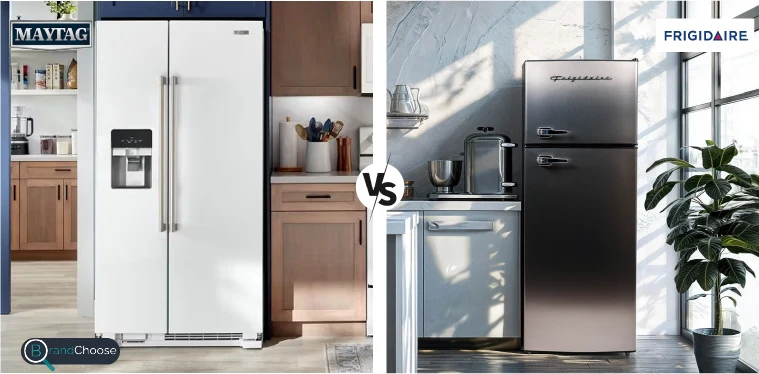
Features
When evaluating the feature landscape of Frigidaire and Maytag refrigerators, the two brands approach food preservation and convenience from fundamentally different engineering philosophies. Frigidaire, particularly within its mid-to-high Gallery and Professional series, focuses on organizational adaptability and sophisticated climate management. Its standout technical offering is the CrispSeal Plus crisper technology, which combines an advanced ethylene filter with an airtight seal to actively slow down produce decay. Furthermore, Frigidaire prioritizes internal flexibility with systems like the SpaceWise organization suite, featuring flip-up shelves, expandable door bins, and the Custom-Flex Temp drawer, which allows consumers to dynamically switch a dedicated compartment between chilling wine, deli storage, and deep-freezing. In contrast, Maytag minimizes modular gadgetry in favor of robust, heavy-duty utility. Maytag's primary technical features are geared toward rapid temperature recovery and prolonged component durability, epitomized by its PowerCold feature—an instantaneous blast of sub-ambient air designed to quickly normalize cabin temperatures after the doors have been open during loading.
The operational trade-offs between the two brands become apparent when contrasting high-tech convenience with mechanical resilience. Frigidaire's PureAir filtration and PurePour water delivery systems present a compelling everyday user experience, offering superior odor elimination and through-the-door dispensing precision, but these additions introduce more electronic controls and moving parts that may require long-term maintenance. Maytag, operating under the Whirlpool umbrella, keeps features straightforward and resilient: its dual-cool evaporators and fingerprint-resistant stainless steel with signature commercial-grade handles reflect a design meant to endure heavy household abuse rather than dazzle with digital modularity. While Maytag's produce preservation systems (like the FreshFlow air and produce preserver filters) are effective, they lack the airtight engineering precision seen in Frigidaire's top-tier crispers, and Maytag rarely includes convertible temperature zones, opting instead for fixed-temperature wide deli drawers.
Ultimately, the choice between Frigidaire and Maytag in terms of features comes down to a preference for smart, customizable convenience versus industrial simplicity. Consumers who prioritize advanced storage customization, precise humidity regulation for fresh ingredients, and modern, space-maximizing modular shelves will find Frigidaire’s feature set substantially more sophisticated. Conversely, buyers who value features engineered around rapid thermal recovery, heavy-gauge steel components, and foolproof, low-maintenance mechanical simplicity will find Maytag's focused, no-nonsense utility to be the superior and more durable investment.
Performance
When evaluating core refrigeration performance, Frigidaire leans heavily on precise climate management and air filtration technologies, making it a standout choice for food preservation. Higher-end models, particularly in the Frigidaire Gallery and Professional series, utilize the advanced TwinTech or EvenTemp cooling systems. These dual-evaporator architectures independently regulate the refrigerated and frozen compartments, preventing odor crossover and drastically minimizing temperature fluctuations that lead to freezer burn. Furthermore, Frigidaire’s CrispSeal Plus crispers incorporate specialized hydrocarbon filters and automatic humidity-control membranes to actively absorb ethylene gas, ensuring fresh produce lasts significantly longer. While their entry-level top-freezer units are more utilitarian, Frigidaire’s mid-to-high tier French door models demonstrate superior dynamic airflow and consistent multi-zone temperature distribution.
Conversely, Maytag approaches performance through a philosophy of mechanical durability and brute-force cooling capacity. Anchored by Whirlpool's engineering ecosystem, Maytag units are powered by robust, high-efficiency compressors backed by their signature 10-year limited parts warranty. The brand prioritizes rapid temperature recovery; features like the signature PowerCold function allow users to quickly chill the entire interior cabinet after the doors have been open during loading, a critical advantage for busy households. However, Maytag’s feature set is more traditional, often relying on single-evaporator systems paired with mechanical air dampers in their mainstream models. While this setup delivers reliable, heavy-duty cooling that rarely fails under high-ambient-temperature conditions, it can struggle to maintain the hyper-specific, microclimate humidity levels that Frigidaire's advanced crispers achieve.
Ultimately, the performance trade-off between the two brands hinges on whether a consumer prioritizes agricultural preservation nuance or long-term operational resilience. Frigidaire offers a more refined culinary performance, with superior humidity calibration, quieter inverter-driven cooling, and fast-acting ice production, making it ideal for consumers who stock up on perishable, fresh ingredients. Maytag delivers an industrial, high-torque cooling experience characterized by rapid pulldown capabilities and rugged internal components designed to withstand rigorous daily use. If precision temperature stabilization and extended produce shelf-life are your primary performance metrics, Frigidaire holds the technical edge; if rapid cabinet recovery, heavy cooling loads, and mechanical stamina are paramount, Maytag is the superior performer.
Design
When evaluating the design philosophy of Frigidaire and Maytag refrigerators, the distinction lies between contemporary flexibility and heavy-duty, utilitarian traditionalism. Frigidaire, operating under the Electrolux umbrella, leans into sleek, modern European-inspired aesthetics characterized by clean exterior lines, edge-to-edge pocket handles on select models, and smudgeproof stainless steel finishes that integrate seamlessly into modern kitchens. Internally, Frigidaire prioritizes ergonomic adaptability through proprietary systems like the SpaceWise organization suite, which includes flip-up shelves, expandable door bins, and the Custom-Flex Temp Drawer capable of transitioning from deep chill to full refrigeration. The engineering focus here is on maximizing usable cubic footage through clever modularity, slim-profile LED lighting arrays, and recessed water filtration enclosures that reduce dead space.
Conversely, Maytag, backed by Whirlpool Corporation, executes an industrial, commercial-grade design language that prioritizes rugged physical durability over cutting-edge versatility. Maytag refrigerators are easily identified by their signature cast-metal components, including heavy-duty, knurled-texture handles and reinforced steel hinges that communicate mechanical resilience. The interior engineering mirrors this no-nonsense approach: Maytag utilizes thick, shatter-resistant glass shelves framed with spill-catcher borders and robust metal slide runners on crisper drawers rather than thin plastic tracks. While Maytag's aesthetic may feel slightly more dated or agrarian compared to Frigidaire’s high-tech finishes, the tactile feedback of the doors, latches, and drawers delivers a reassuring sense of structural longevity that minimizes long-term mechanical wear.
The practical trade-offs between the two brands ultimately center on organizational customization versus mechanical endurance. Frigidaire excels for households that demand dynamic storage options to accommodate odd-sized containers, party platters, and rapid everyday access, though the higher ratio of moving plastic bins and folding mechanisms introduces more potential failure points over prolonged usage. Maytag trades this spatial agility for static reliability; its interiors offer fewer configuration permutations, and its bulkier component engineering marginally encroaches on internal volume. However, for consumers who prioritize a robust, smudge-resistant fingerprint finish, substantial handle hardware that won't flex, and a physical design engineered to withstand aggressive daily family use, Maytag presents a more structurally authoritative package.
Conclusion
In conclusion, both Frigidaire refrigerators and Maytag refrigerators offer outstanding choices depending on your needs.
Frigidaire has budget-friendly options and practical designs for those who want dependable refrigerators without compromising on essential features.
On the other hand, Maytag excels in premium construction, advanced technologies, and durable features, making it ideal for buyers looking for long-lasting, feature-packed refrigerators with enhanced cooling systems.





