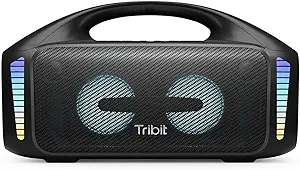
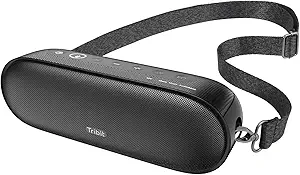
Philips vs Tribit: Overview
Comparing Philips and Tribit helps you determine which brand is best suited for your needs in Boomboxes. Both brands offer strong choices depending on your budget and key feature requirements.
Key Features & Comparison
Evaluate factors such as build quality, warranty, customer satisfaction, and total value before making your final purchase choice between Philips and Tribit.
Features
Philips boomboxes lean heavily into comprehensive physical format support, often incorporating top-loading CD/CD-R/RW players, integrated cassette recorders, and analog or digital radio tuners alongside basic Bluetooth streaming and auxiliary inputs. Many Philips units also feature USB playback ports for MP3 flash drives and headphone jacks for private listening. This extensive array of physical media slots makes Philips exceptionally versatile for users with legacy CD collections, audiobooks, or educational cassette tapes, providing tangible utility that modern pure-digital speakers simply do not offer.
Tribit shifts the feature paradigm entirely toward high-performance digital wireless technology and outdoor resilience. Instead of mechanical media bays, Tribit integrates advanced Bluetooth codecs (such as aptX or AAC), robust power bank functionality to charge external mobile devices, and multi-speaker linking ecosystems like Party Mode and Stereo Pairing. Furthermore, Tribit equips their devices with multi-band customizable EQ settings through proprietary mobile apps and certified IPX7 or IPX8 waterproofing. For modern digital streamers, Tribit’s focused feature set proves significantly more practical and resilient than Philips’ analog-centric approach.
Performance
Acoustic performance between the two brands reveals contrasting tuning philosophies and internal amplification power. Philips generally designs its boomboxes for balanced, room-filling vocal clarity at moderate volumes, incorporating proprietary Dynamic Bass Boost (DBB) circuitry to extract low-end warmth from relatively lightweight plastic enclosures. While mid-range performance on Philips units is exceptional for spoken word, radio broadcasts, and acoustic tracks, their internal amplifiers tend to show harmonic distortion when pushed to high volume thresholds, and their bass response rolls off sharply below mid-bass frequencies.
In contrast, Tribit engineers their boomboxes with a bass-forward, high-SPL (Sound Pressure Level) architecture powered by modern class-D amplification and proprietary XBass technology. Utilizing long-throw neodymium drivers paired with high-mass dual passive radiators, Tribit boomboxes produce visceral sub-bass and crisp, articulate highs that remain distortion-free even at maximum output levels. In open outdoor environments or bustling party settings, Tribit delivers vastly superior acoustic projection, deeper low-frequency extension, and substantially higher headroom compared to the comparatively polite, home-bound acoustic profile of Philips.
Design
The industrial design of Philips boomboxes adheres to the classic, handle-centric silhouette that defined the genre for decades. Built predominantly with lightweight ABS plastics, these units emphasize wide-format utility, featuring top-mounted mechanical buttons, LCD segment displays, and fold-down carrying handles. While this construction keeps the weight manageable for moving from room to room, the large footprints and unsealed plastic seams make Philips boomboxes susceptible to impact damage, dust accumulation, and liquid ingress, restricting their use primarily to indoor environments and dry patios.
Tribit abandons classic consumer-appliance styling in favor of high-impact, ruggedized industrial engineering designed for harsh real-world conditions. Featuring thick silicone shock absorbers, reinforced carry handles, heavy-duty metal or fabric grilles, and fully gasket-sealed ports, Tribit boomboxes are built to survive drops, sand, and complete water submersion. The ergonomic profile of a Tribit unit is significantly more compact, dense, and streamlined for transit in backpacks or vehicle trunks, making it substantially more durable and travel-friendly than Philips' larger, more fragile chassis.
Compare current retail pricing, active promotions, and verified stock availability directly from authorized stores: