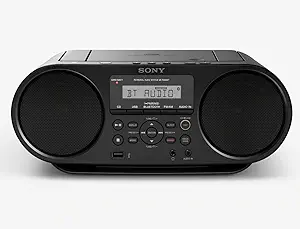
Sony vs Panasonic: Overview
Comparing Sony and Panasonic helps you determine which brand is best suited for your needs in Boomboxes. Both brands offer strong choices depending on your budget and key feature requirements.
Key Features & Comparison
Evaluate factors such as build quality, warranty, customer satisfaction, and total value before making your final purchase choice between Sony and Panasonic.
Features
In terms of feature integration, Sony regularly outperforms competitors by offering comprehensive hybrid configurations that bridge nostalgic analog media with contemporary digital formats. Most Sony boomboxes integrate CD players, legacy cassette tape decks, digital AM/FM tuners, USB playback/recording, and Bluetooth wireless streaming within a single chassis. Furthermore, Sony often includes audio-in auxiliary ports, dedicated headphone jacks, and advanced sleep-timer functions, making their units exceptionally versatile for diverse home and mobile environments. The integration of proprietary DSP processing, such as digital Mega Bass, allows users to instantly reshape their listening profile at the push of a dedicated button.
Panasonic takes a more focused, audiophile-adjacent approach to features, often emphasizing amplification power, digital radio standards, and clean physical media playback. While select Panasonic models retain CD and cassette mechanisms, the brand frequently prioritizes advanced Class-D digital amplifiers, DAB+ digital tuning capabilities, and direct USB connectivity engineered for uncompressed audio playback. Panasonic's feature set leans toward fine sound calibration, providing multi-band equalizers, vocal enhancement settings for spoken word or talk radio, and heavy-duty auxiliary inputs. Sony wins on broad, multi-format convenience, whereas Panasonic provides deeper utility for users seeking disciplined audio configuration and premium radio reception.
Performance
Sony's acoustic performance is defined by high energy, warmth, and an emphasis on sub-bass and mid-bass projection. Utilizing specialized bass reflex duct systems and proprietary sound enhancement circuitry, Sony boomboxes produce an impactful, resonant low-end that punches well above the physical limitations of portable enclosures. This tuning profile makes Sony units exceptionally well-suited for pop, hip-hop, electronic music, and outdoor listening where low frequencies typically dissipate rapidly. However, at extreme volumes, this low-end emphasis can occasionally cloud mid-range detail, leading to slightly recessed vocals and complex instrumental separation.
Panasonic focuses on acoustic transparency, low harmonic distortion, and articulate high-frequency response. By implementing tuned dual-cone or multi-way driver setups with rigid cones, Panasonic units achieve an articulate midrange that renders vocal tracks, acoustic instruments, and classical compositions with exceptional clarity. The bass delivery is tight, controlled, and fast, avoiding the boominess that sometimes plagues consumer audio gear. While Panasonic boomboxes might not deliver the visceral chest thump of Sony's bass-boosted hardware, they maintain greater sonic composure and linear fidelity at elevated volume levels, making them the superior acoustic choice for critical listeners.
Design
Sony adopts a sleek, ergonomic, and lifestyle-oriented design language across its boombox line. Characterized by rounded contours, textured matte-black plastics, integrated carry handles, and flush-mounted tactile controls, Sony units balance portability with an approachable, modern aesthetic. The control panels are organized with strong visual hierarchy, pairing high-contrast LCD screens with logically grouped buttons for effortless navigation in low-light conditions. Sony also pays meticulous attention to weight distribution, ensuring that portable battery operation does not compromise balance or mobility when using the integrated handle.
Panasonic's design ethos is distinctly utilitarian, industrial, and robust, echoing the rugged aesthetic of classic audio components. Featuring pronounced speaker grilles, sharp angles, and reinforced chassis corners, Panasonic boomboxes project durability and physical resilience. Control interfaces on Panasonic models often feature knurled rotary dials for volume and tuning, providing satisfying mechanical feedback that traditional audio enthusiasts appreciate over membrane buttons. While Sony's designs blend seamlessly into contemporary home decor with compact, lightweight profiles, Panasonic offers a more substantial, road-ready enclosure built to withstand years of rigorous physical use.