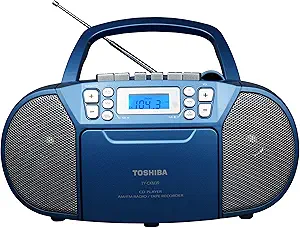
Philips vs TOSHIBA: Overview
Comparing Philips and TOSHIBA helps you determine which brand is best suited for your needs in Boomboxes. Both brands offer strong choices depending on your budget and key feature requirements.
Key Features & Comparison
Evaluate factors such as build quality, warranty, customer satisfaction, and total value before making your final purchase choice between Philips and TOSHIBA.
Features
In terms of feature sets, Toshiba stands out for its deliberate embrace of cross-generational audio formats. Many Toshiba boombox models continue to support top-loading cassette decks with record functionality alongside standard CD, CD-R/RW, and modern Bluetooth 5.0 streaming capabilities. Furthermore, Toshiba regularly incorporates auxiliary inputs, USB MP3 playback ports, and dual microphone inputs with dedicated volume and echo controls, effectively doubling several of their higher-tier models as portable PA or karaoke systems. This deep catalog of legacy and modern connectivity options ensures Toshiba devices cater to diverse audio collections.
Philips counters with a modern, streamlined feature portfolio that emphasizes ease of use, radio reception precision, and reliable disc reading. While Philips selectively offers cassette models, their primary emphasis lies on Bluetooth wireless pairing, pristine CD-DA and MP3-CD playback, and advanced digital FM tuning with extensive station presets. Philips frequently equips its boomboxes with proprietary Dynamic Bass Boost (DBB) circuitry and programmable track sequences, focusing on optimizing the playback of standard contemporary media rather than providing maximal input options. For buyers prioritizing streamlined digital playback and flawless radio reception, Philips delivers a more refined, low-friction user experience.
Performance
Acoustic performance reveals contrasting sound signatures and amplification philosophies between the two brands. Philips boomboxes are tuned with an emphasis on midrange clarity and vocal reproduction, making them especially adept for spoken word, news radio, podcasts, and acoustic music. The brand's integrated Dynamic Bass Boost functions by emphasizing low-end frequencies at lower volume levels to prevent bass loss, resulting in a warm, articulate, and fatigue-free listening experience that holds together well even when battery power begins to deplete.
Toshiba, on the other hand, engineers its systems for raw output and high-impact acoustic delivery. Many of Toshiba’s flagship boomboxes feature bi-amplified speaker configurations, horn tweeters, and passive bass radiators that push substantial air and generate noticeably higher decibel levels without immediate harmonic distortion. While the default frequency curve on lower-end Toshiba units can sometimes favor excessive treble or punchy upper bass at the expense of midrange nuance, their high-wattage amplifiers excel in noisy environments and outdoor spaces where Philips systems might struggle to maintain authority.
Design
From an industrial design standpoint, Philips relies on European consumer aesthetic sensibilities, characterized by curved, ergonomic profiles, matte plastic finishes, and minimalist control layouts. Philips boomboxes generally adopt soft oval or rounded rectangular silhouettes designed to blend smoothly into home decor, workshops, or kitchen countertops. The buttons are tactile and straightforward, accompanied by high-contrast LCD screens that provide clear track and station data without unnecessary visual clutter, reflecting a practical and durable everyday form factor.
Toshiba embraces a much bolder, utilitarian, and sometimes overtly vintage design language. Several models evoke the golden era of 1980s street boomboxes with sharp geometric edges, exposed chrome-accented speaker grilles, analog VU meters, and large physical toggle switches. Modern Toshiba party boomboxes adopt reinforced corner bumpers, robust carry handles, and integrated RGB LED speaker illumination designed for high visual engagement. Although this aesthetic can feel polarizing compared to the clean restraint of Philips, Toshiba’s structural housing often feels ruggedized and purpose-built for physical portability.