Panasonic vs Tribit: Overview
Comparing Panasonic and Tribit helps you determine which brand is best suited for your needs in Boomboxes. Both brands offer strong choices depending on your budget and key feature requirements.
Key Features & Comparison
Evaluate factors such as build quality, warranty, customer satisfaction, and total value before making your final purchase choice between Panasonic and Tribit.
Features
Panasonic's feature suite is deeply anchored in versatility and physical media support. Typical models in their boombox lineup include front-loading or top-loading CD players capable of reading MP3-encoded discs, analog AM/FM or digital DAB+ tuners with extensive preset allocations, and, in select units, dual or single cassette decks with recording capabilities. While they integrate modern conveniences such as Bluetooth pairing and USB playback, these are treated as complementary utilities rather than the core operational architecture. Panasonic units also frequently offer basic equalization presets, headphone outputs, and dual-power options (AC mains or multiple disposable D-cell batteries).
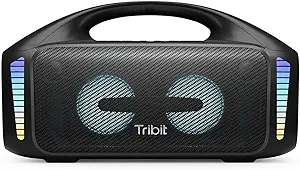
In contrast, Tribit strips away physical media mechanisms to focus purely on high-performance digital functionality. Centered around modern connectivity, Tribit devices feature advanced Bluetooth standards (frequently Bluetooth 5.0 or higher with high-definition codec support), true wireless stereo (TWS) pairing to synchronize multiple units, and power bank outputs capable of fast-charging external mobile devices via USB-C. Furthermore, Tribit leverages proprietary digital signal processing, programmable dynamic lighting arrays that sync to audio transients, and dedicated companion app integration offering granular multi-band equalizer adjustments that far exceed Panasonic's rigid, factory-tuned EQ profiles.
Performance
From an acoustic engineering perspective, Panasonic boomboxes are engineered around clean, mid-range vocal clarity and balanced acoustic dispersion suitable for indoor residential spaces. Because their acoustic cavities must share enclosure volume with mechanical drives and playback components, their physical drivers are generally smaller, often supplemented by simple bass reflex ports. This architecture delivers articulate speech, clean radio broadcasts, and pleasant acoustic playback, but it quickly encounters harmonic distortion and thermal compression when driven near maximum SPL (sound pressure level), particularly in lower frequency registers below 80 Hz.
Tribit shifts the performance paradigm by utilizing sealed, highly rigid enclosures dedicated exclusively to high-excursion dynamic drivers and dual opposing passive radiators. Driven by robust digital amplification capable of delivering significant dynamic headroom, Tribit boomboxes produce deep, authoritative sub-bass extension reaching well below 50 Hz, alongside bright, crisp high frequencies that cut through outdoor ambient noise. Tribit’s digital signal processing dynamically adjusts frequency response at higher volumes to mitigate clipping, allowing these units to sustain remarkably high output levels with minimal total harmonic distortion (THD), distinctly outperforming Panasonic in total volume, bass impact, and dynamic range.
Design
The design language of Panasonic boomboxes reflects traditional utilitarian aesthetics, characterized by lightweight ABS plastic enclosures, mechanical tactile switches, analog volume potentiometers, and integrated LCD segments for track and frequency monitoring. A substantial integrated top handle allows for room-to-room portability, but the chassis is primarily engineered for shelf placement and indoor stability. With numerous vents, unsealed drive bays, and physical ports, Panasonic units carry little to no ingress protection against water or particulate matter, necessitating careful indoor handling and protection from environmental exposure.
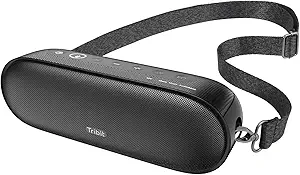
Tribit approaches industrial design from a perspective of rugged resilience and tactical utility, producing boomboxes that resemble modernized industrial field equipment. Their enclosures feature heavy-duty impact-resistant polymers, reinforced rubberized end-caps to absorb shock from drops, and sealed interfaces that achieve certified IPX7 or IPX8 water and dust resistance ratings. The integration of high-density lithium-ion battery packs gives Tribit units a reassuring heft and structural rigidity that eliminates internal rattles even at peak bass excursions. Additionally, ergonomic carrying straps and sealed silicone button interfaces make Tribit distinctly superior for hostile outdoor environments, poolside use, and rigorous travel.
Compare current retail pricing, active promotions, and verified stock availability directly from authorized stores: