Panasonic vs JBL: Overview
Comparing Panasonic and JBL helps you determine which brand is best suited for your needs in Boomboxes. Both brands offer strong choices depending on your budget and key feature requirements.
Key Features & Comparison
Evaluate factors such as build quality, warranty, customer satisfaction, and total value before making your final purchase choice between Panasonic and JBL.
Features
JBL’s feature set is ruthlessly focused on high-performance digital lifestyle use, deliberately stripping away legacy physical media in favor of wireless convenience and battery power. Most modern JBL boomboxes feature exceptionally large battery packs that not only deliver over 20 hours of playtime but also double as massive power banks via dual USB-A and USB-C output ports. Furthermore, JBL integrates its proprietary ecosystem technologies—such as PartyBoost and Auracast—allowing users to link dozens of compatible JBL speakers together in stereo or multi-room configurations. Customization is managed via the intuitive JBL Portable app, which provides direct access to granular multi-band EQ settings and dynamic bass management.
Panasonic takes a fundamentally different path, engineering its boomboxes to be functional media hubs capable of reading almost any consumer audio format. A typical Panasonic boombox includes a top-loading or front-loading compact disc player, high-precision FM/AM digital tuners, USB playback/recording slots, and in select models, full analog cassette playback mechanisms. While Panasonic models frequently incorporate Bluetooth, their wireless networking and companion app ecosystems are rudimentary compared to JBL’s robust digital architecture. Panasonic prioritizes legacy utility, allowing listeners to play their physical collections without an internet connection, whereas JBL focuses on mobile power, software optimization, and advanced wireless integration.
Performance
Acoustic performance between the two brands highlights JBL’s substantial advantage in dynamic range, low-end extension, and sheer acoustic volume. Modern JBL boomboxes utilize bi-amplified architectures powering dual dedicated woofers, dual tweeters, and heavy-stroke passive bass radiators. This technical configuration allows JBL to reproduce sub-bass frequencies as low as 40 Hz without significant port chuffing or distortion, even at extreme volume levels exceeding 95 dB SPL. Whether running on battery power or tethered to AC mains (which unlocks higher peak wattages), JBL speakers deliver a vibrant, bass-forward sound signature engineered to overcome open-air environmental noise effortlessly.
Panasonic crafts a more polite, mid-centric acoustic profile, tailored primarily for indoor acoustics, voice clarity, and general home listening. While some Panasonic models include proprietary bass-accentuation circuits like D.Bass or Beat Sonic, their internal enclosures and smaller drivers lack the displacement necessary to rival JBL’s visceral, room-shaking thump. At moderate volumes, Panasonic provides clear dialog, pleasant mid-range separation, and balanced vocal reproduction ideal for spoken-word radio or classic rock. However, when pushed toward their upper limits, Panasonic systems exhibit audible compression and distortion far earlier than JBL’s DSP-governed amplifiers, which maintain clarity even when pushed to maximum excursion.
Design
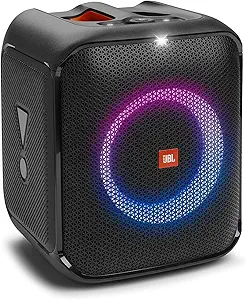
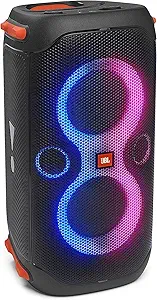
JBL's industrial design ethos is an exercise in extreme durability and rugged ergonomics. Emphasizing a modern cylindrical aesthetic crowned by an integrated, heavy-duty aluminum handle with silicone grip points, JBL boomboxes are purposefully over-engineered for outdoor punishment. They feature tightly woven acoustic fabric grilles, rubberized end-caps that absorb drops, and fully certified IP67 ingress ratings that ensure complete resistance against dust, sand, and submersion in water. The heavy footprint conveys solid engineering, and physical tactile buttons provide unmistakable feedback even when handled with wet or gloved hands.
Panasonic embraces a more classic, utilitarian aesthetic dominated by rigid molded plastics, geometric angles, and prominent LCD display screens. While Panasonic units often feature integrated carry handles, their housings are built primarily for indoor shelf use and lack ingress protection against water or impact damage. The control surfaces on Panasonic boomboxes are dense and button-rich, accommodating complex operations such as CD track programming, radio frequency tuning, and input switching directly on the unit. While JBL achieves an aggressive, contemporary, and indestructible silhouette, Panasonic presents a familiar, appliance-grade design focused on functional accessibility over rugged environmental protection.
Compare current retail pricing, active promotions, and verified stock availability directly from authorized stores: