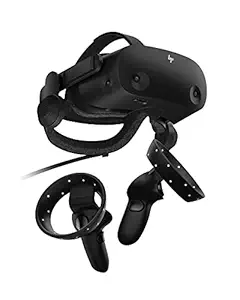
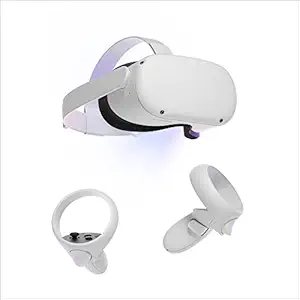
HP vs Meta Quest: Overview
Comparing HP and Meta Quest helps you determine which brand is best suited for your needs in VR Headsets. Both brands offer strong choices depending on your budget and key feature requirements.
Key Features & Comparison
Evaluate factors such as build quality, warranty, customer satisfaction, and total value before making your final purchase choice between HP and Meta Quest.
Features
Meta Quest holds a decisive advantage in modern software features and multimodal interaction. Devices such as the Quest 3 integrate full-color stereoscopic passthrough for mixed reality, dynamic hand tracking without controllers, spatial audio algorithms, and an expansive native app store that operates independently of any host PC. Furthermore, Meta provides flexible connectivity choices, allowing users to play standalone titles on the go or seamlessly tether wirelessly to high-performance gaming rigs via Air Link or dedicated Wi-Fi 6E bridges, alongside access to experimental features like generative AI integration and dynamic room meshing.
HP's feature set is far more specialized and centered on enterprise-grade sensory fidelity and desktop integration. Through variants like the HP Reverb G2 Omnicept Edition, HP introduced advanced biometric tracking features including integrated eye tracking, pupillometry, heart rate sensors, and lower-face movement tracking designed for clinical and training research. However, HP relies entirely on the Windows Mixed Reality and SteamVR platforms, which have seen dwindling software support and lack native standalone functionality, hand tracking capabilities, or practical mixed-reality passthrough.
Performance
Performance trade-offs between HP and Meta Quest center on raw graphical throughput versus compute agility. The HP Reverb series set an early benchmark for visual clarity by deploying high-resolution LCD panels (2160 x 2160 pixels per eye) directly connected via native DisplayPort. Because video signals transmit uncompressed straight from a dedicated PC graphics card, HP yields ultra-sharp image rendering with zero encoding artifacts and practically zero latency, which remains crucial for competitive sim racing and flight simulation where fine instrument legibility is paramount.
Meta Quest approaches performance through hybrid engineering, relying on mobile system-on-chip architectures like the Qualcomm Snapdragon XR2 Gen 2 paired with advanced pancake optics. While standalone compute is fundamentally constrained by mobile thermal limits, Quest matches or exceeds HP in overall edge-to-edge optical clarity due to superior pancake lens design over HP's traditional fresnel lenses. When connected to a PC, Meta uses video stream compression over USB-C or Wi-Fi, introducing minor encoding overhead and micro-latency, but compensating with superior tracking volume stability, higher native refresh rates up to 120Hz, and significantly broader tracking coverage via optimized camera arrays.
Design
In terms of industrial design, HP prioritized long-session ergonomic comfort and premium acoustic integration. Heavily borrowing from the Valve Index, the HP Reverb G2 features floating off-ear nearfield speakers that provide exceptional spatial acoustics without causing ear fatigue or heat buildup. The chassis utilizes a counterbalanced, padded strap system and facial gaskets optimized for long simulation sessions, though the headset remains fundamentally constrained by a heavy, rigid tether cable that restricts rotational movement and physical freedom.
Meta Quest focuses on modularity, self-containment, and sleek industrial minimalism. By utilizing slim pancake lenses, Meta drastically reduced the physical depth of the headset body, pulling the center of gravity closer to the user's face to reduce neck strain during dynamic physical gaming. While the stock cloth headstrap on standard Quest models often necessitates third-party or Elite strap upgrades for optimal comfort, the completely wireless, cable-free form factor offers an unrivaled degree of physical freedom and spatial presence that traditional tethered headsets like HP cannot match.
Compare current retail pricing, active promotions, and verified stock availability directly from authorized stores: