

Lenovo vs Amazon: Overview
Comparing Lenovo and Amazon helps you determine which brand is best suited for your needs in Tablets. Both brands offer strong choices depending on your budget and key feature requirements.
Key Features & Comparison
Evaluate factors such as build quality, warranty, customer satisfaction, and total value before making your final purchase choice between Lenovo and Amazon.
Affordability
When examining pure upfront cost, Amazon dominates the entry-level tablet space by leveraging a hardware-as-a-service business model. Devices in the Fire lineup are engineered to be remarkably cheap, frequently sold near or at cost to funnel users into the broader Amazon Prime, Kindle, and digital media ecosystem. Even Amazon's top-tier Fire Max 11 is positioned well below conventional flagship pricing, making it an extraordinary value proposition for buyers prioritizing media consumption without significant financial investment. However, this lower price ceiling comes with trade-offs, such as lock-screen advertisements on baseline models unless users pay an opt-out fee, and structural compromises like plastic chassis designs.
Lenovo approaches affordability through a more traditional consumer hardware lens, offering an expansive portfolio that ranges from ultra-budget Tab M models to high-end Tab P series devices. While Lenovo's entry-tier offerings sit at a slightly higher price point than equivalent Fire tablets, they provide substantially better long-term hardware value by running standard Android without mandatory ad subsidies or closed ecosystem constraints. Shoppers investing in Lenovo benefit from metal enclosures, broader accessory integration, and access to the complete Google Play store natively, delivering superior flexibility and total cost-of-ownership value for users wanting an open operating environment rather than a branded content portal.
Battery Life
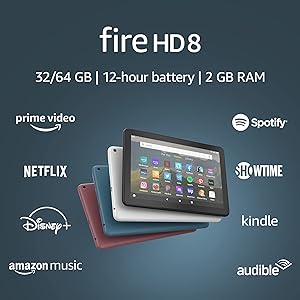
Amazon excels in energy efficiency largely due to its tightly controlled, lightweight operating environment and conservative hardware specifications. Fire OS is optimized around specific, low-demand tasks like streaming video, reading e-books, and browsing, allowing devices like the Fire HD 8 and Fire HD 10 to comfortably reach between 12 to 14 hours of continuous usage. By utilizing power-efficient, lower-clocked processors and aggressive background task management, Amazon tablets minimize standby battery drain, making them exceptionally reliable for travelers or casual users who might leave the device idle for days between charges.
Lenovo tablets, conversely, emphasize battery longevity through larger physical cell capacities paired with sophisticated power management software. Many of Lenovo's mid-range and premium tablets, such as the Tab P11 and P12 series, feature substantial batteries rated for 10 to 12 hours of mixed productivity and multimedia consumption. While intensive tasks like multitasking, running productivity apps, and driving high-refresh-rate displays draw more power than Amazon's conservative setups, Lenovo compensates with superior charging speeds. Many Lenovo models support 20W to 30W fast charging via USB-PD protocols, replenishing large capacities far more rapidly than Amazon's typically slower, bundled charging bricks.
Display
Amazon prioritizes functional durability and adequate visual fidelity across its tablet lineup, outfitting its Fire HD and Fire Max models with standard IPS LCD panels. These screens offer decent viewing angles and acceptable color calibration for casual streaming via Prime Video or Netflix, with resolutions capping out at 2K on the Fire Max 11. However, Amazon generally tunes its displays for cost efficiency rather than critical color accuracy, often resulting in lower peak brightness levels, standard 60Hz refresh rates, and thick protective bezels that can feel dated compared to contemporary design standards.
Lenovo sets a significantly higher benchmark in display engineering, treating visual quality as a primary selling point across multiple tiers. Even mid-range Lenovo tablets regularly feature high-resolution 2K or 2.5K panels, and higher-end configurations incorporate premium OLED displays featuring HDR10+ and Dolby Vision support. Furthermore, Lenovo frequently integrates fluid 90Hz or 120Hz refresh rates, delivering substantially smoother animations, better pen-tracking latency for styluses, and superior brightness levels suitable for varied ambient lighting conditions. For users who prioritize deep black levels, cinematic color reproduction, and modern screen-to-body ratios, Lenovo holds an undeniable advantage.
Performance
Amazon equips its Fire tablets with modest MediaTek system-on-chips (SoCs) and conservative RAM allocations (typically ranging from 2GB to 4GB). This hardware architecture is strictly tailored to execute Fire OS tasks—such as launching Kindle books, streaming video, and running lightweight casual games—without severe stuttering. However, attempting to push these devices beyond their intended scope reveals pronounced bottlenecks: background apps are quickly flushed from memory, UI navigation can hitch under load, and the absence of native Google Mobile Services restricts access to performance-demanding Android applications and sophisticated productivity suites.
Lenovo designs its hardware for versatile, multi-threaded workloads, utilizing a broader spectrum of capable processors from Qualcomm's Snapdragon family and higher-tier MediaTek chipsets. Backed by up to 8GB of RAM on select models, Lenovo tablets excel in split-screen multitasking, gaming, and productivity workflows via Lenovo's dedicated PC-like desktop mode. Because Lenovo devices run full Android with complete Google Play certification, users can run advanced office suites, digital art software, and demanding games without artificial software constraints, rendering Lenovo the clear winner for sustained performance and operational versatility.