Klipsch vs Elac: Overview
Comparing Klipsch and Elac helps you determine which brand is best suited for your needs in Subwoofers. Both brands offer strong choices depending on your budget and key feature requirements.
Key Features & Comparison
Evaluate factors such as build quality, warranty, customer satisfaction, and total value before making your final purchase choice between Klipsch and Elac.
Design/Look
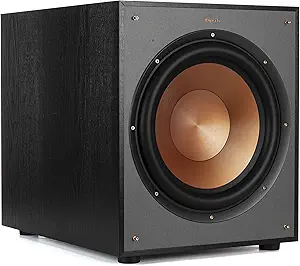
Klipsch subwoofers are celebrated for their bold, unmistakable industrial aesthetic, anchored by their signature spun-copper Cerametallic or thermoformed crystalline polymer (TCP) driver cones. Housed in robust MDF cabinets with textured, scratch-resistant wood-grain vinyl finishes, Klipsch subwoofers demand attention in a room rather than attempting to blend in. The contrast between the deep black cabinetry and the luminous metallic woofer imparts an aggressive, high-energy presence that resonates particularly well in dedicated home theater environments. Contemporary models often feature low-profile magnetic grilles, front-firing aerodynamic ports, and discreet rear-panel amplifier plates that balance aggressive front-facing styling with practical, utilitarian design choices.
Conversely, ELAC approaches subwoofer design with a minimalist, European-inspired sensibility that emphasizes understated elegance and seamless interior integration. ELAC cabinets typically feature clean, geometric lines wrapped in sophisticated matte finishes, subtle brushed vinyl, or elegant satin lacquers that avoid visual clutter. Rather than highlighting oversized metallic drivers, ELAC often conceals its acoustic hardware behind flush fabric grilles or utilizes down-firing passive radiators and dual-opposed driver configurations to maintain a compact, furniture-friendly footprint. The result is a refined, low-profile enclosure that integrates effortlessly into contemporary living spaces, appealing to users who prefer high-performance audio hardware that complements room decor rather than dominating it.
Affordability
Klipsch holds a dominant position in the mainstream consumer market largely due to its broad manufacturing scale and aggressive promotional pricing strategy. While flagship lines such as the Reference Premiere series are priced in the mid-to-high tier, the brand regularly offers steep discounts on its standard Reference and legacy product lines. This pricing agility makes high-output Klipsch subwoofers accessible at entry-level price points, giving cost-conscious buyers exceptional cone area and raw wattage per dollar spent. For shoppers seeking the largest possible ported enclosure and maximum output without stretching their budget, Klipsch offers a historically low barrier to entry in the powered subwoofer sector.
ELAC subwoofers generally occupy a more structured, mid-range pricing tier that reflects their advanced onboard processing rather than pure raw driver size. While entry-level ELAC models are competitively priced against Klipsch, ELAC’s primary value proposition centers on integrated digital technology, specifically proprietary Auto EQ and Bluetooth-controlled DSP tuning found in models like the Varro series. Consequently, buyers often pay a slight premium per watt or per inch of driver displacement compared to discounted Klipsch alternatives, but they receive significant technological value through automated acoustic room calibration and fine-grain mobile app control, eliminating the need to purchase external sound management equipment.
Reputation
Klipsch commands immense brand equity rooted in decades of American audio heritage, tracing back to Paul W. Klipsch's pioneering horn-loaded speaker architectures. In the subwoofer domain, Klipsch has earned a formidable reputation as an undisputed powerhouse for dynamic home theater playback, celebrated for sheer acoustic pressure, visceral impact, and explosive low-frequency transients. The enthusiast community frequently lauds Klipsch for its reliability, expansive distribution, and the ability of its higher-end Reference Premiere series to energize large cinematic spaces. However, among strict audiophiles, older entry-level Klipsch subwoofers historically faced criticism for sounding slightly boomy, a legacy reputation the brand has aggressively remedied with its latest, highly linear acoustic platforms.
ELAC, guided in recent decades by prominent acoustic engineers such as Andrew Jones, enjoys a sterling reputation anchored in precision acoustic engineering and audiophile-grade fidelity. The brand is widely respected for prioritizing sonic neutrality, structural damping, and scientific acoustic methodologies over marketing flamboyance. In the subwoofer arena, ELAC is especially revered for introducing sophisticated digital signal processing and accessible room-correction software to mainstream consumers long before it was standard practice. Audiophiles and home theater connoisseurs view ELAC as an intelligent, high-fidelity brand that reliably delivers refined performance and excellent build standards tailored to critical listening.
Sound Quality
Klipsch subwoofers are engineered primarily for massive dynamic range, high acoustic sensitivity, and visceral tactile impact, making them world-class contenders for cinematic action sequences and bass-heavy tracks. Utilizing high-efficiency Class D amplifiers paired with rigid, lightweight copper-infused cones, Klipsch units excel at delivering explosive transients with negligible distortion even at high sound pressure levels (SPL). The ported architectures prominent across Klipsch lineups emphasize extension in the 20 Hz to 40 Hz threshold, yielding the room-shaking physical slam coveted by movie enthusiasts. While modern revisions exhibit impressive musical control, the fundamental acoustic profile remains forward, punchy, and intensely authoritative.
ELAC subwoofers prioritize acoustic accuracy, speed, and tight, articulate pitch definition, appealing strongly to music purists and balanced home theater systems. Often deploying sealed enclosures or carefully damped dual-passive radiator arrays, ELAC designs effectively minimize group delay, overhang, and port turbulence. This results in a bass signature that is exceptionally clean, textured, and linear across the frequency band. Furthermore, ELAC's onboard digital signal processing and mobile-app-driven Auto EQ allow the subwoofer to automatically correct for standing waves and room boundary reflections, delivering a well-integrated, taut low-frequency response that blends seamlessly with main speakers rather than overpowering them.