Arlo vs Annke: Overview
Comparing Arlo and Annke helps you determine which brand is best suited for your needs in Security Cameras. Both brands offer strong choices depending on your budget and key feature requirements.
Key Features & Comparison
Evaluate factors such as build quality, warranty, customer satisfaction, and total value before making your final purchase choice between Arlo and Annke.
Picture Quality
When evaluating picture quality, Arlo and Annke approach image fidelity from fundamentally different engineering philosophies. Arlo optimizes its hardware for consumer ease and dynamic environmental adjustment, featuring flagship devices like the Arlo Ultra 2 that capture video in native 4K with advanced High Dynamic Range (HDR). Arlo’s digital signal processing (DSP) enhances dynamic contrast, ensuring shadow details are recovered in high-contrast outdoor environments. Additionally, Arlo integrates onboard color night vision powered by integrated motion-activated LED spotlights. While effective at illuminating immediate subjects, this setup relies heavily on digital gain in complete darkness, which can introduce compression artifacts and noise when transmitting over Wi-Fi bands.
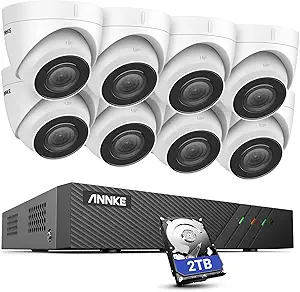
Conversely, Annke leverages commercial-grade surveillance hardware, often employing larger physical sensors such as those found in its NightChroma series with f/1.0 super apertures. Because Annke predominantly utilizes Power over Ethernet (PoE) architectures, its cameras can stream uncompressed or minimally compressed 4K feeds at high bitrates without the bandwidth bottlenecks typical of battery-operated Wi-Fi cameras. The substantial light-gathering capability of Annke's optics delivers true, ambient-light color night vision without necessarily relying on harsh supplementary spotlights. For forensic detail, such as reading distant license plates or capturing facial details across an expansive yard, Annke's optical engineering and superior bitrate deliver a demonstrably sharper, less artifact-laden image.
Smart Features & Connectivity
Arlo excels in smart home ecosystem integration and user-centric intelligent processing. Operating primarily via cloud-based algorithms, Arlo’s platform provides granular edge detection categorized into people, vehicles, animals, and package delivery. Its ecosystem integrates seamlessly with major automation platforms, including Amazon Alexa, Google Assistant, Apple HomeKit, and IFTTT. The primary trade-off stems from its wireless connectivity; while dual-band Wi-Fi and proprietary SmartHubs provide streamlined installation and extended transmission ranges, real-time alerting is subject to latency spikes dictated by residential internet speeds and battery-preservation sleep cycles.
Annke approaches connectivity and smart features from a localized, professional surveillance stance. Most Annke systems utilize wired PoE or traditional analog BNC connections routed through a Network Video Recorder (NVR), offering virtually zero transmission latency and uninterrupted continuous recording. Modern Annke systems incorporate advanced AcuSense or deep-learning perimeter algorithms to classify humans and vehicles directly on the hardware or the NVR, bypassing cloud latency. However, Annke’s smart home compatibility is limited compared to Arlo, often requiring complex RTSP or ONVIF protocols to interface with platforms like Home Assistant, making it far less intuitive for consumers seeking a plug-and-play experience.
Privacy & Data Control
Privacy architecture represents one of the starkest divergences between these two brands. Arlo implements an enterprise-grade cloud security posture designed to satisfy international consumer privacy regulations, incorporating end-to-end encryption (E2EE) on select hardware alongside strict two-factor authentication (2FA). However, because the core value proposition of an Arlo camera is tied to cloud recording and remote offsite analysis, users must entrust video telemetry and data streams to Arlo's centralized servers. For individuals wary of cloud vulnerabilities or third-party server exposure, this reliance presents an inherent trade-off despite Arlo's robust compliance frameworks.
Annke, by contrast, gives absolute data ownership back to the end user by anchoring its architecture to local storage. By utilizing local NVRs, micro-SD cards, or direct Network Attached Storage (NAS) configurations, your surveillance streams never need to leave your local area network (LAN). Advanced users can completely isolate Annke PoE cameras from the public internet using VLANs, entirely eliminating exposure to external data breaches or vendor-side data leaks. The burden of security, however, shifts to the consumer; maintaining firewall rules, applying firmware updates manually, and securing local passwords are required to ensure the system remains safe from network-level exploits.
Subscription Plans
The long-term total cost of ownership between Arlo and Annke is heavily shaped by their respective monetization models. Arlo utilizes a recurring Software-as-a-Service (SaaS) model through its Arlo Secure plans. Without an active subscription, most modern Arlo cameras are functionally hobbled, losing critical features such as cloud-based video history, rich push notifications with preview snapshots, and intelligent AI object detection. While this recurring fee funds continuous cloud server upkeep, AI model refinement, and convenience features, it represents a permanent recurring operating cost that substantially increases the total hardware investment over a multi-year deployment.
Annke stands in sharp contrast by championing a subscription-free model. All core functionalities—including 24/7 continuous recording, high-resolution playback, and local smart detection analytics—are fully functional out of the box with zero ongoing fees. The trade-off is an upfront capital expenditure for the camera units, an NVR, and high-endurance surveillance hard drives, alongside the manual labor required to run physical cabling. For consumers and businesses prioritizing predictability and long-term cost efficiency, Annke’s no-subscription policy offers superior financial scalability compared to Arlo’s per-device or multi-camera cloud subscription tiers.