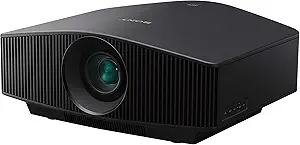
Sony vs Optoma: Overview
Comparing Sony and Optoma helps you determine which brand is best suited for your needs in Projectors. Both brands offer strong choices depending on your budget and key feature requirements.
Key Features & Comparison
Evaluate factors such as build quality, warranty, customer satisfaction, and total value before making your final purchase choice between Sony and Optoma.
Product Selection
When evaluating product selection, Sony and Optoma approach the projector market from distinctly different strategic angles. Sony focuses heavily on the high-end consumer and commercial projection spaces, targeting dedicated home theater connoisseurs, professional AV installations, and large-venue simulation. The core of Sony's domestic lineup revolves around its premium BRAVIA and SXRD home theater projectors, accompanied by commercial laser installations. Consequently, Sony's catalog is intentionally curated rather than expansive, deliberately avoiding entry-level portable units or budget living room projectors to maintain its elite brand positioning.
In contrast, Optoma offers one of the most comprehensive and diverse projector catalogs in the global consumer electronics industry. Utilizing primarily Texas Instruments DLP technology, Optoma covers nearly every conceivable use case, spanning budget-friendly 1080p entertainment units, high-refresh-rate 4K gaming projectors, ultra-short-throw (UST) living room laser displays, portable battery-powered projectors, and enterprise-grade installation hardware. This broad spectrum allows Optoma to cater directly to general consumers, competitive gamers seeking low input lag, and commercial educators alike, giving them a significant advantage in sheer versatility and audience reach.
Affordability
Affordability represents one of the starkest differentiators between these two manufacturers. Sony operates exclusively as a luxury, high-tier brand in projection, with entry prices for their native 4K SXRD models routinely starting in the mid-thousands of dollars and climbing steeply into five-figure sums for flagship laser models. While Sony justifies these prices with cutting-edge proprietary silicone and unmatched processing, the barrier to entry is exceptionally high. For the average consumer or someone setting up a casual living room projection setup, Sony is almost entirely out of reach financially.
Optoma, on the other hand, dominates the entry-level to mid-tier price brackets, making large-format projection accessible to mainstream buyers. By leveraging pixel-shifting DLP micro-mirror chips, Optoma delivers compelling 4K UHD resolutions at price points that are often a fraction of Sony’s base models. Furthermore, Optoma offers a vast spectrum of lamp-based and cost-effective solid-state laser options under $1,000 to $3,000, presenting high lumen output per dollar spent. For shoppers balancing performance against a realistic budget, Optoma is practically unmatched in value proposition.
Quality/Durability
In terms of build quality and mechanical durability, Sony projectors represent the gold standard of premium engineering. Housing bespoke optical assemblies, heavy-duty cooling channels, and proprietary Silicon X-tal Reflective Display (SXRD) liquid crystal panels, Sony chassis are robust, whisper-quiet, and meticulously calibrated from the factory. Sony's transition to long-life Z-Phosphor laser light sources across its modern portfolio guarantees up to 20,000 hours of near-maintenance-free operation with exceptional thermal management that shields delicate polarization filters from heat degradation.
Optoma relies primarily on single-chip DLP architecture, which is inherently resilient against dust and optical misalignment due to sealed optical light engines and the mechanical durability of Digital Micromirror Devices (DMDs). While high-end Optoma models feature robust aluminum or reinforced polycarbonate housings, their budget-friendly and gaming-oriented units incorporate lighter plastics and louder cooling fans, reflecting cost-saving compromises. Optoma's laser units also offer competitive 20,000 to 30,000-hour lifespans, but long-term electronic and color wheel stability can occasionally be less consistent than Sony’s reference-grade industrial design.
Customer Support & Warranty
Customer support and warranty structures reflect each company's target market demographics. Sony provides exceptional post-purchase support tailored to the custom install (CI) and luxury markets. Sony premium home theater projectors typically include a robust 3-year limited warranty, frequently backed by advanced exchange programs or direct integration support through certified AV dealers and custom integrators. This white-glove approach minimizes client downtime, providing dedicated technical lines and highly qualified service centers skilled in precise optical realignment and firmware diagnostics.
Optoma’s warranty coverage generally spans 1 to 3 years depending on the tier, often with separate, dedicated warranties on light sources such as laser diodes or traditional lamps. While Optoma offers standard RMA repair processes and responsive web-based ticketing, customer experiences can be more utilitarian compared to Sony's boutique service. Turnaround times for warranty servicing at regional Optoma facilities can vary, and consumers navigating entry-level warranty claims often handle troubleshooting and shipping arrangements through standard commercial channels without dedicated concierge support.
Picture Quality
Picture quality is the arena where Sony truly establishes its masterclass status, universally lauded for producing true cinematic excellence. Because Sony utilizes native 4K SXRD three-chip panels, there is zero color breakup or rainbow effect, and color alignment is pristine. Coupled with the proprietary 'X1 for projector' or 'XR Processor', Sony delivers class-leading dynamic tone mapping, precise motion interpolation, and extraordinary native contrast. Deep, inky blacks, nuanced shadow detail, and true-to-source cinematic colors make Sony projectors the preferred choice for light-controlled, dedicated theater rooms.
Optoma excels at high brightness, sharpness, and vibrant color dynamics tailored to mixed-use or ambient-light environments. Most modern Optoma 4K models achieve resolution via Texas Instruments' fast-switching XPR technology, which produces an image with razor-sharp single-pixel clarity that rivals or sometimes perceptually exceeds native 4K in static text. However, single-chip DLP setups can present visible rainbow artifacts to sensitive viewers, and native black levels rarely match Sony's deep contrast thresholds. Nevertheless, for HDR punchiness, ambient-light rejection, and gaming fluidity, Optoma provides an energetic, visually impressive image.