







Skytech vs Thermaltake: Overview
Comparing Skytech and Thermaltake helps you determine which brand is best suited for your needs in Prebuilt PC. Both brands offer strong choices depending on your budget and key feature requirements.
Key Features & Comparison
Evaluate factors such as build quality, warranty, customer satisfaction, and total value before making your final purchase choice between Skytech and Thermaltake.
Features
Thermaltake holds an inherent advantage regarding component-level features because the company manufactures many of the critical subsystems that define a PC's peripheral capabilities. Their prebuilt lines, such as the Reactor, LCGS, and Glacier series, routinely feature high-end closed-loop or fully open-loop liquid cooling configurations with thick radiators, premium magnetic levitation or hydraulic bearing fans, and gold-rated power supplies with high wattage ceilings. Software integration is another strong point for Thermaltake, as their TT RGB PLUS ecosystem allows deep synchronization of thermal telemetry, lighting arrays, and fan speed curves through a singular, dedicated interface, providing advanced control directly out of the box.
Skytech counters this by leaning into flexibility and unadorned standard component integration. Instead of utilizing proprietary controllers, Skytech typically utilizes industry-standard 3-pin ARGB headers connected directly to the motherboard, giving users the freedom to control lighting via Asus Aura Sync, MSI Mystic Light, or Gigabyte RGB Fusion. While Skytech's feature set often sticks to the fundamentals—such as standard Wi-Fi configurations, baseline I/O port selections, and mainstream AIO coolers on upper-tier SKUs—they rarely use customized, non-standard form factors. This open-standard methodology ensures that modifying the feature set down the line, such as expanding storage across multiple M.2 NVMe slots or swapping out networking cards, is completely unrestricted by proprietary chassis cages or bespoke wiring looms.
Performance
From a sustained computational throughput perspective, Skytech matches CPU and GPU tiers very aggressively against current market pricing. A buyer can often secure an Nvidia GeForce RTX 4080 or 4090 paired with an Intel Core i7/i9 or AMD Ryzen 7/9 in a Skytech build for substantially less capital outlay than a similarly equipped system from boutique builders. Skytech's tuning typically relies on stock motherboard power limits, which delivers standard multi-core rendering and high frame-rate gaming performance. However, because Skytech utilizes a rotating mix of OEM and partner components (varying between brands like PNY, Zotac, or Gigabyte depending on supply chain allocations), real-world acoustic profiles and peak GPU boost clock thermals can vary slightly across identical SKU lines.
Thermaltake demonstrates its engineering excellence in thermal dissipation and operational stability under heavy sustained loads. By utilizing advanced liquid-cooling architectures—including thick 240mm to 360mm radiators and high-static-pressure fans—Thermaltake systems sustain peak turbo boost clocks for extended durations without thermal throttling. Their component selection minimizes power ripple and transient-load drops through the use of their own high-efficiency Toughpower units, allowing for superior system stability during grueling rendering tasks or intense, long-duration 4K gaming sessions. While you may pay a premium for the underlying silicon compared to Skytech, Thermaltake’s performance envelope is characterized by quieter acoustic operation and rock-solid thermal control under extreme stress.
Design
Thermaltake’s design language is visually striking, architectural, and deeply rooted in contemporary enthusiast PC trends. Utilizing their own catalog of cases, such as the open-frame Core series, the panoramic view Tower series, or the micro-ATX Ah T200, Thermaltake systems double as high-tech centerpieces. The incorporation of heavy-gauge SPCC steel, modular panels, thick tempered glass, and meticulously routed custom soft-tubing or hard-tubing makes their prebuilts visually indistinguishable from custom-commissioned workshop rigs. Internal cable management is executed with immense discipline, utilizing dedicated routing channels, velcro straps, and concealed power supply shrouds that optimize internal air pathways while maintaining gallery-level aesthetics.
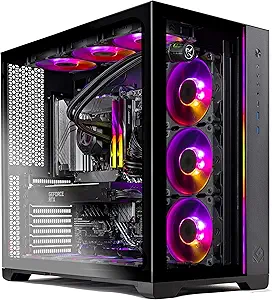
Skytech embraces a cleaner, more conventional mid-tower aesthetic that focuses on functional elegance. Models like the Chronos, Prism, and Azure incorporate modern glass-faced and mesh-front designs that facilitate direct airflow over the graphics card and processor intake areas. While Skytech's cable management is clean and professionally bundled, it lacks the custom-sleeve detailing and structural rigidity seen in Thermaltake’s specialized enclosures. Skytech focuses on accessible utility: their chassis are easy to open with tool-free thumb screws, internal bays are easy to navigate for non-technical users, and the lighting displays an engaging, vibrant look without requiring the structural bulk or heavy footprint typical of Thermaltake’s showcase chassis.