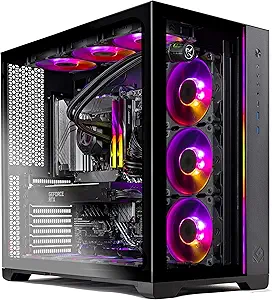






Omen vs Skytech: Overview
Comparing Omen and Skytech helps you determine which brand is best suited for your needs in Prebuilt PC. Both brands offer strong choices depending on your budget and key feature requirements.
Key Features & Comparison
Evaluate factors such as build quality, warranty, customer satisfaction, and total value before making your final purchase choice between Omen and Skytech.
Features
HP Omen sets itself apart through a mature, cohesive software and hardware ecosystem, anchored primarily by the Omen Gaming Hub. This unified software suite offers granular control over system telemetry, integrated fan curves, customizable RGB lighting, network boosting, and accessible automated undervolting/overclocking routines. Furthermore, higher-end Omen chassis often incorporate unique mechanical features, such as the patented Cryo Chamber—an isolated cooling bay that draws ambient air directly into the liquid cooling radiator. However, Omen falls short in internal flexibility; HP frequently utilizes proprietary motherboards, bespoke power supplies, and restricted BIOS interfaces that limit memory speed tuning and third-party component swaps.
Skytech counters with a purist approach centered on modularity, transparency, and standard ATX componentry. Every Skytech machine is built using retail-grade parts, meaning the motherboard, power supply, RAM, and liquid coolers conform to universal industry form factors without locked-down firmware. While Skytech lacks a proprietary, all-encompassing software suite like Omen’s—often requiring users to juggle disparate third-party utilities for RGB and peripheral control—it compensates by providing unmatched hardware transparency. Consumers know the exact specification of their components, benefit from unlocked motherboard BIOS environments for precise XMP/EXPO profiles, and face zero barriers when upgrading individual parts in the future.
Performance
In real-world gaming and compute benchmarks, both brands deliver raw horsepower aligned with their underlying CPU and GPU configurations, yet they differ in how they sustain those peak clock speeds. HP Omen engineers its cooling envelopes meticulously within its custom chassis, yielding solid thermal and acoustic performance on mid-tier builds. However, on flagship configurations pushing top-tier Intel Core i9 or AMD Ryzen 9 processors alongside high-wattage GPUs, Omen’s reliance on compact liquid loops and specialized chassis baffling can lead to thermal saturation and fan ramp-up under prolonged multi-threaded workloads, resulting in mild thermal throttling to maintain acoustic targets.
Skytech systems often achieve more sustained peak performance during extended gaming and rendering sessions due to their use of high-airflow, standard retail cases equipped with expansive mesh front panels and full-sized 240mm or 360mm AIO liquid coolers. Because Skytech pairs high-end silicon with robust, retail-grade motherboards featuring unthrottled power stages (VRMs), the processors can draw their maximum rated wattage for longer durations. Additionally, the unlocked BIOS on Skytech motherboards ensures memory runs at full rated speeds with tighter secondary timings, often squeezing a noticeable 3% to 8% frame-rate advantage over OEM systems that occasionally restrict sub-timings or memory voltages for system stability.
Design
The aesthetic identity of HP Omen leans heavily toward sophisticated, monolithic minimalism, making it one of the few gaming desktops that effortlessly fits into a professional home office. Featuring clean geometric lines, diamond-cut silhouettes, tinted tempered glass, and a subdued matte-black or ceramic-white finish, Omen’s industrial design is cohesive and refined. Cable management is tightly managed within internal channels tailored specifically to the chassis layout. The physical engineering prioritizes acoustic dampening and controlled airflow channels, though the high density of internal components can make manual servicing slightly cramped.
Skytech embraces the overt, high-energy gaming aesthetic that dominates the enthusiast community, leaning into panoramic dual-chamber designs, high-airflow mesh fronts, and vibrant ARGB illumination across multiple intake and exhaust fans. While their chassis designs are sourced from third-party case manufacturers rather than developed in-house, this grants Skytech the agility to adopt current market trends quickly, such as aquarium-style glass enclosures and dual-zone cooling layouts. Cable management quality can vary slightly from build to build due to assembly-line human factors, but the spacious interior makes routing, cleaning, and maintenance substantially easier than in Omen’s tightly tailored enclosures.
Compare current retail pricing, active promotions, and verified stock availability directly from authorized stores: