Lenovo vs Thermaltake: Overview
Comparing Lenovo and Thermaltake helps you determine which brand is best suited for your needs in Prebuilt PC. Both brands offer strong choices depending on your budget and key feature requirements.
Key Features & Comparison
Evaluate factors such as build quality, warranty, customer satisfaction, and total value before making your final purchase choice between Lenovo and Thermaltake.
Features
The feature sets of Lenovo and Thermaltake reveal opposing strategies regarding proprietary integration versus open-platform modularity. Lenovo equips its Legion prebuilts with proprietary software suites like Lenovo Vantage, which offers intuitive, user-friendly control over system diagnostics, automatic driver updates, network priority routing, and basic overclocking profiles. Lenovo also integrates tailored hardware features such as custom-molded internal fan shrouds, optional integrated carry handles on compact models, and specialized thermal venting. However, Lenovo machines frequently utilize custom motherboards with non-standard front-panel connectors or OEM-specific power supply configurations, which severely curtails post-purchase motherboard or chassis swaps.
Thermaltake counters this with exceptional component transparency and retail-grade versatility. Every Thermaltake prebuilt features brand-name motherboards from partners like ASUS, MSI, or Gigabyte, alongside Thermaltake’s own retail-grade power supplies, RAM, and liquid coolers. This open architecture means users are not locked into a closed software ecosystem; lighting and performance profiles can be controlled via universal RGB ecosystems (such as ASUS Aura Sync or Razer Chroma) or Thermaltake’s proprietary TT RGB PLUS software. Furthermore, Thermaltake systems often boast advanced hardware features rarely seen on mass-market systems, such as open-frame chassis variants, rotatable PCIe expansion slots, and premium tempered-glass paneling with quick-release mechanisms, providing superior tactile functionality for hardware enthusiasts.
Performance
Performance metrics between the two brands reflect divergent priorities in thermal management and silicon configuration. Lenovo constructs its Legion systems to extract reliable, sustained performance from modern multi-core CPUs and high-TDP GPUs while keeping noise levels and power draws well within safe operating envelopes. Lenovo's Coldfront cooling architecture employs specialized heatsinks and high-blade-count fans that perform admirably under standard gaming workloads. However, because Lenovo uses custom OEM graphics cards and compact motherboard VRM heatsinks on lower-to-mid-tier models, thermal headroom can be constrained under extreme, continuous synthetic loads, occasionally leading to conservative factory power limits that leave a small percentage of potential performance on the table.
Thermaltake, leveraging its extensive heritage in thermal engineering, typically delivers superior sustained performance and higher overclocking headroom. By outfitting many of their prebuilts with large all-in-one (AIO) liquid coolers—or even custom hard-tube open loops in their ultra-high-end configurations—Thermaltake keeps CPU temperatures exceptionally low even under punishing multithreaded workloads. The use of high-airflow retail cases and premium retail GPUs with robust triple-fan coolers ensures that boost clocks remain pinned at their maximum frequencies without thermal throttling. For users running sustained 4K gaming sessions, rendering pipelines, or heavy compute tasks, Thermaltake’s aggressive cooling solutions translate into measurably better long-term acoustic and thermal performance.
Design
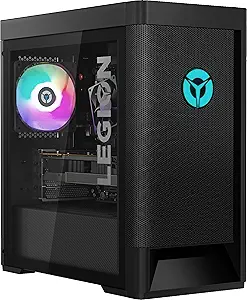
From an aesthetic and industrial design standpoint, Lenovo adopts a sleek, understated approach that bridges the gap between a gaming battlestation and an executive workstation. Legion desktops typically feature matte black or storm grey minimalist chassis accented by clean phantom blue or RGB lighting behind subtle front mesh grilles. The visual language is refined and cohesive, avoiding excessive industrial ostentation in favor of clean lines and practical footprint sizes that easily fit into office environments or compact desks. Internally, Lenovo’s cable management is clean and functional, utilizing custom-molded plastic channels and zip-tie points to ensure efficient airflow, though the interior finish can look industrial rather than showpiece-ready.
Thermaltake treats PC design as a visual centerpiece, embracing bold, unapologetic enthusiast aesthetics. Their prebuilts showcase dynamic case geometries, ranging from panoramic dual-chamber designs to open-frame vertical test-bench style enclosures like the Core P-series, as well as distinct chassis colors including turquoise, racing green, and snow white. Heavy utilization of thick tempered glass puts retail-grade components, meticulously routed braided cables, and vibrant ARGB illumination on full display. The visual focus is on hardware pride and mechanical artistry, making Thermaltake the clear choice for users seeking a dramatic, showcase-worthy desk centerpiece rather than Lenovo's restrained, corporate-styled efficiency.
Compare current retail pricing, active promotions, and verified stock availability directly from authorized stores: