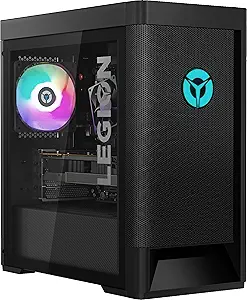
Lenovo vs Corsair: Overview
Comparing Lenovo and Corsair helps you determine which brand is best suited for your needs in Prebuilt PC. Both brands offer strong choices depending on your budget and key feature requirements.
Key Features & Comparison
Evaluate factors such as build quality, warranty, customer satisfaction, and total value before making your final purchase choice between Lenovo and Corsair.
Features
Lenovo approaches desktop features through the lens of streamlined consumer convenience and integrated device management. The Legion ecosystem relies on the Lenovo Vantage utility, a centralized, low-overhead software dashboard that provides clean hardware monitoring, fan profiles, Network Boost prioritizing, and automated driver updates. Internally, modern Legion towers feature tool-less drive sleds and straightforward expansion options, though users will often find semi-customized OEM motherboards and basic OEM power distribution boards rather than retail-grade parts. While Lenovo’s feature set is sufficient for the everyday gamer, it intentionally lacks the granular over-clocking interfaces and hyper-detailed telemetry demanded by power users.
Corsair, by comparison, delivers a feature set centered around its powerful and sprawling iCUE ecosystem, bringing an unprecedented level of granular control to the prebuilt landscape. Every Corsair prebuilt is outfitted with retail-tier components, including award-winning Vengeance DDR5 memory, industrial-grade Hydro Series closed-loop liquid coolers, and fully modular RMx-series 80-Plus Gold power supplies. The iCUE software enables users to program complex per-LED lighting routines, map custom fan and pump speed curves based on specific sensor inputs, and monitor thermal performance down to individual VRM temperatures. Corsair's commitment to using strictly retail standard motherboards and power supplies ensures full BIOS tuning capabilities and true plug-and-play component replacement down the line.
Performance
From a baseline thermal and compute perspective, Lenovo Legion towers perform admirably, reliably delivering on the core specifications promised on paper. Lenovo equips its rigs with solid heat-pipe tower air coolers or OEM-designed closed-loop liquid coolers that comfortably prevent thermal throttling under typical gaming workloads. Nevertheless, Lenovo’s thermal headroom is generally constrained by compact chassis dimensions, proprietary airflow channel designs, and conservative OEM fan acoustic profiles. While games run with fluid, sustained frame rates at stock clock speeds, Lenovo's motherboards feature locked or heavily restricted BIOS environments that prevent meaningful manual voltage tuning, memory sub-timing adjustments, or aggressive CPU overclocks.
Corsair redefines prebuilt performance by prioritizing maximum continuous wattage throughput and elite thermal dissipation. Utilizing high-airflow chassis such as the 4000D or the dual-chamber cooling chambers found in the compact Corsair One, these systems maintain exceptionally low operational temperatures even during punishing multi-hour rendering or ray-traced gaming sessions. Corsair leverages thick liquid cooling radiators, top-tier magnetic levitation or fluid dynamic bearing fans, and premium thermal pastes to give components room to maximize their native boost algorithms (such as Intel Thermal Velocity Boost or AMD Precision Boost Overdrive). Furthermore, the retail-grade BIOS loaded on Corsair machines permits enthusiastic users to extract every ounce of extra performance through memory XMP/EXPO profiles and customized CPU overclocking.
Design
Lenovo’s industrial design language strikes a subtle balance between modern gamer aesthetics and clean, minimalist workplace design. The Legion desktop series features a contemporary, textured front-mesh panel, discreet ARGB lighting that can be switched off entirely for professional environments, and an integrated rear-top carry handle that adds genuine functional convenience for transportation. Inside the chassis, Lenovo employs an efficient layout with basic cable-routing channels and an integrated acrylic or tempered-glass side panel. However, the use of basic stamped steel chassis internals and occasionally exposed OEM harness wiring reveals where budget compromises were made to maintain lower retail prices.
Corsair’s design philosophy, conversely, is an exercise in bespoke craftsmanship, heavy-gauge materials, and showroom-ready cable management. Whether considering the monolith-like extruded aluminum casing of the small-form-factor Corsair One or the tempered-glass, multi-fan architectural showcases of the Vengeance series, Corsair builds hardware designed to be displayed on top of the desk. Internal cable management is executed with meticulous artisan precision, leveraging routing channels, tie-down anchors, and matching sleeved cabling. Corsair eliminates cheap plastic accents entirely, relying on thick powder-coated steel, CNC-machined aluminum, and panoramic tempered glass, creating an unmistakable impression of luxury and mechanical solidity that Lenovo’s mass-production pipeline does not match.
Compare current retail pricing, active promotions, and verified stock availability directly from authorized stores: