





Ibuypower vs Skytech: Overview
Comparing Ibuypower and Skytech helps you determine which brand is best suited for your needs in Prebuilt PC. Both brands offer strong choices depending on your budget and key feature requirements.
Key Features & Comparison
Evaluate factors such as build quality, warranty, customer satisfaction, and total value before making your final purchase choice between Ibuypower and Skytech.
Features
In terms of component features and expandability, Skytech prioritizes standardized non-proprietary hardware across its entire portfolio. This engineering approach ensures standard ATX and Micro-ATX specifications, giving users completely open upgrade pathways for standard power supplies, graphics cards, and motherboards down the line. Furthermore, Skytech often incorporates ample high-airflow fan arrays and modern PCIe Gen4/Gen5 ready motherboards even in cost-conscious lineups like the Archangel or Chronos series. Their systems reliably arrive clean of invasive third-party bloatware, giving users a bare-metal Windows installation that maximizes baseline storage efficiency and reduces background process overhead.
iBUYPOWER stands out distinctly through proprietary technological integrations and modular aesthetic options that are unavailable through traditional boutique builders. Notable among these is their advanced internal lighting systems, optional front-panel LCD screens (such as the signature Snowblind transparent display technology), and sophisticated HYTE chassis ecosystem partnerships. Additionally, iBUYPOWER’s custom configurator tool offers unmatched granular customization features, allowing enthusiasts to specify precise memory latency timings, specific closed-loop liquid coolers, and custom cabling sleeves. While their retail-shelf models may feature more modest utility ecosystems, their direct custom ordering features remain among the most comprehensive in the industry.
Performance
Performance benchmarks between iBUYPOWER and Skytech depend heavily on thermal dissipation efficiency and sustained power limits. Skytech machines generally show an aggressive performance-per-dollar metric out of the box, largely due to their thermal designs that prioritize perforated mesh fronts and generous pre-installed fan allocations. Because Skytech avoids choked-intake designs even on mid-range builds like the Azure and Siege lines, thermal throttling is rarely observed under heavy multi-threaded rendering or long-session 4K gaming, allowing modern Intel Boost and AMD Precision Boost Overdrive algorithms to maintain higher core frequencies consistently.
iBUYPOWER provides exceptional performance scaling at the extreme enthusiast tier, particularly when configured with premium 360mm AIO liquid coolers and uncapped BIOS profiles. However, thermal performance across their mass-market retail configurations can be uneven; models featuring solid tempered-glass front panels sometimes encounter thermal build-up, resulting in higher acoustic signatures as fans ramp up to maintain acceptable operating temperatures. Nonetheless, when matched component-for-component in equal airflow environments, both brands fully utilize the silicon capabilities of current-generation NVIDIA GeForce and AMD Radeon GPUs, delivering virtually identical baseline frame rates in modern titles.
Design
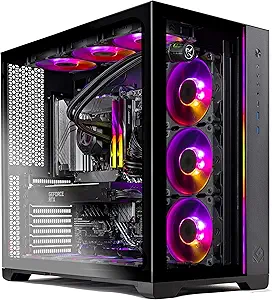
From an industrial design standpoint, iBUYPOWER takes a more avant-garde and bold approach, catering to gamers who want their desktop to serve as a centerpiece showpiece. Thanks to their corporate relationship with case designer HYTE, iBUYPOWER builds regularly incorporate cutting-edge chassis trends, such as dual-chamber panoramic glass enclosures and integrated vertical GPU mounts. Their cable management in mid-to-high tier builds is clean and professionally routed, complemented by synchronized ARGB ecosystems that unify case lighting, memory modules, and liquid cooling pumps into an immersive visual package.
Skytech adopts a more utilitarian, understated design language that balances modern clean lines with structural function. While they offer distinct RGB-forward models such as the Skytech Prism and Shiva, their visual aesthetic leans toward industrial minimalism with powder-coated steel finishes and heavily ventilated front fascias. Cable management within Skytech systems is exceptionally neat and functional behind the back panel, facilitating unobstructed cross-chassis airflow. For users who prioritize subtle refinement and thermal optimization over dramatic geometric shapes and wrap-around glass panels, Skytech’s design choices present a highly practical, enduring appeal.