Ibuypower vs CyberpowerPC: Overview
Comparing Ibuypower and CyberpowerPC helps you determine which brand is best suited for your needs in Prebuilt PC. Both brands offer strong choices depending on your budget and key feature requirements.
Key Features & Comparison
Evaluate factors such as build quality, warranty, customer satisfaction, and total value before making your final purchase choice between Ibuypower and CyberpowerPC.
Features
In terms of features and configurability, CyberPowerPC generally holds an edge in the breadth of individual hardware choices available on its custom configurator. CyberPowerPC allows enthusiasts to drill down into specific brands for almost every sub-component, from individual RAM timings and SSD controller brands to specific power supply models and customized liquid cooling loops. Furthermore, CyberPowerPC frequently bundles brand-name mechanical keyboards, mice, and extensive external peripheral packages with their prebuilts. Their retail models also frequently incorporate hot-swap drive bays and versatile I/O panels that appeal to both general gamers and content creators who need diverse connectivity.
iBUYPOWER counters by focusing on unique, proprietary hardware integrations and tailored ecosystem features that simplify the PC gaming experience. Signature offerings like their 'Snowblind' series with translucent side-panel LCD displays and their specialized Revolt compact chassis demonstrate a strong willingness to innovate outside standard parts catalogs. Additionally, iBUYPOWER puts substantial engineering into simplified RGB ecosystem control through their HYTE collaboration and standardized lighting hubs, reducing the software bloatware footprint that often plagues prebuilts. While CyberPowerPC offers wider raw component versatility, iBUYPOWER provides a more cohesive feature set targeted at modern aesthetics and hassle-free system synchronization.
Performance
Performance benchmarks between iBUYPOWER and CyberPowerPC systems with identical silicon—such as matching Intel Core or AMD Ryzen processors paired with NVIDIA GeForce RTX GPUs—are essentially neck-and-neck, as neither company artificially restricts power limits through proprietary motherboard firmware. Both brands provide open UEFI access, enabling users to enable XMP/EXPO memory profiles and adjust power curves to maximize boost clocks. However, practical sustained performance hinges heavily on thermal design and component pairing. Thermal throttling can occasionally occur in base models from either brand if equipped with budget single-fan all-in-one liquid coolers or restrictive, solid-front glass cases that starve intake fans of fresh air.
Where differences emerge in the performance arena is often related to the baseline motherboards and cooling solutions specified in standardized retail builds. CyberPowerPC builds frequently employ budget-friendly motherboards with basic VRM designs in their entry-to-mid tier configs, which can marginally inhibit multi-core thermal headroom under sustained heavy production workloads. iBUYPOWER tends to specify slightly more balanced standard air and liquid cooling pairings out of the box, translating into steadier acoustic and thermal performance in heavy gaming sessions. Ultimately, both builders deliver full-throttle gaming performance relative to the components installed, provided the buyer opts for high-airflow chassis variants and adequate cooling solutions.
Design
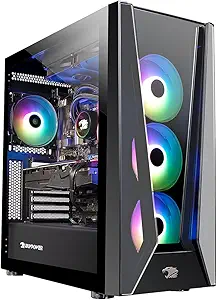
Design and aesthetic identity represent one of the clearest differentiators between these two competitors. iBUYPOWER has invested heavily in clean, modern industrial design, largely bolstered by its close partnership with sister brand HYTE. This synergy yields systems with visually striking cases featuring panoramic glass corners, chamfered edges, and intentional cable routing channels that result in an exceptionally tidy internal layout. iBUYPOWER systems often exhibit a refined, minimalist aesthetic that feels modern and desktop-worthy, successfully avoiding the overly aggressive 'gamer' tropes of previous decades while prioritizing directional airflow through dedicated intake patterns.
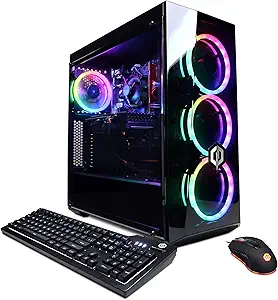
CyberPowerPC takes a more aggressive, traditional approach to PC chassis design, favoring high-impact RGB lighting, bold geometric front fascias, and high-visibility tempered glass panels. While CyberPowerPC offers a massive portfolio of proprietary cases alongside third-party chassis from Lian Li, Corsair, and Phanteks, their in-house cases prioritize maximum direct airflow via extensive mesh front grilles. This mesh-heavy design philosophy yields superior raw cooling efficiency, albeit sometimes at the expense of acoustic dampening and sleek minimalism. Fit-and-finish in CyberPowerPC builds is utilitarian and effective, whereas iBUYPOWER delivers a slightly more cohesive, designer-focused visual presentation.