HP vs Thermaltake: Overview
Comparing HP and Thermaltake helps you determine which brand is best suited for your needs in Prebuilt PC. Both brands offer strong choices depending on your budget and key feature requirements.
Key Features & Comparison
Evaluate factors such as build quality, warranty, customer satisfaction, and total value before making your final purchase choice between HP and Thermaltake.
Features
HP differentiates its systems primarily through unified software integration and proprietary utility suites. The HP OMEN Gaming Hub acts as a central control plane for system diagnostics, basic thermal profiles, network prioritization, and dynamic fan curves, offering a streamlined interface tailored for mainstream users. Furthermore, HP integrates robust system recovery utilities and simplified driver deployment pipelines via HP Support Assistant. However, HP's feature set is severely constrained on the physical layer; many configurations lack essential motherboard expansion headers, feature locked or minimal BIOS environments, and implement non-standard 12V-only power delivery designs that prevent drop-in aftermarket PSU replacements.
Thermaltake approaches features from a hardware-first perspective, equipping their prebuilts with standard ATX or Micro-ATX motherboards sourced from top-tier brands such as ASUS, MSI, or ASRock. This structural choice grants users complete UEFI BIOS access, enabling advanced memory tuning via XMP/EXPO, granular voltage controls, and unrestricted PCIe lane utilization. Additionally, Thermaltake prebuilts excel in ecosystem cohesion by leveraging the company's proprietary TT RGB PLUS software alongside high-end internal components like ARGB controller hubs, multi-zone lighting sync, and tempered glass quick-release mechanisms, providing a substantially richer and more adaptable hardware interface for advanced enthusiasts.
Performance
In real-world performance benchmarks, both brands leverage top-tier silicon from Intel, AMD, and NVIDIA, but their thermal architectures lead to notably different sustained compute behavior. HP machines, particularly within the lower-profile Victus and compact OMEN cases, frequently suffer from thermal throttling under prolonged multi-threaded CPU rendering or high-TGP gaming workloads. While HP has improved its thermal engineering by introducing Cryo Chamber liquid cooling on flagship OMEN 45L configurations, mid-range and budget offerings often feature modest air coolers and restrictive intake front panels that limit the maximum boost clock duration of modern, power-hungry processors.
Thermaltake demonstrates superior acoustic and thermal efficiency across nearly all tiers due to its origins as a high-performance cooling manufacturer. Standard configurations typically include closed-loop all-in-one (AIO) liquid coolers or heavy-duty multi-heatpipe tower coolers paired with high-static-pressure fans and open-airflow chassis designs. This optimized thermal headroom allows both CPU and GPU silicon to sustain higher boost frequencies for extended durations without aggressive thermal throttling. Consequently, in sustained synthetic stress tests and marathon gaming sessions, Thermaltake generally delivers higher frame consistency, lower core temperatures, and significantly reduced fan noise compared to standard HP configurations.
Design
From an industrial design standpoint, HP champions a clean, cohesive, and relatively understated aesthetic that blends seamlessly into modern office environments as well as gaming spaces. The OMEN lineup utilizes sleek, matte-black chassis with minimalist geometry, restrained RGB implementation, and engineered tool-less access panels for the primary side door. However, the internal layout often feels cramped and utilitarian, utilizing stamped metal frames, limited cable management routing space, and occasionally non-standard internal mounting brackets that compromise both interior airflow and visual elegance once the case is opened.
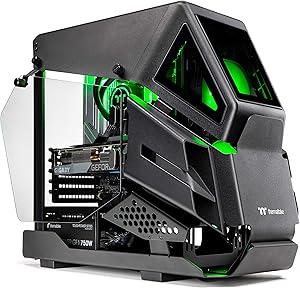
Thermaltake takes a radically opposite design philosophy, emphasizing visual spectacle, open-frame concepts, and display-grade hardware presentation. Featuring popular designs such as the panoramic View series or the vertical open-chassis Tower series, Thermaltake emphasizes multi-panel tempered glass, immaculate cable shrouding, and showcase-level component visibility. The internal engineering prioritizes structural modularity, offering ample space for full-length graphics cards, standard dual- or triple-radiator mounts, and industry-standard clearance margins, making their systems vastly superior in both visual craftsmanship and layout ergonomics.