





HP vs Skytech: Overview
Comparing HP and Skytech helps you determine which brand is best suited for your needs in Prebuilt PC. Both brands offer strong choices depending on your budget and key feature requirements.
Key Features & Comparison
Evaluate factors such as build quality, warranty, customer satisfaction, and total value before making your final purchase choice between HP and Skytech.
Features
Feature implementation between the two brands highlights a trade-off between integrated proprietary software ecosystems and open hardware adaptability. HP equips its systems with robust software features, most notably the OMEN Gaming Hub. This centralized utility provides polished fan tuning, dynamic network prioritization, intelligent undervolting, and system-wide lighting synchronization. Additionally, HP systems frequently offer convenient front I/O selections, broad wireless connectivity (such as modern Wi-Fi 6E configurations), and bundled entry-level peripherals. Nonetheless, HP's feature set is somewhat diminished by the inclusion of pre-installed bloatware and motherboards that often lack supplemental PCIe lanes, extra M.2 NVMe slots, or robust power delivery heatsinks.
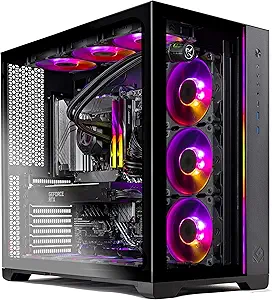
Skytech counters this by offering superior hardware-level features derived from standard consumer DIY components. Because Skytech uses commercially available motherboards and power supplies, users gain fully unrestricted BIOS interfaces featuring advanced memory profiles (XMP/EXPO), comprehensive fan curves, and full PCIe generation compliance for future expansion. Furthermore, Skytech systems generally incorporate robust cooling solutions—such as 240mm or 360mm all-in-one (AIO) liquid coolers and multiple high-airflow ARGB case fans—which are often compromised in lower-to-mid-tier HP builds. While Skytech lacks a proprietary branded unified software suite, it avoids unnecessary bloatware, leaving users with a clean Windows install and maximum hardware utility.
Performance
On paper, both HP and Skytech offer hardware configurations utilizing modern Intel Core or AMD Ryzen processors alongside NVIDIA GeForce RTX or AMD Radeon graphics cards. However, actual sustained performance heavily depends on thermal management, motherboard power limits, and memory optimization. Lower-tier and mid-tier HP configurations frequently suffer from restrictive power limits (PL1/PL2 profiles) imposed by proprietary motherboards, combined with compact chassis designs that restrict ambient airflow. While high-end OMEN 40L and 45L systems mitigate this with innovative cooling chambers, lower-tier HP models can throttle under prolonged compute loads, resulting in performance dips during extended gaming or rendering sessions.
Skytech generally achieves higher sustained compute and graphics throughput across comparable price tiers due to superior thermal engineering and unconstrained power delivery. Utilizing high-airflow mesh chassis paired with multi-fan cooling configurations, Skytech prebuilts keep core temperatures low, enabling graphics cards to hold their maximum boost clocks consistently. Moreover, Skytech frequently configures their systems with higher-frequency, lower-latency dual-channel RAM modules, whereas baseline HP models may occasionally ship with single-channel configurations or memory restricted to base JEDEC speeds. Consequently, Skytech frequently delivers tighter 1% low frame rates and more consistent benchmark numbers in CPU- and GPU-intensive tasks.
Design
From an industrial design standpoint, HP delivers sleek, understated, and highly refined aesthetics tailored for multi-environment versatility. The OMEN lineup features minimalist, clean geometric chassis with tinted tempered glass panels, refined exterior matte finishes, and tastefully diffused RGB accents that effortlessly blend into both an upscale gaming battlestation and a professional office environment. The engineering zenith of their lineup, the OMEN 45L, features the patented "Cryo Chamber," an external liquid-cooling radiator housing placed outside the main chassis to isolate heat. The overall exterior fit and finish of HP builds feel exceptionally cohesive, although internal component density can sometimes feel cramped and difficult to navigate during maintenance.
Skytech prioritizes the quintessential modern gaming aesthetic, leaning heavily into vibrant aesthetics characterized by panoramic tempered glass, mesh front intake fascias, and synchronized addressable RGB (ARGB) lighting. Their builds look and feel like custom DIY gaming PCs, showcasing prominent graphics cards, braided cable management, and high-visibility internal layouts. Because they rely on standardized mid-tower and full-tower cases from mainstream manufacturers, internal component clearance is generous, significantly improving airflow dynamics and making future component replacements remarkably painless. For consumers who appreciate visible enthusiast engineering, Skytech’s transparent and open design ethos stands out clearly against HP’s more reserved, monolithic construction.
Compare current retail pricing, active promotions, and verified stock availability directly from authorized stores: