HP vs Ibuypower: Overview
Comparing HP and Ibuypower helps you determine which brand is best suited for your needs in Prebuilt PC. Both brands offer strong choices depending on your budget and key feature requirements.
Key Features & Comparison
Evaluate factors such as build quality, warranty, customer satisfaction, and total value before making your final purchase choice between HP and Ibuypower.
Features
From a feature and software perspective, HP differentiates itself with its proprietary OMEN Gaming Hub, an all-in-one software ecosystem that controls lighting, monitors system thermals, manages network prioritization, and even automates basic processor undervolting and overclocking profiles. While this unified software suite provides convenience for novices, it comes alongside pre-installed software and OEM-restricted BIOS configurations that often lock users out of advanced hardware tuning, XMP memory profiles, or detailed fan curve adjustments. HP’s physical connectivity features can also be hit-or-miss; while the top-tier OMEN desktops feature comprehensive I/O arrays, their lower-tier models often rely on minimalist, non-standard front-panel integrations with limited PCIe expansion slots.
In contrast, iBUYPOWER shines in its open-platform feature set, deploying standard motherboards from reputable vendors like ASUS, MSI, and ASRock. This grants users full, unrestricted UEFI/BIOS access for granular control over voltage, memory timings, and storage configurations, completely free from the proprietary limitations common to mass-market OEMs. Additionally, iBUYPOWER configurations generally boast richer internal expandability, featuring multiple standard M.2 NVMe slots, extra SATA ports, and universal ARGB lighting headers compatible with open software ecosystems. While iBUYPOWER lacks a single, centralized management software suite comparable to the polished OMEN Hub, it makes up for it by providing true component independence, eliminating bloatware, and ensuring universal component compatibility.
Performance
The raw performance comparison between HP and iBUYPOWER relies heavily on thermal management, component headroom, and sustained power limits. HP’s flagship OMEN desktops, especially the 40L and 45L models, have made massive strides in mitigating thermal throttling, with the OMEN 45L utilizing a patented 'Cryo Chamber' external liquid-cooling bracket that consistently keeps top-tier CPUs running at maximum boost clocks. However, HP's budget and midrange configurations frequently utilize basic air coolers, restrictive chassis designs, and strict OEM power limits, which can lead to acoustic spikes and modest thermal throttling under sustained rendering or intensive gaming workloads.
Because iBUYPOWER builds into mainstream performance-focused cases equipped with mesh front panels and third-party AIO liquid coolers, their systems generally maintain lower sustained temperatures across a wider range of price points. This thermal headroom enables processors and graphics cards to boost to their maximum advertised clock frequencies without running against hard thermal limits. Furthermore, because iBUYPOWER uses standard retail-grade RAM and power supplies, users avoid the performance bottlenecks often caused by HP's occasional reliance on single-channel JEDEC-speed memory or power supplies with restrictive wattage ceilings. For pure, sustained throughput and high-load thermal stability, iBUYPOWER typically holds a measurable advantage over HP's mainstream lineup.
Design
HP’s industrial design philosophy balances sleek minimalism with utilitarian functionality. The modern OMEN lineup stands out with clean, monolithic black or white chassis aesthetics, tinted tempered-glass side panels, and integrated cable routing channels that hide clutter effectively. The OMEN 45L in particular showcases impressive engineering maturity, segregating the radiator from the main chamber to optimize airflow dynamics while preserving a unified, sophisticated aesthetic that feels right at home in either an executive office or a streaming setup. However, HP’s entry-level systems are noticeably more spartan, often utilizing compact, stamped-steel cases with limited intake perforations and proprietary front panel layouts that resist reconfiguration.
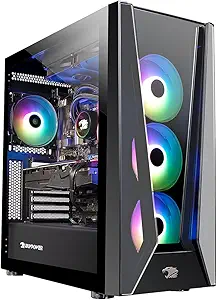
iBUYPOWER presents a distinctly gamer-centric design language defined by striking geometric lines, aggressive mesh grilles, and prominent addressable RGB illumination. Their chassis selections emphasize visual flair, often utilizing dual-chamber designs, panoramic tempered glass wrap-arounds, and showpiece vertical GPU mounts. Build quality and internal aesthetic neatness can vary slightly depending on the individual assembly technician, but the cable management is typically high quality with zip-tied bundles hidden in dedicated rear channels. While HP achieves a more refined, mass-manufactured industrial polish, iBUYPOWER offers dynamic visual customization and the unmistakable aesthetic of a bespoke, enthusiast-grade battle station.
Compare current retail pricing, active promotions, and verified stock availability directly from authorized stores: