HP vs CyberpowerPC: Overview
Comparing HP and CyberpowerPC helps you determine which brand is best suited for your needs in Prebuilt PC. Both brands offer strong choices depending on your budget and key feature requirements.
Key Features & Comparison
Evaluate factors such as build quality, warranty, customer satisfaction, and total value before making your final purchase choice between HP and CyberpowerPC.
Features
HP approaches features with a centralized, consumer-oriented ecosystem anchored by software like the Omen Gaming Hub. This suite gives users accessible tools for undervolting, automated overclocking, fan curve tuning, and lighting synchronization without having to venture into a complex UEFI BIOS. Additionally, HP prebuilts often integrate enterprise-level security features, robust integrated Wi-Fi adapters, and standardized front-panel I/O configurations. The trade-off, however, lies in physical feature constraints: HP often uses micro-ATX or non-standard motherboard form factors with fewer PCIe slots, limited M.2 NVMe storage expandability, and restricted memory clearance beneath compact cooler assemblies.
CyberpowerPC excels by offering uncompromised enthusiast hardware features straight out of the box. Because they utilize standard retail-tier motherboards, users benefit from unlocked BIOS environments, extensive VRM cooling, plentiful SATA and PCIe expansion, and robust multi-zone addressable RGB (ARGB) headers. CyberpowerPC configurations also feature standardized ATX power supplies with ample headroom and standard modular cabling, contrasting sharply with HP's occasionally bundled 12V-only proprietary PSUs. The primary drawback with CyberpowerPC is software fragmentation; users must often juggle multiple disparate third-party utilities for driver updates and peripheral illumination control instead of a single unified dashboard.
Performance
Under sustained workloads, the thermal and power delivery designs of these two manufacturers significantly influence raw compute and graphical output. HP has made noticeable strides with its newer Omen desktop cases featuring cryo-chambers and improved mesh intakes, allowing high-end Intel Core and AMD Ryzen CPUs to maintain stable boost clocks alongside NVIDIA GeForce RTX or AMD Radeon GPUs. Nevertheless, entry-level models such as the HP Victus can suffer from conservative power limits and restricted chassis airflow, which can lead to thermal throttling or aggressively loud acoustic profiles during extended gaming sessions or heavy multi-threaded rendering.
CyberpowerPC typically achieves higher continuous performance ceilings by leveraging expansive airflow chassis equipped with multiple standard 120mm or 140mm intake and exhaust fans, alongside large all-in-one (AIO) liquid coolers. Because their motherboards adhere to raw board partner power limits without proprietary thermal throttling thresholds, CPUs and GPUs in CyberpowerPC rigs frequently sustain maximum boost frequencies for longer periods. The caveat rests in build-to-build silicon and configuration variance; CyberpowerPC often sources various component revisions depending on inventory, meaning two identically named configurations might feature differing RAM timings or GPU cooler variants that yield slight deviations in synthetic benchmarks.
Design
The industrial design of HP gaming PCs tilts toward sophisticated minimalism, characterized by clean geometric lines, subdued matte finishes, and subtle branding. HP aims for an aesthetic that fits equally well in a modern gaming setup or an executive home office, eschewing excessive ostentation in favor of compact, space-saving desktop footprints. Internally, HP's newer Omen enclosures display disciplined cable management and distinct internal partitioning, though access can feel cramped during teardowns due to custom metal framing and compact internal chassis envelopes.
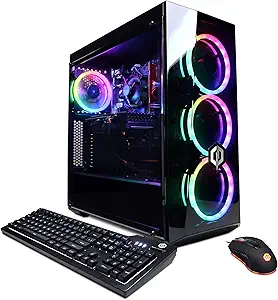
CyberpowerPC embraces full-blooded enthusiast PC gaming aesthetics, prioritizing panoramic tempered glass panels, prominent mesh front grilles, and vivid ARGB lighting arrays. Their systems utilize standard mid-tower and full-tower enclosures that maximize interior volume, providing immense airflow pathways and abundant room for oversized triple-fan graphics cards. While this design facilitates effortless maintenance and superior ventilation, the visual footprint is substantially larger, requiring significant desk space, and internal cable routing can occasionally lack the uniform precision found in HP's automated, high-volume production lines.
Compare current retail pricing, active promotions, and verified stock availability directly from authorized stores: