





CyberpowerPC vs Skytech: Overview
Comparing CyberpowerPC and Skytech helps you determine which brand is best suited for your needs in Prebuilt PC. Both brands offer strong choices depending on your budget and key feature requirements.
Key Features & Comparison
Evaluate factors such as build quality, warranty, customer satisfaction, and total value before making your final purchase choice between CyberpowerPC and Skytech.
Features
In terms of component sourcing and feature ecosystems, both builders rely heavily on standardized desktop architecture, deliberately avoiding the proprietary motherboards and power supplies that plague traditional OEM giants. CyberpowerPC excels dramatically in component diversity; their direct-to-consumer configurator allows users to select specific motherboards, RAM speeds, low-noise fans, and closed-loop liquid coolers from top-tier brands like Corsair, ASUS, and MSI. However, in their mass-market retail skus, CyberpowerPC has a documented history of cutting costs on secondary components, occasionally bundling generic power supplies or entry-level motherboards with limited VRM thermal management to keep headline prices ultra-competitive.
Skytech distinguishes itself by maintaining a higher baseline for auxiliary hardware across its entire catalog, frequently highlighting the inclusion of 80-Plus Gold power supplies, reliable dual-channel memory kits, and branded AIO coolers even on mid-range tiers like the Archangel or Chronos lines. While Skytech's customization options are far more rigid—often forcing buyers to choose between fixed configurations rather than hand-picking every single header and heatsink—the trade-off is a curated, cohesive internal ecosystem. Furthermore, Skytech systems generally ship with cleaner Windows environments free of intrusive third-party bloatware, ensuring that out-of-the-box driver initialization and software utility suites remain unburdened.
Performance
Thermal dynamics and component pairing heavily dictate the practical performance of prebuilt systems, and both brands showcase distinct engineering trade-offs in this domain. CyberpowerPC delivers exceptional peak performance when configured with high-tier components, but thermal throttling can occasionally manifest in their entry-to-mid-tier retail cases that favor solid front tempered glass panels over ventilated mesh. When equipped with adequate airflow chassis, CyberpowerPC rigs unleash the full potential of contemporary silicon from Intel, AMD, and NVIDIA, maintaining aggressive boost clocks during extended gaming sessions and sustained multithreaded rendering workloads without artificial power caps.
Skytech demonstrates a more uniform approach to thermal engineering across its portfolio, often standardizing high-airflow mesh front panels and generous fan configurations even on their most affordable builds. This commitment to chassis ventilation translates into lower ambient internal temperatures, reduced GPU junction hot spots, and lower acoustic profiles under full load. Consequently, Skytech systems frequently exhibit superior sustained clock stability out of the box, as their cooling solutions prevent premature thermal throttling without requiring users to manually adjust fan curves in the BIOS or replace pre-installed intake fans.
Design
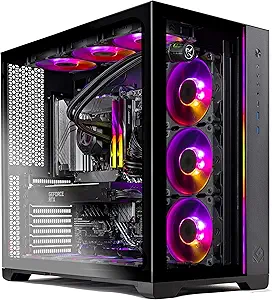
Aesthetic presentation and structural design highlight contrasting brand identities, with CyberpowerPC leaning into bold, eye-catching chassis choices accented by addressable RGB lighting. CyberpowerPC frequently uses proprietary case designs alongside partner options from Lian Li, Phanteks, and NZXT, giving their lineup a diverse aesthetic range that spans from understated minimalist towers to futuristic dual-chamber showcases. Cable management in CyberpowerPC units can be somewhat inconsistent due to varying assembly speeds across production lines, occasionally leaving rat's nests behind the rear panel, though visible front-facing cabling is typically secured neatly enough to maintain clean visual appeal through tempered glass side panels.
Skytech adopts a more unified, modern visual language characterized by clean lines, purposeful symmetry, and well-thought-out structural ergonomics. Chassis lines such as the Skytech Prism and Shiva showcase immaculate white-and-black themes with high-quality powder-coated steel finishes, magnetic dust filters, and thoughtfully routed cable channels that rival custom boutique builders. Skytech's assembly technicians routinely execute superior cable bundling and tensioning behind the motherboard tray, which not only elevates the overall craftsmanship but also makes future storage drive additions or power supply swaps significantly easier for the end user.