Corsair vs Thermaltake: Overview & Brand Philosophy
The prebuilt gaming PC market has evolved beyond generic beige boxes and cut-corner OEM systems. Leading component manufacturers Corsair and Thermaltake have leveraged their extensive hardware heritage to engineer fully assembled, high-performance desktops. Rather than relying on proprietary, non-upgradable motherboards or subpar power supplies typical of traditional mass-market OEMs, both brands build their prebuilts using retail-grade, off-the-shelf components. However, their underlying engineering philosophies and design priorities target distinctly different segments of the enthusiast market.
Corsair approaches the prebuilt PC space with a focus on streamlined elegance, ecosystem integration, and space-saving engineering. Known primarily for its Vengeance series of mid-towers and the groundbreaking, ultra-dense Corsair One form factor, Corsair's philosophy centers on quiet efficiency, minimalist modern aesthetics, and unified software control through its proprietary iCUE suite. Corsair builds are engineered to function out of the box as premium lifestyle appliances for gamers, streamers, and creative professionals who value understated sophistication and seamless hardware-software harmony.
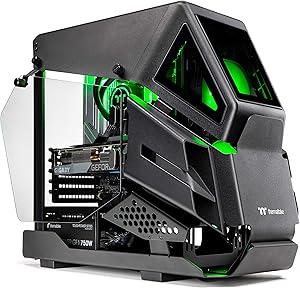
Thermaltake, through its Liquid Cooling Gaming System (LCGS) division, embraces a philosophy rooted in visual drama, enthusiast DIY culture, and aggressive thermal engineering. Thermaltake treats prebuilt PCs as desktop centerpieces. The brand frequently uses distinctive open-frame chassis (such as the Core P series) and unique vertical architectural cases (such as the Tower series), along with vibrant, custom-loop liquid cooling options. Thermaltake prioritizes maximum airflow, eye-catching mechanical design, and high hardware accessibility, appealing to users who want their gaming rig to deliver visual impact alongside computational horsepower.
Key Differences & Technological Comparison
While both brands utilize standard ATX/ITX architecture that ensures long-term upgradeability, their technological implementation differs across several core areas:
Chassis Architecture and Form Factors
Corsair emphasizes optimized airflow within standard footprints (such as the 4000D and 5000D Airflow frames) and high-density packaging in small form factors. The Corsair One remains an engineering marvel, deploying a patented dual-sided convection cooling layout that cools both the CPU and GPU via independent closed-loop liquid systems inside an ultra-compact, 12-liter aluminum chassis. Thermaltake, by contrast, focuses on open-air showcase layouts and panoramic tempered glass designs. Systems like the Thermaltake Reactor and Glacier series deploy large-volume cases designed to display custom hard-tube or soft-tube liquid loops, prioritizing uninhibited component exposure and unconventional mounting orientations.
Component Ecosystem and Synergy
Corsair holds a distinct technological advantage in end-to-end component synergy. A Corsair prebuilt is composed nearly entirely of first-party hardware: Corsair Vengeance/Dominator DDR5 memory, Corsair RMx or SF-series power supplies, Corsair MP-series NVMe SSDs, and Corsair Elite Capellix liquid coolers. This vertical integration allows for comprehensive hardware diagnostics, unified thermal profiles, and synchronized addressable RGB lighting controlled through a single instance of Corsair iCUE. Thermaltake also incorporates its own high-quality Toughpower PSUs, TOUGHRAM, and water blocks, but often relies on a wider mix of third-party motherboard vendors and GPU partners, resulting in a less integrated software experience.
Software and Ecosystem Control
Software stability is a major differentiator for prebuilt ownership. Corsair's iCUE platform, while resource-intensive, is universally recognized for its depth of customization, automated fan curves linked directly to internal coolant temperatures, and native game integrations. Thermaltake utilizes its TT RGB Plus and NeonMaker platforms for lighting and thermal management. While functional, Thermaltake’s software ecosystem has historically lagged behind Corsair in terms of user interface refinement, third-party plugin support, and overall driver stability.
Pros & Cons Comparison
Corsair Prebuilts
- Pro: Exceptional Component Cohesion: Utilizing first-party power supplies, memory, cooling, and storage ensures strict quality control and predictable component synergy.
- Pro: Corsair One Form Factor: Industry-leading high-performance, small-form-factor engineering that delivers workstation-tier components in a whisper-quiet, ultra-compact chassis.
- Pro: Superior Software Integration: Corsair iCUE provides advanced unified control over system acoustics, pump speeds, sensor telemetry, and complex lighting profiles.
- Pro: Clean, Professional Aesthetics: Sleek brushed metals, tinted tempered glass, and minimal clutter make these systems suitable for both high-end gaming stations and professional studios.
- Con: Pricing Premium: Corsair systems command a steep price-to-performance markup relative to the raw cost of the silicon inside.
- Con: Compact Upgradability Limits: While Vengeance towers are easily upgradable, the Corsair One series is complex and restrictive to modify or upgrade down the line.
Thermaltake Prebuilts
- Pro: High-End Custom Liquid Cooling: Thermaltake LCGS offers pre-configured, hard-tube custom liquid loops at price points significantly lower than boutique custom builders.
- Pro: Bold, Eye-Catching Case Designs: Open-frame and panoramic glass chassis turn the internal hardware into an expressive desktop showcase.
- Pro: Excellent Out-of-the-Box Thermals: Massive radiators, open-air chassis dynamics, and heavy liquid displacement yield outstanding CPU and GPU operating temperatures.
- Pro: High Repairability and Upgradability: Spacious, non-standard cases provide expansive internal clearances, making future component swaps, GPU upgrades, and liquid maintenance straightforward.
- Con: Clunky Software Ecosystem: TT RGB Plus and ancillary management tools are less refined, occasionally suffering from UI glitches and higher setup friction.
- Con: Dust Accumulation: Open-air and heavy-mesh showcase designs require frequent internal cleaning and routine maintenance to prevent dust buildup on components.
Performance, Durability & Value Analysis
When analyzing performance and thermal durability, both brands post exceptional metrics due to their reliance on premium cooling and tier-one internal hardware, but they manage thermal wear differently. Corsair prebuilt towers rely on directed convection and high-static-pressure fans pulling air through fine dust filtration, keeping internal temperatures well within safe operating envelopes while shielding delicate solder joints and power delivery phases from environmental dust. The Corsair One trades some thermal headroom for silence, running warmer under sustained multi-threaded workloads, though still within silicon thermal specifications. Thermaltake’s open-air designs offer unmatched immediate heat dissipation, eliminating the thermal soak typical of sealed cases. However, the lack of traditional filtration means components are exposed to ambient humidity, pet dander, and dust, necessitating proactive owner maintenance to sustain component durability over a three-to-five-year period.
In terms of monetary value, Thermaltake consistently offers a superior price-to-specification ratio. A consumer spending $2,500 to $3,500 with Thermaltake typically receives high-tier GPUs paired with open-loop liquid systems or expansive 360mm AIO configurations that would cost substantially more from boutique builders. Corsair systems, by comparison, carry a clear brand tax. You pay for Corsair's industrial design, stringent factory assembly tolerances, comprehensive multi-year customer support pipelines, and ecosystem integration. While Corsair delivers an ownership experience closer to a luxury consumer electronics brand, Thermaltake maximizes the hardware firepower and liquid cooling hardware delivered per dollar spent.
Final Verdict: Which Brand Should You Choose?
The decision between Corsair and Thermaltake comes down to whether you prioritize refined ecosystem integration or dramatic custom-cooling performance.
Choose Corsair if: You want a turnkey, whisper-quiet system with immaculate internal cable management, industry-leading software control, and an understated aesthetic. Corsair is the ideal choice for professionals, streamers, and gamers who view their PC as a refined appliance and are willing to pay a premium for cohesive first-party components, compact footprint options (like the Corsair One), and dependable support.
Choose Thermaltake if: You want your gaming PC to be a bold, visual centerpiece featuring expansive custom liquid cooling loops, open-air chassis architecture, or distinctive showcase styling without paying traditional boutique custom prices. Thermaltake is the better fit for hardware enthusiasts who appreciate open layouts, maximize cooling headroom for overclocking, and do not mind periodic manual dusting to keep their rig running at peak performance.
Features
When evaluating the feature ecosystems of Corsair and Thermaltake in the prebuilt PC space, the fundamental divergence lies in unified proprietary integration versus chassis-driven modularity. Corsair leverages its vast internal component portfolio to engineer systems—such as the Vengeance and ultra-compact Corsair ONE series—that function as cohesive, synchronized machines. The standout technical strength of Corsair’s prebuilts is the proprietary iCUE ecosystem, increasingly augmented by iCUE LINK architecture. This feature dramatically reduces cable clutter through single-cable daisy-chaining for power, thermal monitoring, and addressable RGB, while enabling system-wide synchronized telemetry and custom fan curves through a single software suite. Additionally, Corsair systems offer native synergy with Elgato capture and streaming hardware, making them particularly feature-rich out of the box for content creators who value automated workflows and unified dashboard control.
Conversely, Thermaltake’s feature set is heavily anchored in its enthusiast liquid-cooling heritage and bold, specialized chassis designs through its Liquid Cooling Gaming System (LCGS) division. While Corsair excels at polished, mainstream mid-towers and densely packaged mini-ITX engineering, Thermaltake offers prebuilt configurations that feature bespoke, open-loop hard-tube liquid cooling with dedicated pump/reservoir combos—a premium feature virtually non-existent in mainstream competing lineups. Thermaltake also differentiates itself through dramatic presentation form factors, utilizing panoramic open-frame cases (Core Series) and vertical showcase enclosures (Tower Series) that offer superior component visibility and expansive radiator mounting capabilities. In terms of hardware standards, Thermaltake leans closer to standard 5V ARGB and conventional PWM headers, avoiding the proprietary connector lock-in found in Corsair's latest revisions and offering greater long-term third-party part versatility.
The practical trade-offs between these feature sets come down to software sophistication versus hardware maintainability. Corsair delivers an unrivaled day-to-day user experience via iCUE, which provides granular sensor logging, complex lighting orchestration, and automated hardware diagnostics; however, this comes at the cost of proprietary connector dependency, making future non-Corsair component upgrades somewhat cumbersome. Thermaltake offers unmatched aesthetic presence and factory-assembled custom liquid loops for hardcore overclocking enthusiasts, but its companion software, TT RGB Plus, lacks the polish, reliability, and low CPU overhead of Corsair's suite. Furthermore, Thermaltake’s custom-loop prebuilts introduce maintenance obligations—such as draining, flushing, and refilling coolant—that general prebuilt buyers looking for a plug-and-play experience may find burdensome compared to Corsair’s zero-maintenance closed-loop liquid solutions.
Performance
When evaluating raw processing power and sustained operational performance, Corsair holds a distinct engineering advantage through meticulous component curation and unified system optimization. Corsair’s prebuilt systems, notably the Vengeance and Corsair One lines, benefit from in-house component vertical integration. By pairing top-tier Intel or AMD processors with hand-tested Corsair Vengeance or Dominator DDR5 memory tuned to aggressive XMP/EXPO profiles, these rigs consistently minimize memory latency and micro-stuttering. Furthermore, Corsair integrates its high-efficiency, tier-A power supplies (such as the RMx series), ensuring rock-solid transient power delivery to high-draw GPUs like the NVIDIA RTX 4080 and 4090. This level of power stability enables modern graphics cards to sustain their maximum boost clocks over extended gaming sessions or rendering tasks without voltage-induced performance dips. In contrast, Thermaltake’s Liquid Cooling Gaming Systems (LCGS) generally deploy standard off-the-shelf hardware configurations. While Thermaltake matches Corsair component-for-component on paper using equivalent CPU and GPU tiers, their baseline memory timings and out-of-the-box BIOS optimizations tend to be more conservative, leading to marginally lower 1% low framerates in memory-sensitive gaming benchmarks.
Thermal management is where the architectural philosophies of both brands diverge, directly dictating sustained thermal headroom and prevention of clock-speed throttling. Corsair leverages advanced closed-loop AIO liquid coolers combined with precision-tuned fan curves managed by the iCUE software ecosystem. This creates an exceptionally controlled internal environment where coolant temperatures, intake pressure, and exhaust velocity are dynamically harmonized; even the ultra-compact Corsair One manages flagship thermal loads via its ingenious vertical convection chassis without severe thermal throttling. Thermaltake, however, approaches thermal performance with brute-force spatial engineering and liquid-cooling versatility. Utilizing high-volume chassis like the Tower series or open-frame Core series, Thermaltake often incorporates thicker radiators, custom open-loop systems with dedicated reservoirs, and substantial ambient airflow dynamics. In sustained multi-threaded rendering or heavy continuous compute workloads, Thermaltake’s massive liquid volume and unrestricted airflow can occasionally yield lower GPU junction and CPU package temperatures than Corsair’s standard mid-towers, granting enthusiast users a higher ceiling for manual overclocking.
Ultimately, the trade-off in performance between these two brands comes down to curated out-of-the-box optimization versus modular, brute-force thermal headroom. Corsair delivers an exceptionally refined, plug-and-play performance profile where hardware and firmware are tightly coupled to extract maximum stock efficiency with minimal noise and zero user intervention required. Thermaltake trades proprietary software polish for traditional desktop modularity and expansive cooling loops, offering a platform that excels when driven hard in thermal-heavy environments, albeit often at the cost of higher acoustic levels and bulkier footprints. For users demanding plug-and-play stability, frame-rate consistency, and ultra-low system latency, Corsair claims the performance edge; for creators and tinkerers prioritizing raw thermal dissipation mass to push hardware beyond factory parameters, Thermaltake remains a formidable contender.
Design
In the prebuilt PC landscape, Corsair and Thermaltake approach chassis architecture and industrial design from fundamentally divergent philosophies. Corsair champions a refined, minimalist, and monolithic aesthetic characterized by clean lines, premium materials, and tightly integrated component ecosystems. Lines like the Corsair Vengeance leverage the brand's critically acclaimed Airflow chassis, utilizing high-density steel frames and subtle tinted tempered glass to balance executive restraint with modern gaming flair. Even more impressively, the flagship Corsair One demonstrates masterclass small-form-factor (SFF) engineering, packing top-tier hardware into a bead-blasted aluminum vertical tower with an exceptionally compact desktop footprint. In contrast, Thermaltake’s prebuilt lineup—particularly within its Liquid Cooling Gaming System (LCGS) portfolio—embraces an unapologetically bold, enthusiast-centric showpiece design. Thermaltake routinely utilizes open-frame architectures (such as the Core P-series) and distinctive vertical prism geometries (like the Tower series), prioritizing maximum component visibility, panoramic glass wraps, and an overt showcase of custom-loop and all-in-one liquid cooling hardware.
When evaluating structural engineering and thermal layout, Corsair prioritizes disciplined airflow dynamics and out-of-the-box internal order. The brand excels in thermal channeling, utilizing structured front-to-back wind tunnels and proprietary RapidRoute cable management channels behind the motherboard tray, which ensures that even retail-derivative prebuilts possess immaculate interior presentation and unrestricted intake paths. Thermaltake approaches thermal design with sheer volume, modularity, and structural adaptability. Thermaltake prebuilts often employ unconventional motherboard orientations—such as rotated 90-degree mountings in the Tower chassis to induce a natural chimney effect—alongside expansive radiator brackets that accommodate thick cooling hardware. However, this architectural bravado introduces practical engineering trade-offs: Thermaltake’s open-frame and ultra-panoramic cases often demand significantly more physical desk real estate and leave sensitive internal components vulnerable to rapid dust accumulation, whereas Corsair’s enclosed, filtered geometries prioritize long-term thermal sustainability and ease of environmental maintenance.
The definitive design trade-off between the two brands centers on visual cohesion versus theatrical customization. Corsair’s prebuilts deliver an exceptionally harmonious, unified aesthetic because the chassis, fans, memory modules, power supply, and liquid coolers are engineered to match identical design languages and sync natively through a unified iCUE lighting profile, resulting in a turnkey machine that feels purpose-built from the ground up. Thermaltake, conversely, offers peerless visual drama for consumers who view their PC as a visual centerpiece rather than an understated workstation. While Thermaltake's fit, finish, and cable-routing tolerances occasionally exhibit the slightly rugged variance of modular showcase enclosures rather than Corsair’s millimeter-precise factory uniformity, it rewards buyers seeking vibrant liquid cooling reservoirs, multi-angle visibility, and an industrial, custom-modded look straight from the crate.