




Corsair vs Skytech: Overview
Comparing Corsair and Skytech helps you determine which brand is best suited for your needs in Prebuilt PC. Both brands offer strong choices depending on your budget and key feature requirements.
Key Features & Comparison
Evaluate factors such as build quality, warranty, customer satisfaction, and total value before making your final purchase choice between Corsair and Skytech.
Features
Corsair holds a distinct technological advantage in its software and feature integration, primarily driven by its proprietary iCUE ecosystem. An out-of-the-box Corsair prebuilt offers centralized control over RGB lighting, complex custom fan and pump curves, system-wide sensor monitoring, and macro assignments across both internal hardware and peripheral suites. Additionally, Corsair’s adoption of cutting-edge internal features—such as zero-RPM fan modes on premium Gold- and Platinum-rated PSUs, magnetic levitation cooling fans, and modern PCIe Gen5 storage configurations—sets a high benchmark for enthusiast feature sets.
Skytech counters with pragmatic, standardized feature sets that rely on universal industry components rather than a walled-garden ecosystem. Skytech builds generally utilize standard motherboard BIOS controls and vendor-neutral RGB addressable headers (controlled via software like Asus Aura Sync or MSI Mystic Light), which makes the system intrinsically easier to upgrade or modify without needing proprietary controller hubs. While Skytech machines generally provide generous front-panel I/O, ample storage drive bays, and integrated Wi-Fi across their model lines, they lack the centralized diagnostic depth, unified firmware management, and advanced acoustic profiling that Corsair's bespoke hardware-software stack provides.
Performance
In terms of raw thermal and computational performance, Corsair engineers its systems to sustain aggressive boost clocks over extended workloads with minimal acoustic footprint. Corsair machines consistently feature top-tier, closed-loop AIO liquid coolers (frequently 240mm to 360mm radiators) and high-airflow chassis designs that maintain low junction temperatures on power-hungry CPUs and GPUs like the Intel Core i9 or AMD Ryzen 9 series paired with NVIDIA RTX 40-series cards. This thermal headroom ensures that Corsair rigs avoid thermal throttling, delivering exceptional 4K gaming stability and heavy content creation throughput without sounding like an industrial turbine.
Skytech delivers virtually identical nominal frame rates when comparing identical CPU and GPU specifications, but with distinct thermal and acoustic trade-offs. Because Skytech prioritizes component value, thermal configurations often rely on entry-level 120mm/240mm liquid coolers or standard tower air coolers that, while adequate for out-of-the-box operation, can result in higher core temperatures under sustained synthetic or heavy gaming loads. Consequently, fan profiles on Skytech machines tend to operate more aggressively to dissipate heat, leading to higher ambient noise levels compared to the meticulously tuned acoustics of Corsair’s premium thermal solutions.
Design
Design and industrial engineering represent another stark contrast, with Corsair favoring a minimalist, sophisticated aesthetic characterized by architectural precision. Corsair’s chassis—whether the monolithic, space-saving vertical form factor of the Corsair ONE or the tempered-glass elegance of the 4000/5000-series cases used in their Vengeance line—feature powder-coated steel, clean chamfered edges, and high-density acoustic dampening. Internal layout design is meticulous, with rapid-route cable management channels, hidden power supply shrouds, and balanced component symmetry that appeals to both modern gamers and professional workstation users.
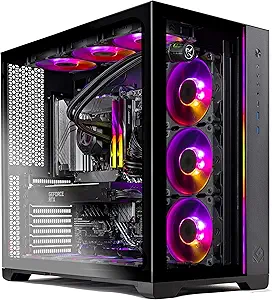
Skytech’s design language leans decidedly toward expressive, modern gamer aesthetics with prominent angular lines, high-contrast white or black chassis options, and dramatic RGB illumination. Models such as the Skytech Chronos, Azure, or King 95 utilize panoramic glass panels to showcase hardware, appealing strongly to users who value display-worthy visual flair. While Skytech's exterior visual presence is impactful, the internal assembly execution—specifically rear cable management, wiring bundling, and structural rigidity of the sheet metal—is functional rather than artisanal, reflecting its production-oriented assembly process versus Corsair’s boutique-tier finish.