Corsair vs CyberpowerPC: Overview
Comparing Corsair and CyberpowerPC helps you determine which brand is best suited for your needs in Prebuilt PC. Both brands offer strong choices depending on your budget and key feature requirements.
Key Features & Comparison
Evaluate factors such as build quality, warranty, customer satisfaction, and total value before making your final purchase choice between Corsair and CyberpowerPC.
Features
Corsair holds a distinct feature advantage through its deep ecosystem integration, centered largely on the iCUE software suite. Prebuilts such as the Corsair Vengeance line come fully wired with iCUE-compatible controllers, enabling granular, synchronized control over RGB lighting, customized fan curves, pump speeds, and hardware telemetry across the memory, cooler, case fans, and even compatible power supplies. Furthermore, Corsair systems often integrate specialized, high-tier features like custom liquid-cooling loops in their compact Corsair One models, zero-RPM fan modes for dead-silent idle operations, and premium modular power units with 80-Plus Gold or Platinum efficiency as standard inclusions.
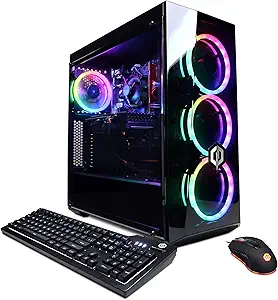
CyberpowerPC offers a feature set driven by sheer hardware diversity and customization scope. Their expansive configuration tool allows users to select exact component models, including specific motherboard chipsets, specialized PCIe expansion cards, varied storage configurations, and distinct case architectures ranging from panoramic dual-chamber designs to compact towers. While CyberpowerPC includes addressable RGB features and universal software compatibility, it typically lacks a unified software ecosystem; users must frequently juggle motherboard software utilities, separate peripheral programs, and GPU tuning suites. However, CyberpowerPC often includes bundled peripherals and promotional software packs, reinforcing their feature strategy around out-of-the-box convenience and component-level choice.
Performance
Performance on Corsair prebuilts is marked by stability, exceptional thermal efficiency, and consistent clock speed retention. Because Corsair designs both the chassis and the thermal dissipation hardware, their systems exhibit meticulously optimized airflow profiles that prevent thermal throttling even during sustained multi-threaded rendering or high-refresh-rate gaming. By consistently selecting top-tier, low-latency DDR5 memory, aggressive factory overclocks on graphics cards, and robust power delivery systems, Corsair ensures that the raw computing power of high-end Intel or AMD processors and NVIDIA RTX GPUs can run at maximum boost states indefinitely without thermal decay or excessive acoustic disruption.
CyberpowerPC delivers immense raw processing and graphical performance per dollar, often beating Corsair in benchmark-per-dollar metrics by allocating capital strictly toward high-end CPUs and GPUs. However, sustained performance can be more volatile depending on the selected configuration. Base-tier CyberpowerPC builds may utilize standard 120mm AIO coolers, entry-level motherboards with limited VRM thermal dissipation, or cases with restricted front-panel airflow, which can result in elevated operating temperatures and louder fan acoustics under heavy compute loads. When configured with premium cooling and motherboard options, CyberpowerPC matches Corsair frame-for-frame, but the onus is often on the consumer to verify that the thermal and power delivery subsystems can adequately sustain peak hardware throughput.
Design
In terms of industrial design, Corsair stands out for its sophisticated, cohesive aesthetic and meticulous assembly standards. Models like the compact Corsair One demonstrate masterclass engineering, utilizing a vertical mini-ITX footprint with dual convection liquid cooling and bead-blasted aluminum shells that fit effortlessly into high-end creative studios or living spaces. Even standard mid-tower units such as the Vengeance series showcase professional-grade cable management, branded tie-downs, tempered glass integration with subtle tinting, and synchronized lighting that feels purposeful rather than garish. The physical build quality is extraordinarily solid, reflecting an engineering ethos focused on structural rigidity, dust prevention, and effortless modern style.
CyberpowerPC embraces a broader, more gamer-centric aesthetic, characterized by vibrant panoramic glass enclosures, dynamic RGB diffusion, and aggressive styling motifs. While their builds can be visually arresting—especially models utilizing dual-chamber chassis that showcase the internal hardware on multiple viewing angles—the build consistency varies more noticeably. Cable routing is functional and generally clean, but often lacks the precision-tailored cable combs and proprietary routing channels found in Corsair rigs. CyberpowerPC’s design language is versatile and exciting for enthusiasts who want their PC to be the glowing centerpiece of a gaming battlestation, though it generally leans away from the subtle minimalism and industrial refinement championed by Corsair.