Alienware vs Thermaltake: Overview
Comparing Alienware and Thermaltake helps you determine which brand is best suited for your needs in Prebuilt PC. Both brands offer strong choices depending on your budget and key feature requirements.
Key Features & Comparison
Evaluate factors such as build quality, warranty, customer satisfaction, and total value before making your final purchase choice between Alienware and Thermaltake.
Features
Alienware systems come heavily equipped with Dell’s proprietary ecosystem features, anchored by the Alienware Command Center (AWCC). This unified software suite allows users to manage overclocking profiles, fan curves, power plans, and AlienFX RGB lighting across compatible peripherals with intuitive simplicity. Additionally, Alienware machines often include cutting-edge wireless interfaces like Killer Wi-Fi, tailored BIOS firmware, and optional factory-sealed liquid cooling loops engineered directly to fit their complex plastic shrouds. However, the reliance on proprietary motherboard form factors, non-standard front I/O headers, and custom power supply configurations significantly limits internal expansion and third-party part swaps down the road.
Thermaltake counters with features drawn directly from the enthusiast PC builder market, emphasizing cooling innovation and open-platform utility. Many Thermaltake prebuilts showcase closed-loop all-in-one (AIO) liquid coolers with thick radiators, high-static-pressure ARGB fans, and premium tempered glass panels. Because they utilize standard retail motherboards (frequently from brands like ASUS, MSI, or ASRock) and standard ATX power supplies, the feature set includes standard BIOS access, uninhibited PCIe slot availability, and native support for universal RGB protocols. The trade-off lies in the software experience: managing a Thermaltake machine may require juggling separate motherboard and peripheral software rather than a single unified manufacturer dashboard like Alienware’s.
Performance
Raw performance metrics between Alienware and Thermaltake can appear similar on paper when comparing equivalent tiers of Intel Core or AMD Ryzen processors paired with NVIDIA GeForce RTX GPUs. However, thermal dissipation and sustained boost clocks reveal notable operational divergences. Older Alienware Aurora designs were notorious for thermal throttling under sustained heavy loads due to compact internal layouts and restricted airflow pathways. While recent redesigns like the Aurora R16 have significantly improved acoustic and thermal efficiency through modernized side venting and improved liquid cooling configurations, the system still operates in a tighter thermal envelope compared to standard DIY-style enclosures.
Thermaltake consistently holds an advantage in sustained thermal performance and acoustic floor, directly benefiting from high-airflow mesh chassis and generous radiator capacities. By utilizing spacious cases engineered specifically for heat extraction, Thermaltake prebuilts allow modern silicon to maintain peak boost clocks for longer durations without aggressive thermal throttling. Memory performance also tends to be more flexible on Thermaltake rigs, as standard retail motherboards readily support advanced XMP/EXPO memory profiles and user-controlled tuning. Alienware systems deliver blistering out-of-the-box speed, but Thermaltake generally provides cooler, quieter operation under prolonged gaming and heavy multi-threaded productivity workflows.
Design
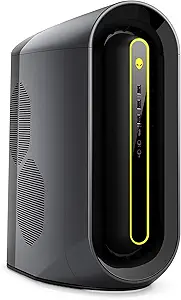
Design identity is where Alienware establishes its most dramatic departure from conventional PC hardware. Embracing their futuristic 'Legend' industrial design language, Alienware rigs showcase sculpted, organic curves, integrated stadium lighting rings, and distinctive space-age aesthetics. The interior architecture is uniquely customized, often featuring a swing-out power supply arm or tightly zoned internal compartments designed to optimize space utilization. This results in a machine that functions as a striking visual centerpiece, though the extensive exterior plastic cladding and proprietary internal frame can make physical maintenance, dusting, and component re-routing cumbersome for the end user.
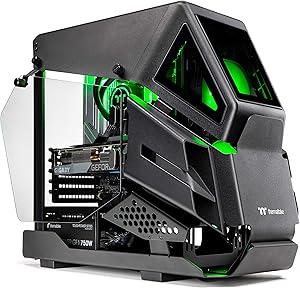
Thermaltake’s design ethos celebrates the modern gaming aesthetic with transparency, modularity, and structural elegance. Featuring open-frame concepts like the Core P-series or panoramic tempered glass cases like the Tower and View series, Thermaltake emphasizes internal component visibility and vibrant ARGB illumination. Cable management is managed cleanly along conventional rear trays, and chassis access typically requires only standard thumbscrews. While Thermaltake PCs lack the unique monolithic, sci-fi appearance of an Alienware chassis, their industrial design is fundamentally more functional, offering superior internal accessibility, expansive airflow paths, and an aesthetic that stays true to custom desktop culture.
Compare current retail pricing, active promotions, and verified stock availability directly from authorized stores: