





Alienware vs Skytech: Overview
Comparing Alienware and Skytech helps you determine which brand is best suited for your needs in Prebuilt PC. Both brands offer strong choices depending on your budget and key feature requirements.
Key Features & Comparison
Evaluate factors such as build quality, warranty, customer satisfaction, and total value before making your final purchase choice between Alienware and Skytech.
Features
From a feature and software perspective, Alienware provides a tightly controlled, deeply integrated proprietary ecosystem led by the Alienware Command Center (AWCC). This suite grants users unified control over thermal management, automated performance overclocking profiles, and advanced per-zone AlienFX RGB lighting across both the chassis and compatible peripherals. Furthermore, Alienware machines benefit from Dell's enterprise-grade logistical perks, such as premium on-site repair services, rapid parts dispatch, and extensive diagnostic software that detects component anomalies before critical failures occur.
Skytech counters this centralized ecosystem by offering the transparency and freedom of standard open-market hardware. Rather than trapping users in a proprietary software stack that can sometimes be resource-heavy, Skytech leaves system control to component-level utilities such as standard BIOS/UEFI interfaces, motherboard RGB software, and universal overclocking suites like MSI Afterburner. In terms of hardware features, Skytech boasts superior standard I/O layouts, universally compatible PCIe expansion slots, and non-restrictive power configurations, guaranteeing that users can swap any individual part—from the liquid cooler to the power supply unit—years down the line without compatibility roadblocks.
Performance
Raw compute performance yields compelling nuances when evaluating identically configured CPU and GPU pairings from both brands. Skytech routinely extracts superior sustained performance and lower thermal throttling thresholds primarily due to superior airflow dynamics and standard cooling hardware. By employing standard mesh front panels, high-clearance ATX mid-tower or full-tower chassis, and commercial-grade AIO liquid coolers or large fin-stack air coolers, Skytech ensures components maintain optimal boost clocks under heavy, continuous rendering or gaming workloads without aggressive acoustic penalties.
Alienware systems historically struggled with thermal dissipation in earlier chassis generations like the Aurora R10 through R14 due to cramped interior layouts and restricted air intake paths. While newer iterations, such as the redesigned Aurora R16, have dramatically overhauled airflow efficiency and reduced ambient noise levels by over 20 decibels, Alienware must still work harder thermally within its sculpted enclosures. Nevertheless, Alienware achieves exceptional out-of-the-box clock stability and memory optimization via custom factory-tuned firmware, offering formidable peak framerates, though Skytech maintains a slight edge in thermal headroom and sustained thermal consistency during extended marathon sessions.
Design
The aesthetic and industrial design contrast between these two manufacturers is stark. Alienware stands as an icon of bold, futuristic industrial design, drawing inspiration from sci-fi motifs with its iconic 'Legend' design language. The chassis feature complex curved geometries, distinct stadium lighting rings, seamless molded exterior paneling, and an undeniably cohesive, bespoke presentation that stands out in any setup. Every contour, venting channel, and power button is engineered to reinforce an unmistakable, premium identity that cannot be replicated using standard retail parts.
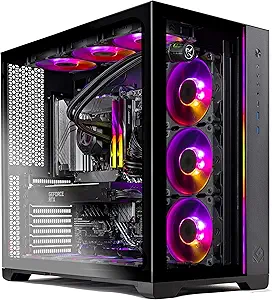
Conversely, Skytech adopts a clean, enthusiast-centric aesthetic that mirrors the contemporary custom PC building scene. Utilizing high-quality tempered glass side panels, dual-chamber compartments, and addressable RGB fan arrays within modern chassis architectures, Skytech systems celebrate internal component visibility. While Skytech's designs may lack the singular, futuristic silhouette of an Alienware unit, they excel functionally: cable management is meticulously routed by hand, interior access requires standard thumb screws without finicky plastic latches, and internal component spacing is optimized for natural convection and unhindered maintenance.