Alienware vs Ibuypower: Overview
Comparing Alienware and Ibuypower helps you determine which brand is best suited for your needs in Prebuilt PC. Both brands offer strong choices depending on your budget and key feature requirements.
Key Features & Comparison
Evaluate factors such as build quality, warranty, customer satisfaction, and total value before making your final purchase choice between Alienware and Ibuypower.
Features
Feature distribution highlights the ideological divide between these two system builders. iBUYPOWER’s feature set is derived largely from the commercial retail ecosystem, meaning their systems include standard retail-tier motherboards from brands like ASUS, MSI, and ASRock, equipped with standard BIOS interfaces that offer full overclocking, fan curve tuning, and expansion capabilities. Connectivity is robust and follows mainstream ATX standards, giving users abundant PCIe slots, standard M.2 NVMe headers, and universal front-panel I/O configurations. Furthermore, iBUYPOWER incorporates standard ARGB controllers that synchronize effortlessly with popular open-source or motherboard-specific lighting software suites.
Alienware, conversely, provides a feature suite defined by deep proprietary integration, headlined by the Alienware Command Center (AWCC). This proprietary utility consolidates thermal management, automated performance profiles, custom acoustic curves, and multi-zone AlienFX RGB lighting into a sleek, unified dashboard. In their modern systems, Alienware also incorporates enterprise-derived remote diagnostics, specialized power delivery modules, and factory liquid-cooling configurations engineered exclusively for their internal chassis dimensions. While Alienware’s integrated ecosystem yields a streamlined user experience, it severely limits the bios-level granular control and third-party peripheral synergy that iBUYPOWER naturally facilitates via standard ATX components.
Performance
Raw performance metrics between iBUYPOWER and Alienware are heavily influenced by thermal design and component thermal throttling tolerances. Because iBUYPOWER utilizes traditional airflow-focused mid- and full-tower cases equipped with standard mesh front panels and 240mm or 360mm AIO liquid coolers, their systems frequently maintain lower sustained temperatures under high CPU and GPU workloads. This sustained thermal dissipation allows silicon from Intel, AMD, and NVIDIA to maximize boost clocks for extended gaming and rendering sessions. The presence of non-proprietary power delivery networks and standard dual-channel high-speed DDR5 RAM also ensures consistent frame times without artificial thermal ceiling interference.
Alienware configurations, while packing identical tier-level silicon such as the Intel Core i9 or NVIDIA GeForce RTX 40-series GPUs, have historically contended with compact, specialized internal chassis layouts that challenge thermal dynamics. Recent chassis revisions have improved acoustic dampening and airflow channels, yet components inside an Alienware often run hotter than those inside a high-airflow iBUYPOWER tower. As a consequence, Alienware systems may experience more aggressive thermal throttling or higher fan noise profiles during synthetic stress tests and multi-hour gaming marathons, although out-of-the-box factory overclocks remain stable for mainstream and competitive gameplay scenarios.
Design
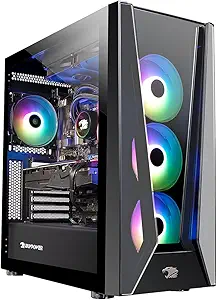
From an industrial design standpoint, iBUYPOWER embraces the modern PC enthusiast aesthetic, prioritizing glass side panels, mesh ventilation grilles, and standard internal layouts that showcase internal components with RGB lighting loops. Their builds reflect the ethos of custom home-built rigs, providing clean cable management within traditional internal frames that make routing, swapping, and inspecting hardware effortless. Because the architecture adheres strictly to ATX and micro-ATX dimensions, aesthetics can be modified post-purchase by simply swapping out case fans, coolers, or the chassis entirely, giving iBUYPOWER systems exceptional longevity in visual relevance.
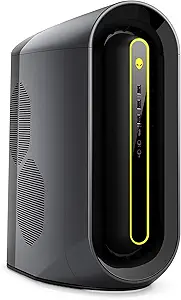
Alienware stands at the opposite end of the design spectrum with its futuristic, sculptured aesthetics. Characterized by curvaceous external shells, aggressive vents, and iconic status lighting accents, an Alienware chassis is immediately recognizable and commands attention in any workstation setup. However, this artistic exterior hides a dense, proprietary interior frame that relies heavily on custom swing-out power supply brackets and non-standard mounting brackets. While this provides a cohesive, purpose-built product reminiscent of a game console, it renders the interior cramped, makes routine dust cleaning more complex, and effectively prevents the user from modernizing the build with off-the-shelf components in subsequent years.