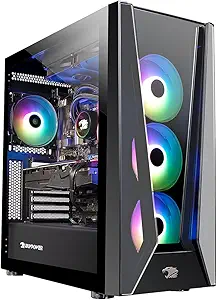
Acer vs Ibuypower: Overview
Comparing Acer and Ibuypower helps you determine which brand is best suited for your needs in Prebuilt PC. Both brands offer strong choices depending on your budget and key feature requirements.
Key Features & Comparison
Evaluate factors such as build quality, warranty, customer satisfaction, and total value before making your final purchase choice between Acer and Ibuypower.
Features
When analyzing feature sets, Acer leans heavily into unified proprietary firmware and curated software ecosystems. The flagship Predator series integrates Acer’s PredatorSense software, an all-in-one suite that provides granular thermal telemetry, native profile switching, audio enhancements via DTS:X Ultra, and proprietary overclocking profiles. Additionally, Acer frequently outfits its mid-to-high tier rigs with specialized lifestyle amenities, such as integrated pull-out headset cradles, hot-swappable hard drive bays, and custom external Wi-Fi antenna arrays. However, BIOS firmware on Acer motherboards remains heavily locked down, severely restricting advanced consumer tuning, memory timing adjustments through fine-tuned XMP/EXPO sub-timings, and fan curve customization outside of Acer’s software layer.
iBuyPower shifts the feature landscape toward hardware-level versatility, standardized peripheral integration, and expansive customizability. Because systems are assembled using standard retail motherboards (frequently based on mainstream B-series and Z-series chipsets), users retain full access to uncapped UEFI BIOS menus, enabling precision voltage control, custom fan profiles, and true hardware-agnostic overclocking. On the aesthetic and utility front, iBuyPower has historically innovated with retail-grade ARGB ecosystems managed via standard 3-pin headers, high-airflow mesh chassis variations, and specialized integrations like the transparent LCD-equipped Snowblind panels. While iBuyPower lacks a monolithic, proprietary software suite like PredatorSense, it circumvents OEM bloatware by letting users utilize standard third-party utility software to drive their hardware.
Performance
Performance profiles between the two brands reflect their contrasting approaches to thermal design and component power budgets. Acer builds, particularly in the compact Nitro lineups and older Predator Orion iterations, have historically balanced high-end silicon against dense internal layouts and restricted intake venting. While recent Orion revisions have embraced improved mesh surfaces and custom AIO liquid coolers, Acer’s conservative OEM power delivery modules (VRMs) and strict adherence to Intel or AMD baseline power envelopes (PL1/PL2 states) can lead to early thermal throttling or curtailed sustained boost clocks under prolonged rendering or demanding gaming workloads. Despite this, Acer achieves strong out-of-the-box reliability and acoustic suppression within factory-defined thermal envelopes.
iBuyPower’s performance model is structurally closer to a custom DIY PC, often translating to superior sustained clock speeds and lower operating temperatures. By employing standard ATX airflow dynamics—frequently packing three front-intake fans, high-fin-density AIO radiators up to 360mm, and non-restrictive dust filters—iBuyPower chassis architectures move significantly more cubic feet per minute (CFM) of air than Acer’s enclosed shells. Furthermore, because iBuyPower selects standard retail motherboards with higher-phase VRM designs, processors are generally freed to sustain maximum boost clocks without running into aggressive power limit throttling. While system noise can occasionally register higher depending on the specific fan models included in a given configuration, raw compute and graphical throughput typically edge ahead in prolonged real-world stress scenarios.
Design
The industrial design of Acer’s desktop lineup is unmistakably aggressive, geometric, and monolithic. Incorporating automotive-inspired venting, tinted tempered glass, and sharp, angular aerospace-grade plastics, the Predator Orion series presents a hyper-stylized gamer aesthetic that stands apart from standard flat-panel desktop chassis. Acer’s chassis tooling is completely bespoke, showcasing sculpted handles on top of the case for LAN mobility and rigid internal metal bracing to mitigate graphics card sag during shipping. However, this bespoke structural design heavily favors aesthetics and rigidity over component accessibility, often resulting in cramped interiors that complicate routine maintenance, dust mitigation, and cable rerouting.
iBuyPower embraces modern minimalist and open-concept desktop aesthetics, aligned with contemporary DIY culture. Utilizing conventional mid-tower and full-tower form factors with edge-to-edge tempered glass side panels, clean PSU shrouds, and expansive mesh front fascias, iBuyPower machines showcase internal components through clean sightlines and standardized layouts. Cable management is completed by human assemblers using conventional zip-ties and routing channels behind the motherboard tray, making internal access intuitive for any user familiar with desktop hardware. While iBuyPower cases may lack the ultra-distinctive, alien-like chassis silhouettes characteristic of Acer’s custom molds, their utilitarian layout provides far superior thermal efficiency, internal clearance for triple-fan modern GPUs, and an evergreen design that ages gracefully.
Compare current retail pricing, active promotions, and verified stock availability directly from authorized stores: