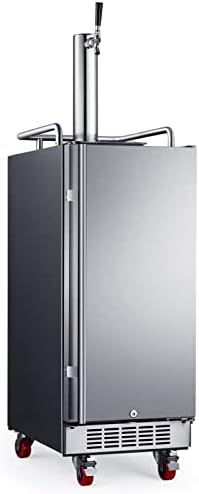
INSIGNIA vs EdgeStar: Overview & Brand Philosophy
The home draft beer market has expanded rapidly over the past decade, shifting from a niche luxury for dedicated homebrewers to an accessible centerpiece for home entertainment. Within this landscape, INSIGNIA and EdgeStar represent two distinctly different approaches to draft dispense equipment. INSIGNIA, Best Buy’s private-label house brand, approaches the kegerator category from a value-first, mass-market perspective. Their design philosophy centers on eliminating cost barriers for entry-level consumers by offering basic, functional refrigeration paired with standard draft components, making the prospect of draft beer at home straightforward and financially approachable.
In contrast, EdgeStar operates as a dedicated specialty manufacturer within the niche appliance sector. Rather than treating kegerators as generic refrigerated boxes with tap towers bolted on, EdgeStar approaches product development with an emphasis on draft precision, thermal consistency, and enthusiast-grade versatility. Their brand philosophy is built around catering to a spectrum of users—from casual drinkers who demand ultra-cold lagers to serious homebrewers and hospitality managers who require precise digital temperature control, multi-keg configurations, and commercial-grade durability.
Key Differences & Technological Comparison
The engineering differences between INSIGNIA and EdgeStar become immediately apparent when evaluating their cooling systems, component hardware, and interior layouts:
- Refrigeration & Temperature Precision: INSIGNIA units typically employ manual mechanical thermostats. While functional, these analog dials lack incremental precision, meaning users must rely on external thermometers and iterative dial adjustments to dial in their optimal serving temperature. EdgeStar distinguishes itself by utilizing digital thermostats across many of its models, paired with targeted internal air circulation. This enables users to reach and maintain precise temperatures, frequently dropping as low as the mid-30s Fahrenheit—a critical capability for preventing excessive foam.
- Interior Architecture & Keg Capacity: INSIGNIA kegerators are usually designed to house a single standard half-barrel keg or two sixth-barrel (torpedo) kegs, but the interior dimensions are rigidly optimized for mass-market commercial keg sizes. EdgeStar designs prioritize flexible interior cavity profiles, readily accommodating oversized commercial rubber-ring kegs, Cornelius ball-lock kegs for homebrewers, or multiple slim quarter/sixth-barrel kegs simultaneously.
- Dispense Components & Hardware Quality: Out of the box, INSIGNIA provides basic draft hardware—typically chrome-plated brass faucets, lightweight Sankey D couplers, and basic regulators. While functional for standard use, the chrome plating is susceptible to wear and acid corrosion over time. EdgeStar packages higher-grade dispense components, offering commercial-grade dual-gauge regulators, higher-end tower insulation to prevent "first pour foam," and broader availability of full stainless steel contact pathways.
- Form Factor & Versatility: INSIGNIA focuses almost exclusively on freestanding residential units with casters. EdgeStar offers a significantly wider product portfolio, including front-venting built-in undercounter units, dual and triple-tap towers, outdoor-rated stainless steel kegerators, and specialty units designed specifically for nitro cold brew or wine dispense.
Pros & Cons Comparison
INSIGNIA Kegerators
- Pros:
- Highly accessible price point, often serving as the lowest barrier to entry for standard half-barrel capacity.
- Simple, intuitive setup process with all essential hardware included in the box.
- Easy local availability and straightforward warranty exchange through national Best Buy retail stores.
- Includes conversion shelves to double as an auxiliary beverage refrigerator when not dispensing kegs.
- Cons:
- Manual mechanical thermostat lacks precise temperature readouts.
- Draft tower insulation is minimal, frequently leading to warm, foamy first pours.
- Limited product lineup with no native multi-tap, outdoor-rated, or undercounter options.
- Component materials (faucets and couplers) degrade faster under heavy use.
EdgeStar Kegerators
- Pros:
- Superior temperature management with digital controls capable of reaching deep cold temperatures (mid-30s °F).
- Extensive catalog including built-in, freestanding, dual-tap, triple-tap, and outdoor-rated models.
- Higher-grade hardware out of the box, including dual-gauge regulators and better-insulated towers.
- Accommodates diverse keg configurations, making it superior for homebrewers and craft beer enthusiasts.
- Cons:
- Significantly higher purchase price compared to entry-level alternatives.
- Stock configurations may still include brass faucets unless premium stainless steel trims are selected.
- Customer service and parts distribution rely primarily on online channels rather than local brick-and-mortar support.
Performance, Durability & Value Analysis
From a raw performance standpoint, the difference between these two brands comes down to thermal recovery and foam mitigation. Pouring draft beer is an exact science governed by temperature and applied pressure. EdgeStar’s superior interior airflow and well-insulated draft towers ensure that beer remains chilled entirely through the shank and faucet. This minimizes the common draft issue of "first pour foam," which wastes beer and frustrates users. INSIGNIA units can keep beer sufficiently cold once equilibrium is reached, but their compressor recovery time is slower following door openings, and the lack of tower cooling means users frequently need to discard the first few ounces of foam after the unit sits idle.
Regarding durability and long-term value, EdgeStar provides an ecosystem that grows with the user. Its internal dimensions and mechanical tolerances tolerate component upgrades—such as secondary regulators, tower blowers, and forward-sealing stainless faucets—with ease. INSIGNIA delivers exceptional short-term value for buyers who want an off-the-shelf solution for casual game days or seasonal entertaining without a steep financial commitment. However, users seeking equipment designed to reliably pour varied beer styles over years of continuous operation will find EdgeStar's higher upfront cost justified by its hardware longevity and reduced beer waste.
Final Verdict: Which Brand Should You Choose?
Choose INSIGNIA if you are an entry-level buyer, on a strict budget, or seeking a straightforward plug-and-play kegerator for occasional weekend use. If you plan to host standard commercial half-barrel kegs (such as domestic lagers), prefer the safety net of picking up or servicing an appliance at a local retail store, and don't require surgical temperature adjustments, INSIGNIA delivers capable draft beer dispensing at the lowest possible cost.
Choose EdgeStar if you are a homebrewer, craft beer enthusiast, or plan on building a permanent home bar installation. EdgeStar is the definitive pick for those who need multi-tap setups (serving two or three distinct beers simultaneously), undercounter integrated cabinetry, or precise digital temperature readouts to pour beers at their optimal temperature profiles. The investment in EdgeStar pays dividends in poured beer quality, build reliability, and long-term system flexibility.
Features
Feature architecture clearly delineates INSIGNIA’s minimalist design philosophy from EdgeStar’s enthusiast-driven flexibility. INSIGNIA systems generally come pre-packaged with essential, single-tap dispense hardware: an entry-grade chrome draft tower, standard brass-and-plastic faucets, an entry-level CO2 regulator, and basic mechanical thermostat dials. While this out-of-the-box configuration minimizes setup complexity for novices, it lacks functional adaptability. Advanced features such as internal fan-forced air circulation, customizable tap handle threads, and multi-keg gas splitters are notably absent, limiting the system’s operational versatility for different craft beer styles or simultaneous multi-keg pouring.
In stark contrast, EdgeStar treats feature design as a platform for customized dispensing. Many EdgeStar models feature electronic digital displays with precise push-button temperature adjustments, integrated deep-chill modes, and internal circulation fans that blow cold air directly up into the draft tower—an indispensable feature for eliminating first-pour foam. Furthermore, EdgeStar offers comprehensive dual-tap and triple-tap variants paired with commercial-grade Sankey couplers, heavy-duty dual-gauge regulators, and fully modular chassis that allow easy upgrading to forward-sealing stainless steel faucets like Perlick or Intertap. For consumers who prioritize control, hardware customizability, and multi-beverage setups, EdgeStar presents a decidedly more sophisticated feature set.
Performance
Thermodynamic performance and draft stability highlight the technical engineering differences between the two brands. INSIGNIA relies primarily on static, cold-wall refrigeration cycles governed by analog mechanical thermostats. While adequately capable of maintaining standard refrigerator temperatures, these units often suffer from noticeable thermal stratifications within the cabinet. The absence of active tower cooling leads to warmed draft lines within the exposed tower neck, which causes localized temperature spikes, gas breakout, and excessive foaming on the first pour. Furthermore, recovery times following repeated door openings or ambient room temperature fluctuations can be sluggish, resulting in inconsistent pour temperatures during prolonged hosting events.
EdgeStar demonstrates marked superiority in thermal stability and draft consistency through purpose-built dispense refrigeration. Many of EdgeStar’s flagship models integrate forced-air cooling systems that systematically eliminate cold pockets and actively insulate the draft lines up to the faucet shank. Their compressors are specifically tuned to reach and hold the low-30s Fahrenheit threshold—a crucial benchmark for domestic lagers and high-carbonation beverages. Rapid temperature pulldown, tight temperature hysterics, and minimized line resistance ensure that carbon dioxide remains suspended in solution, resulting in pristine head formation, reduced product waste, and reliable, repeatable performance even under demanding ambient conditions.
Design
The industrial design of INSIGNIA kegerators is defined by clean simplicity, compact footprints, and mass-market appliance aesthetics. Featuring a black vinyl or basic stainless steel door exterior with an integrated drip tray and mobility casters, the INSIGNIA chassis easily integrates into casual environments like garages, basements, or informal game rooms. However, the reliance on lightweight sheet metals, plastic internal liners, and non-reversible hardware mountings reveals its value-oriented build quality. The structural insulation is thinner than that of premium competitors, which can lead to higher compressor duty cycles and subtle exterior condensation in humid environments.
EdgeStar designs, on the other hand, reflect an emphasis on modern home integration and heavy-duty structural integrity. EdgeStar offers a broad portfolio including freestanding units with durable textured finishes, field-reversible doors, and fully finished 304-grade stainless steel frontages designed for seamless under-counter zero-clearance installations. The cabinet interiors feature reinforced floor plates to withstand the mechanical abrasion of heavy half-barrel steel kegs, high-density cyclopentane insulation for maximum thermal retention, and sleek integrated drip trays that drain cleanly. From heavy-duty locking casters to refined front-venting louvers on built-in models, EdgeStar delivers a polished, premium aesthetic paired with robust commercial durability.