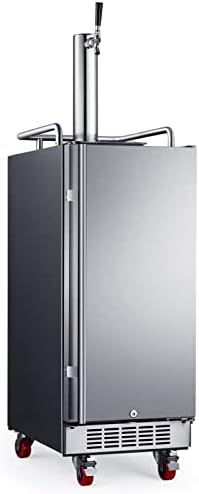
Danby vs EdgeStar: Overview & Brand Philosophy
The home draft beverage market has matured significantly over the past two decades, transitioning from DIY refrigerator conversion projects to sophisticated, plug-and-play draft appliances. In this space, Danby and EdgeStar stand out as two of the most recognizable and widely distributed manufacturers. While both companies target the residential enthusiast, their foundational design philosophies, engineering methodologies, and component sourcing reflect distinct approaches to serving the draft beer community.
Danby, a Canadian appliance conglomerate with more than seven decades of manufacturing heritage, approaches kegerators through the lens of general refrigeration. The brand leverages its massive supply chain scale to deliver cost-effective, energy-efficient, and dependable cooling platforms. Danby kegerators typically feature consumer-friendly designs, intuitive digital interfaces, and clean exterior aesthetics intended to blend seamlessly into modern game rooms, kitchens, or basements. However, because Danby operates as a broad-line appliance brand, its draft equipment is largely engineered around standardized cooling chassis adapted for keg storage rather than built from the ground up strictly for professional-grade draft performance.
EdgeStar, a flagship brand of the specialty appliance distributor Build.com (an operational subsidiary of Ferguson Enterprises), focuses intensely on niche indoor and outdoor refrigeration, specifically targeting beverage and wine enthusiasts. EdgeStar views kegerators as dedicated draft dispensing instruments first and standard refrigerators second. This focus is apparent in their modular product line, which ranges from ultra-compact single-tap units to commercial-grade, multi-tap, built-in outdoor units. EdgeStar embraces the technical nuances of the draft hobbyist—offering extensive component cross-compatibility, high-flow draft towers, and advanced airflow dynamics that cater directly to craft beer aficionados and homebrewers.
Key Differences & Technological Comparison
Understanding the fundamental distinctions between Danby and EdgeStar requires an examination of cooling engineering, tower temperature management, capacity versatility, and draft hardware quality.
Cooling Technology & Temperature Pull-Down: Temperature stability is the single most critical factor in draft dispensing, as beer lines that run too warm release dissolved carbon dioxide, resulting in excessive foam and wasted beer. Danby units typically rely on cold-plate cooling systems paired with electronic thermostats. While they operate with admirable energy efficiency and minimal compressor noise, they can experience localized temperature variances between the bottom cabinet floor and the upper internal volume. EdgeStar frequently implements forced-air refrigeration systems in its mid-to-high-tier lines (such as the KC series). Forced-air systems utilize internal fans to continuously circulate air around the keg, resulting in a more uniform temperature gradient from top to bottom and faster recovery times after the cabinet door is opened.
Tower Cooling Dynamics: One of the most prevalent points of failure in residential draft systems is the uncooled draft tower. Warm air naturally pools in the tower neck above the refrigerated cabinet, warming the first pour of beer. Most standard Danby units do not come equipped with active tower cooling tubes out of the box, often requiring owners to implement aftermarket blower modifications to prevent foamy initial pours. EdgeStar explicitly accounts for this issue across several of its performance models by incorporating dedicated blower hoses that channel chilled air directly up into the tower housing, ensuring the draft shank and faucet maintain pouring temperature between pours.
Internal Capacity & Keg Geometry: Draft enthusiasts rarely stick to a single keg standard. Between sixth barrels (torpedoes), quarter barrels (pony kegs), slim quarters, and commercial half-barrel kegs (full-size), interior dimensions dictate usability. Danby kegerators are renowned for their wide interior cavities, comfortably housing a standard full-size Sankey half-barrel keg along with an interior CO2 tank. EdgeStar models are heavily optimized for multi-keg configurations. While EdgeStar full-size cabinets can accommodate a half-barrel, their internal layouts and floor plates are uniquely suited to fitting multiple sixth-barrel kegs or Corny (Cornelius) kegs simultaneously, making them the preferred platform for dual-tap and triple-tap setups.
Draft Hardware & Build Specifications: The out-of-the-box hardware included with these units reveals a distinct philosophical split. Danby generally packages its kegerators with entry-level chrome-plated brass faucets, basic Sankey "D" couplers, and basic regulators. These components function adequately for casual commercial domestic lagers but are prone to plating wear and oxidation over long-term exposure to acidic craft beers. EdgeStar, particularly in its premium and craft-focused configurations, often ships with commercial-grade regulators, domestic NSF-approved couplers, and provides easier pathways to upgrade to stainless steel draft components, forward-sealing faucets (such as Intertap or Perlick styles), and commercial gas manifold splitters.
Pros & Cons Comparison
Danby Kegerators
- Pros:
- Exceptional value proposition with lower retail entry price points.
- High energy efficiency with quiet, unobtrusive compressor operation.
- Spacious cabinet design easily swallows oversized standard half-barrel kegs.
- Sleek, scratch-resistant worktop surfaces with integrated, easy-to-clean drip trays.
- Reversible door designs for flexible residential room placement.
- Cons:
- Lack of standard active tower cooling, leading to foamy initial pours.
- Internal hardware (couplers, regulators, faucets) is largely basic, chrome-plated brass.
- Limited native multi-tap configuration options compared to specialty competitors.
- Thermostat sensors can be overly sensitive to ambient room fluctuations.
EdgeStar Kegerators
- Pros:
- Extensive lineup ranging from budget freestanding units to front-breathing, built-in undercounter models.
- Available forced-air refrigeration and active tower cooling on higher-tier models.
- Exceptional modularity; easily configured for single, dual, or triple-faucet dispensing.
- Deep temperature pull-down capabilities, reliably maintaining temperatures in the low-to-mid 30s Fahrenheit.
- Strong compatibility with commercial craft kegs and homebrew ball-lock/pin-lock setups.
- Cons:
- Higher baseline price point across comparable size tiers.
- Compressors on budget models can produce noticeable acoustic hum during active chilling cycles.
- Entry-level models still feature chrome-plated components unless upgraded to specific craft packages.
- Assembly documentation can be dense for non-technical users unfamiliar with draft gas lines.
Performance, Durability & Value Analysis
From an operational reliability perspective, both brands exhibit durable cooling infrastructure, but they fail or succeed in different areas over a 5-to-10-year service life. Danby excels in foundational refrigeration longevity. Their hermetically sealed compressors and static condensers are robust, rarely experiencing mechanical failure under normal indoor ambient conditions. However, the operational frustration with Danby rarely stems from the refrigeration loop itself, but rather from the draft thermodynamics. Users frequently report having to manage line pressures extensively or purchase aftermarket fan kits to combat temperature loss in the draft arm. When viewed strictly through an economic lens, Danby provides superior raw refrigeration cubic-footage per dollar, making it an exceptional value for buyers willing to perform minor modifications or those who drink beer at standard commercial temperatures.
EdgeStar delivers performance tailored specifically to the chemical requirements of beer dispensing. Its forced-air circulation systems minimize stratification, meaning the top of the keg is chilled to the exact same degree as the bottom pint. This results in significantly higher beverage yield per keg by mitigating the foam waste that plagues passive systems. In terms of durability, EdgeStar’s stainless steel cabinet exteriors and reinforced interior stainless steel floor plates endure heavy keg-loading impacts without puncturing or warping the inner liner. While EdgeStar units carry a premium price tag—particularly their built-in outdoor series designed to shed heat in high-ambient environments—the total cost of ownership is offset by reduced beverage waste, high-grade draft component lifespans, and native multi-tap capability that eliminates the need for expensive structural retrofits down the line.
Final Verdict: Which Brand Should You Choose?
Selecting between Danby and EdgeStar ultimately comes down to your dispensing ambitions, technical expectations, and intended installation environment:
Choose Danby if: You are seeking an affordable, straightforward, reliable single-tap draft system for a garage, basement, or casual entertainment space. If your primary goal is to keep a standard commercial domestic half-barrel (such as Bud Light, Miller Lite, or Coors) or occasional craft quarter-barrel cold and pouring reliably without spending top-tier money, Danby offers the best out-of-the-box appliance value. It is the ideal purchase for the budget-conscious consumer who wants plug-and-play simplicity and straightforward aesthetic integration.
Choose EdgeStar if: You consider yourself a draft purist, homebrewer, or craft beer enthusiast who values precise thermal regulation, multi-keg versatility, and component modularity. EdgeStar is the definitive pick if you plan to pour multiple beers simultaneously (via dual or triple taps), require an under-counter built-in installation that vents out the front, need an outdoor-rated appliance, or want active tower cooling to eliminate foaming issues entirely. EdgeStar demands a higher initial investment, but it delivers an authentic commercial bar experience tailored to the serious beverage connoisseur.
Features
When evaluating the feature ecosystems of Danby and EdgeStar kegerators, the two brands diverge significantly between accessibility-driven design and enthusiast-grade versatility. Danby focuses on practical, user-friendly features tailored primarily for standard single-tap domestic setups. Most Danby models boast reversible door hinges, heavy-duty interior floor protectors to prevent keg puncture, scratch-resistant worktops with integrated drip trays, and intuitive push-button mechanical or digital temperature interfaces. However, Danby’s component engineering tends to stick closely to standard entry-level hardware; their draft towers and couplers are generally composed of chrome-plated brass, which is functional for casual use but prone to acid corrosion over extended periods compared to stainless steel. Furthermore, Danby typically limits internal cavern geometry to accommodate one full-size half-barrel or two sixth-barrel kegs, offering fewer native configurations for multi-tap aficionados.
Conversely, EdgeStar engineers its feature set with a strong emphasis on modularity, high-performance dispensing, and aesthetic adaptability. EdgeStar’s major technical strength lies in its extensive draft versatility, offering factory-configured single, dual, and triple-tap variants across both freestanding and undercounter built-in models. Advanced EdgeStar units frequently feature front-venting compressor designs that permit flush cabinet integration, alongside an electronic deep-chill feature (often branded as a "Super Cool" mode) that forces the compressor into continuous operation to rapidly pull a room-temperature keg down to serving temp. Their internal dimensions are optimized to allow flexible dual-keg setups (such as two Cornelius or sixth-barrel kegs with room to spare for the gas canister), and they frequently include commercial-grade D-system couplers and insulated draft towers out of the box to mitigate the first-pour foaming common in less insulated lines.
From a practical consumer standpoint, the trade-offs come down to out-of-the-box simplicity versus long-term draft customization. Danby delivers high reliability in basic, low-maintenance hardware features, making it ideal for buyers seeking a straightforward, reliable beer dispenser without unnecessary complications. EdgeStar, while slightly more demanding in terms of fine-tuning temperature balances and line resistance, outclasses Danby for craft-beer enthusiasts requiring multi-pour capabilities, lower serving temperatures (consistently achieving the sub-36°F threshold where Danby sometimes hovers near the mid-30s), and seamless cabinetry integration. Ultimately, Danby provides robust baseline functionality for standard domestic beer, whereas EdgeStar's feature suite is far better engineered for versatility, expansion, and precision draft management.
Performance
When evaluating thermal performance and cooling engineering, EdgeStar generally holds an advantage over Danby, particularly for enthusiasts who demand precise, ultra-low serving temperatures. EdgeStar kegerators frequently employ deep-chill technology and heavy-duty, forced-air refrigeration systems that can reliably pull internal temperatures down into the low-to-mid 30s Fahrenheit (often reaching 32°F to 34°F). This rapid heat dissipation and deep cooling capability make EdgeStar units exceptionally proficient at preventing foamy pours caused by temperature spikes. Danby, while utilizing reliable and energy-efficient compressors, typically operates within a slightly warmer baseline, cooling down to the mid-30s to high-30s Fahrenheit. While this is adequate for standard American lagers and optimal for craft ales, users in hotter ambient environments may notice Danby units taking longer to recover after frequent door openings compared to their EdgeStar counterparts.
The operational divide deepens when examining draft system integration, air circulation, and temperature stability. Premium EdgeStar models excel by integrating dedicated tower cooling blowers that direct chilled air up into the draft tower. This critical engineering detail drastically reduces "first-pour foam" by keeping the beer lines and shanks as cold as the keg itself. Danby units, by contrast, rely largely on passive internal convection cooling and traditional mechanical or basic digital thermostats. While Danby's auto-defrost mechanism and quiet operation are commendable for indoor residential spaces, the lack of factory-integrated tower cooling in standard models means consumers often have to implement DIY modifications or insulate the tower to achieve consistent pour quality. Furthermore, EdgeStar's digital controls offer narrower temperature differentials, minimizing thermal cycling and maintaining carbonation equilibrium within the keg.
Ultimately, the practical trade-off between the two brands comes down to specialized performance versus low-maintenance reliability. EdgeStar is engineered specifically for draft beer purists, delivering superior pressure balance, colder output, and better resistance to ambient heat—albeit with slightly higher operational noise and electrical consumption. Danby prioritizes an appliance-grade balance of quiet efficiency, stable long-term durability, and user-friendly operation, making it ideal for casual home tap enthusiasts who do not require ice-cold temperatures. For users whose performance benchmark is an effortlessly crisp, foam-free pour every single time, EdgeStar's purpose-built draft engineering takes the lead, whereas Danby serves as a solid, dependable performer for standard home beverage dispensing.
Design
From an engineering and aesthetic standpoint, Danby and EdgeStar approach kegerator design with distinct operational philosophies. Danby’s design language leans heavily into sleek, contemporary domestic appliances, often featuring fingerprint-resistant spotless steel finishes and seamlessly integrated mechanical layouts. Danby excels in foundational durability, incorporating scratch-resistant worktop surfaces and reversible door hinges that simplify interior placement. However, Danby’s interior spatial engineering is somewhat conservative; while it readily accommodates a standard full-size half-barrel keg, the clearance tolerances around the compressor hump can make fitting oversized rubber-rimmed commercial kegs or multi-keg configurations a challenge. The exterior chassis is strictly functional and minimalist, prioritizing streamlined utility for casual residential entertaining over extensive modularity.
Conversely, EdgeStar focuses on a more utilitarian, commercial-inspired design paradigm tailored specifically to craft beer enthusiasts and homebrewers. EdgeStar units showcase robust stainless steel facades paired with reinforced steel-lined floors, specifically engineered to withstand the repeated physical impacts of loading and sliding heavy steel kegs without compromising the internal cabinet integrity. The brand's standout design advantage lies in its spatial efficiency and internal optimization; EdgeStar kegerators are purposefully laid out to support complex setups, easily housing multiple Cornelius kegs or dual-tap configurations alongside integrated internal CO2 tank brackets. While Danby relies heavily on streamlined, non-intrusive exterior silhouettes, EdgeStar incorporates exposed, performance-driven design features like front-venting exhaust grilles on select models to permit seamless, zero-clearance under-counter installations.
When weighing the trade-offs of design, the consumer's layout requirements and desired tap configurations become the decisive factors. Danby provides a quieter, highly polished aesthetic that seamlessly integrates with existing modern kitchen appliances, making it a superior design choice for low-maintenance, single-tap family room or bar applications. In contrast, EdgeStar sacrifices subtle aesthetic blending in favor of high-performance versatility, modular tower interchangeability, and interior volume optimization. EdgeStar’s design fundamentally treats the kegerator as an adaptable beverage delivery system rather than a modified compact refrigerator, making it the superior technical design for consumers requiring multi-keg versatility and professional-grade durability.