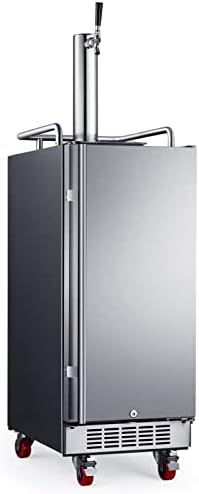
Vevor vs EdgeStar: Overview & Brand Philosophy
When investing in draft beer at home or outfitting a commercial space, selecting the right kegerator brand dictates everything from pour quality and temperature stability to long-term reliability. In this segment, Vevor and EdgeStar represent two distinct product philosophies. Vevor, primarily known as a budget-conscious, direct-to-consumer industrial and utility equipment supplier, has aggressively expanded into home beverage dispensing. Their philosophy centers on democratization: delivering feature-rich, high-capacity draft setups at aggressively low entry-level price points, making the luxury of a multi-tap kegerator accessible to casual enthusiasts.
Conversely, EdgeStar is an established, specialized pillar in consumer appliances, luxury refrigeration, and beverage hospitality. Operating under the Ferguson/Build.com brand umbrella, EdgeStar approaches kegerators with an emphasis on engineering refinement, precision temperature regulation, and specialized fitment. Rather than treating draft systems as generic refrigerated boxes with tap shanks drilled through the top, EdgeStar designs purpose-built kegerators equipped with tailored draft towers, high-grade components, and specialized airflow systems meant to recreate commercial-grade pours in residential or light-commercial settings.
Key Differences & Technological Comparison
The technological gulf between Vevor and EdgeStar is most evident in refrigeration dynamics, component materials, and interior volumetric design:
- Cooling Architecture & Temperature Management: EdgeStar utilizes high-efficiency forced-air refrigeration systems in the majority of their models, often incorporating internal fans that circulate cold air directly into the draft tower. This prevents "first-pour foam"—a common problem caused by warm beer lingering in an unchilled tower. Vevor units generally rely on static, cold-wall evaporative cooling. While Vevor models achieve cold temperatures (often down into the mid-30s Fahrenheit), they can suffer from stratified internal temperatures and warmer draft towers unless modified with aftermarket fan blowers.
- Draft Hardware & Component Quality: EdgeStar equips its units with premium commercial-grade hardware, including domestic D-system Sankey couplers, brass or 304-grade stainless steel contacts, and precise dual-gauge regulators. Vevor provides all-in-one bundle packages, but the bundled hardware—such as draft lines, regulators, and faucets—often relies on lower-grade plastics and lighter alloy metals. Vevor lines frequently benefit from immediate user upgrades to barrier tubing and stainless steel forward-sealing faucets to eliminate off-flavors and sticky tap levers.
- Chassis Engineering & Placement Flexibility: EdgeStar leads the market in variety, offering both dedicated freestanding models and front-venting, zero-clearance undercounter built-in units engineered to slide seamlessly between kitchen or outdoor cabinetry. Vevor’s portfolio leans almost exclusively toward freestanding units requiring continuous rear and side clearance for heat dissipation, limiting them to garages, basements, or freestanding bar positions.
- Digital Controls vs. Mechanical Thermostats: Many modern EdgeStar units feature integrated digital thermostats with exterior LED interfaces, lock-out modes, and deep-chill functionality (such as their Ultra Low Temperature series). Vevor models range from rudimentary mechanical dial thermostats hidden behind the keg to basic digital controllers, which can exhibit wider temperature swings (hysteresis) during compressor cycling.
Pros & Cons Comparison
Vevor Kegerators
- Pros:
- Significantly lower cost of entry, often hundreds of dollars cheaper than comparable multi-tap systems.
- Comprehensive out-of-the-box bundles including CO2 tanks, guard rails, drip trays, and casters.
- Versatile interior cavities capable of holding standard full-size half-barrel kegs or multiple Cornelius (homebrew) kegs.
- Easily convertible into a standard mini-fridge with included wire shelving.
- Cons:
- Inconsistent tower cooling leads to excessive foam on the first pour after idle periods.
- Bundled regulators and plastic tap components lack commercial-grade precision and durability.
- Customer service and warranty fulfillment can be slow and process-heavy compared to domestic appliance brands.
- Limited options for true undercounter, built-in installations.
EdgeStar Kegerators
- Pros:
- Superior refrigeration engineering with options for integrated blower fans and tower cooling.
- Extensive catalog including undercounter, built-in, outdoor-rated, and multi-tap configurations.
- High-grade, durable draft hardware that reduces off-flavors and withstands heavy commercial use.
- Tight temperature control capable of consistently maintaining beer at ice-cold levels (down to 32°F–34°F).
- Robust domestic customer support, comprehensive user documentation, and easily available OEM replacement parts.
- Cons:
- Substantially higher initial retail investment across all product tiers.
- Premium features like full stainless steel interiors and dual-gauge regulators drive costs up further.
- Some baseline models still include standard rear-sealing faucets, requiring paid upgrades to premium forward-sealing taps.
Performance, Durability & Value Analysis
From a pure performance perspective, EdgeStar consistently outperforms Vevor in critical draft metrics: temperature maintenance, foam minimization, and component longevity. Draft beer is a delicate product that requires an unbroken cold chain from the keg to the faucet lip. EdgeStar's forced-air circulation ensures the entire liquid line remains at a uniform temperature, preventing the dissolved CO2 from breaking out of solution and causing high-volume foam waste. Over the lifespan of several dozen kegs, the beer saved from down-the-drain foam loss in an EdgeStar system can noticeably offset the brand's higher retail price point.
When evaluating value, Vevor holds a powerful position for the DIY-minded or budget-restricted buyer. If you are comfortable performing minor modifications—such as installing an inexpensive 12V tower blower fan, insulating the tap tower with foam pipe wrap, and replacing standard draft lines with premium EVAbarrier tubing—a Vevor unit can approach the performance of a mid-tier EdgeStar at a fraction of the cost. However, in terms of sheer appliance longevity, compressor duty cycles, and exterior finish resilience (especially in humid or outdoor settings), EdgeStar provides commercial-grade durability that Vevor's lighter-duty construction struggles to match over a multi-year horizon.
Final Verdict: Which Brand Should You Choose?
Your choice between Vevor and EdgeStar ultimately hinges on your installation requirements, budget flexibility, and patience for equipment tinkering.
Choose Vevor if: You are setting up your first draft system on a strict budget, need a straightforward freestanding unit for a garage or game room, or are a homebrewer who enjoys customizing and upgrading draft hardware over time. Vevor offers the most cost-effective entry point into draft beverage dispensing on the market today.
Choose EdgeStar if: You require a premium, reliable pour straight out of the box with zero modifications required. EdgeStar is the definitive choice for built-in undercounter kitchen or outdoor patio installations, commercial hospitality environments, or discerning beer enthusiasts who prioritize stable temperatures, minimal foam loss, and long-term appliance reliability backed by robust domestic customer support.
Features
When evaluating the feature ecosystems of Vevor and EdgeStar kegerators, the comparison centers on utility-focused functionality versus refined, draft-specific engineering. Vevor builds its units primarily around expansive feature lists and high-capacity versatility at an accessible price point. A typical Vevor kegerator includes an integrated digital thermostat with a straightforward external LED display, allowing users to dial in temperatures between 32°F and 50°F. Many Vevor models boast universal interior layouts designed to accommodate a full-size half-barrel or combinations of sixth-barrels, supported by modular wire shelving to double as a standard beverage cooler. However, where Vevor focuses on broad, multi-use capabilities, its draft hardware leans generic. The standard kits feature basic chrome-plated brass draft towers, commercial-grade Sanke D couplers of utilitarian build, and entry-level dual-gauge regulators that offer adequate pressure control but lack the fine micro-adjustability desired by serious homebrewers.
Conversely, EdgeStar focuses on a feature set distinctly optimized for temperature stability, pour quality, and pour-line longevity. EdgeStar’s engineering prioritizes components tailored specifically to beer dispense dynamics, offering models equipped with integrated draft tower blowers—a crucial feature that circulates cold air directly up into the beer tower to eliminate "first pour foam," an engineering detail frequently missing from budget-tier Vevor setups. EdgeStar also excels in atmospheric flexibility, offering reversible doors, rolling casters with integrated heavy-duty locks, and deep-chill modes that quickly pull down reservoir temperatures after a keg swap. While EdgeStar also utilizes digital interfaces, its internal sensors and thermistor-based temperature management systems demonstrate tighter variance control, reducing the temperature swings that cause carbonation breakout in draft lines.
The practical trade-off between the two brands lies in the sophistication of their out-of-the-box hardware. Vevor provides an all-in-one, feature-dense package ideal for the casual entertainer who desires quick plug-and-play assembly, decent interior capacity, and multi-functional refrigeration without substantial upfront cost. EdgeStar, on the other hand, directs its feature suite toward the enthusiast, offering pre-configured options for premium commercial-grade forward-sealing faucets (such as Perlick or Intertap upgrades), custom-tailored multi-tap gas manifolds, and stainless-steel interior sub-flooring engineered to withstand the repeated physical abuse of loading heavy steel kegs. For consumers prioritizing draft science, component durability, and foam mitigation, EdgeStar’s specialized feature set outperforms Vevor’s broader, value-engineered approach.
Performance
When evaluating thermal performance and cooling engineering, EdgeStar distinctly outpaces Vevor with its specialized refrigeration systems designed specifically for draft beverage storage. EdgeStar kegerators are renowned for their ability to achieve and maintain exceptionally low serving temperatures—often dropping to the mid-30s Fahrenheit—which is critical for preventing excess foam. The brand employs precision digital thermostats, high-capacity compressors, and integrated internal fan-forced cooling systems in its mid-to-high-tier models. This internal circulation eliminates hot spots within the cabinet and effectively chills the draft tower, ensuring that the first pour of the day is as cold and crisp as subsequent ones. In contrast, Vevor takes a more utilitarian, budget-friendly approach to cooling, offering standard cold-wall refrigeration that reliably keeps beer cold (typically stabilizing between 36°F and 45°F), but without the same degree of thermal uniformity or rapid pull-down recovery after the door has been opened.
The operational divide between the two brands becomes even more pronounced when analyzing draft system pressure stability and component performance. EdgeStar equips its units with commercial-grade draft hardware, featuring high-tolerance brass couplers, precise dual-gauge regulators, and NSF-approved beer lines that minimize temperature and pressure fluctuations across the dispense cycle. Vevor, while offering remarkable out-of-the-box value with multi-tap configurations, relies on entry-level dispensing components. Users often report that Vevor’s factory-supplied regulators and uninsulated towers require aftermarket optimization—such as adding tower cooling fans or upgrading to longer, higher-resistance tubing—to prevent pressure drops and over-foaming. Furthermore, EdgeStar demonstrates superior ambient adaptation, with higher-end units engineered to operate efficiently even in fluctuating garage or outdoor environments, whereas Vevor units perform best within strictly climate-controlled indoor spaces.
Ultimately, the performance trade-off centers on consistency versus affordability. Vevor delivers adequate, baseline refrigeration capable of serving domestic lagers and homebrews reliably for casual consumers who do not mind occasional micro-adjustments to pressure and pour speed. EdgeStar, however, provides a noticeably superior, professional-grade dispensing performance characterized by whisper-quiet compressor operation, tighter temperature hysteresis, and stable pouring dynamics. For draft enthusiasts seeking immediate, commercial-quality temperature control and pour consistency straight from the box, EdgeStar is the technically superior performer, while Vevor represents a capable, cost-effective alternative for less temperature-sensitive applications.
Design
When evaluating the design of kegerators, EdgeStar and Vevor approach draft dispensing from fundamentally different engineering perspectives, catering to distinct segments of the home-draft market. EdgeStar positions its design language around premium aesthetic integration and architectural versatility. Their units, particularly within the KC series, feature thoughtfully engineered chassis options suited for both freestanding and seamless under-counter, built-in installations. EdgeStar employs front-facing ventilation grates in their built-in models, zero-clearance door hinges, and high-grade 304 stainless steel finishes that mirror upscale residential kitchen appliances. Furthermore, their draft towers frequently offer integrated fan-forced cooling to reduce first-pour foam, showing a high level of thermal engineering designed to keep beer cold all the way from the keg coupling to the faucet. The internal layouts are optimized for maximum usability, providing tailored bracket systems for CO2 tank mounting and spacious cavity footprints that easily accommodate commercial half-barrel kegs or multiple homebrew Cornelius kegs without valve interference.
Conversely, Vevor adopts an industrial, budget-centric design philosophy that favors rugged functionality over high-end aesthetics. Primarily built for utilitarian residential or light-commercial freestanding environments, Vevor units rely on rear-heat dissipation, which inherently limits them from flush cabinetry installation. The external casing typically utilizes standard painted steel or embossed, thinner-gauge stainless finishes, giving them a more utilitarian look. Internally, Vevor relies on a straightforward, spacious layout with a removable wire shelf configuration, but often lacks the nuanced thermal routing found in EdgeStar's product line. While Vevor's top-mounted draft towers and included hardware—such as standard chrome faucets and entry-level dual-gauge regulators—are functional and user-friendly, they lack the polished ergonomics, tap vibration dampening, and sophisticated drip tray integrations characteristic of EdgeStar. Vevor does, however, design their units with practical mobility in mind, consistently including heavy-duty omnidirectional casters and integrated guard rails as standard package features.
The practical trade-offs in design ultimately resolve into a decision between refined appliance cohesion and raw cost-efficiency. EdgeStar commands a design advantage in component customization, offering modular, high-polish dual- and triple-tap stainless towers and reversible doors engineered with tighter tolerance seals that minimize ambient temperature bleed. For buyers designing an integrated home bar or high-end entertainment area, EdgeStar’s cohesive look and quiet operational dampening make it the superior design choice. In contrast, Vevor provides a functional, albeit basic, plug-and-play solution that excels in garages, basements, or outdoor event settings where architectural subtlety and front-venting mechanics are secondary to simple durability and ease of transport. While EdgeStar delivers a precision-engineered dispensing appliance that elevates its surroundings, Vevor provides a utilitarian design that prioritizes affordable practicality above design sophistication.
Compare current retail pricing, active promotions, and verified stock availability directly from authorized stores: