Yamaha vs VIZIO: Overview
Comparing Yamaha and VIZIO helps you determine which brand is best suited for your needs in Home Theaters. Both brands offer strong choices depending on your budget and key feature requirements.
Key Features & Comparison
Evaluate factors such as build quality, warranty, customer satisfaction, and total value before making your final purchase choice between Yamaha and VIZIO.
Features
Yamaha's feature ecosystem is characterized by deep customization, professional-grade processing, and extensive networking capabilities. Central to Yamaha’s identity is its proprietary Cinema DSP 3D sound field mapping and YPAO (Yamaha Parametric room Acoustic Optimizer) calibration, which analyzes room geometry to optimize speaker output mathematically. Yamaha’s MusicCast platform offers sophisticated multi-room audio networking, allowing high-resolution streaming (FLAC, ALAC, DSD) alongside robust voice control via Alexa and Google Assistant. Furthermore, their modern AV receivers and premium bars offer expansive physical I/O, including multiple full-bandwidth HDMI 2.1 inputs with 4K/120Hz and 8K passthrough, VRR, and ALLM support designed for next-generation gaming and enthusiast video chains.
VIZIO counters with an aggressive, user-centric feature suite focused on modern surround immersion without setup friction. Their M-Series and Elevate systems prioritize consumer-friendly standards like Dolby Atmos, DTS:X, and eARC support right out of the box, often packaging wireless subwoofers and satellite speakers together at price points Yamaha cannot match. VIZIO's headline features are practical and visual, such as the rotating height speakers on the Elevate soundbar that physically articulate when an Atmos or DTS:X signal is detected. While VIZIO lacks comprehensive room correction software, complex network streaming protocols, and multi-zone support, it compensates with Bluetooth connectivity, voice assistant integration via dedicated aux ports, and streamlined on-screen display interfaces that sync effortlessly with Smart TVs.
Performance
From a pure sonic performance standpoint, Yamaha delivers superior dynamic range, lower total harmonic distortion (THD), and unmatched channel separation. Whether operating a multi-channel Aventage receiver driving floor-standing speakers or a compact MusicCast soundbar, Yamaha emphasizes acoustic authenticity, refined mid-range clarity, and pristine high-frequency articulation. Classical compositions, acoustic sets, and dialogue-heavy cinema benefit enormously from Yamaha’s natural frequency response and powerful toroidal power transformers. Bass management is another technical high point, offering tight, articulate low-end reproduction that avoids the muddy, boomy resonance common in mass-market lifestyle systems.
VIZIO's acoustic profile is intentionally tuned for immediate cinematic impact, delivering heavy low-end rumble and punchy, emphasized dialogue. Utilizing dedicated rear satellite speakers wired directly to a wireless subwoofer, VIZIO easily produces a physically enveloping 5.1 or 5.1.4 soundfield that easily beats standalone soundbars in sheer spatial immersion. However, on an engineering level, VIZIO systems reveal their cost-engineered limitations during complex musical passages and high-volume playback. Crossover transitions between the compact satellite drivers and the subwoofer can sound somewhat hollow, and high frequencies can lean harsh or compressed when pushed to their limits, lacking the warmth, instrument separation, and effortless headroom characteristic of Yamaha's amplification.
Design
Yamaha’s industrial design reflects professional-grade durability, precision manufacturing, and utilitarian elegance. In their AV receivers, this translates to heavy-gauge chassis construction, anti-resonance technology (such as their signature fifth foot on Aventage models), brushed aluminum faceplates, and tactile, weighted volume dials. Their soundbars utilize premium acoustic cloth grilles, low-profile form factors designed to slide cleanly under modern display bezels, and minimalist indicator displays. Everything about Yamaha's physical design suggests longevity, thermal efficiency, and shielding from electromagnetic interference, prioritizing substance and durability over flashy, consumer-tech gimmicks.
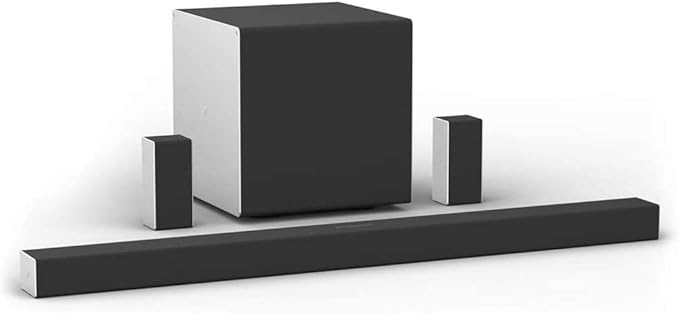
VIZIO adopts a distinctly contemporary, lifestyle-oriented design language characterized by clean geometric lines, dark fabric wraps, and low-profile enclosures. The aesthetic centerpiece of VIZIO’s lineup—the Elevate system—features anodized aluminum accents and motorized speaker pods that mechanically rotate upward, delivering a striking visual cue for immersive audio. Satellite speakers and subwoofers are engineered to be as unobtrusive as possible, allowing them to integrate invisibly into modern living room decor. While VIZIO products are visually appealing and space-efficient, the extensive use of lightweight plastics and external power bricks underscores their budget-conscious manufacturing compared to the robust, heavy-duty build standard set by Yamaha.